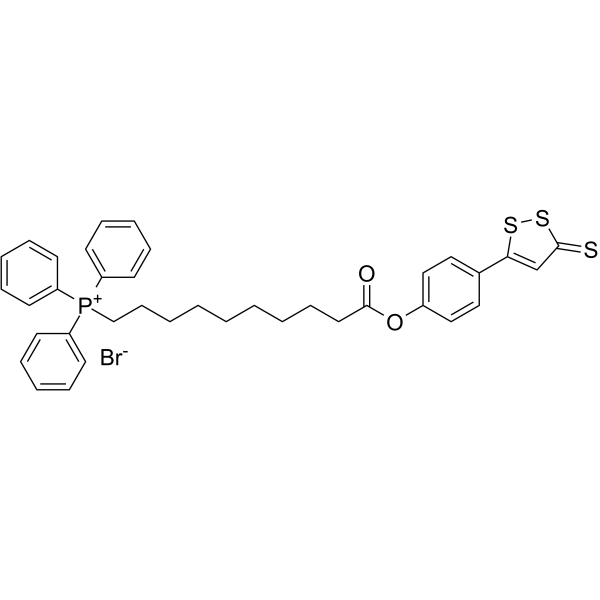
Physicochemical Properties
| Molecular Formula | C37H38BRO2PS3 |
| Molecular Weight | 721.77 |
| Exact Mass | 720.095 |
| CAS # | 1429061-80-2 |
| PubChem CID | 71537388 |
| Appearance | Orange to red solid powder |
| Hydrogen Bond Donor Count | 0 |
| Hydrogen Bond Acceptor Count | 6 |
| Rotatable Bond Count | 16 |
| Heavy Atom Count | 44 |
| Complexity | 835 |
| Defined Atom Stereocenter Count | 0 |
| InChi Key | PUEBFERUDPTIDR-UHFFFAOYSA-M |
| InChi Code | InChI=1S/C37H38O2PS3.BrH/c38-36(39-31-26-24-30(25-27-31)35-29-37(41)43-42-35)23-15-4-2-1-3-5-16-28-40(32-17-9-6-10-18-32,33-19-11-7-12-20-33)34-21-13-8-14-22-34;/h6-14,17-22,24-27,29H,1-5,15-16,23,28H2;1H/q+1;/p-1 |
| Chemical Name | [10-oxo-10-[4-(5-sulfanylidenedithiol-3-yl)phenoxy]decyl]-triphenylphosphanium;bromide |
| HS Tariff Code | 2934.99.9001 |
| Storage |
Powder-20°C 3 years 4°C 2 years In solvent -80°C 6 months -20°C 1 month Note: Please store this product in a sealed and protected environment, avoid exposure to moisture. |
| Shipping Condition | Room temperature (This product is stable at ambient temperature for a few days during ordinary shipping and time spent in Customs) |
Biological Activity
| ln Vitro | In APP/PS1 neurons, AP39 (25,100 nM) for 24 hours increases cell viability; in WT neurons, it has no effect[1]. OPA1 and Mfn1 levels are raised by AP39 (100 nM), while Mfn2 levels are not. Furthermore, Fis1 levels are decreased by AP39 but not Drp1 levels[1]. The H2S-detecting dye AzMC's fluorescence and H2S production increase in a concentration-dependent manner when exposed to AP39 (25-250 nM; 2 h)[1]. (100 nM) dramatically raises the APP/PS1 neurons' maximal respiratory capacity connected to the OCR as well as their basal respiratory rate. AP39 causes WT and APP/PS1 neurons to produce a notably higher amount of ATP. For APP/PS1 neurons, AP39 provides substantial protection against mtDNA damage. via mtDNA integrity restoration in part[1]. Triphenylphosphonium (TPP+), a mitochondria-targeting motif, is joined to dithiolethione, an H2S-donating moiety, via an aliphatic linker to form AP39. AP39 (100 nM) maintains cell survival, mitochondrial respiration, and mitochondrial DNA integrity by lowering intracellular oxidative stress. At lower concentrations (30 and 100 nM), these actions are typically stimulatory; however, at higher concentrations (300 nM), they tend to become less pronounced or transform into inhibitory effects[2]. |
| ln Vivo | AP39 (100 nM/kg/day; i.p.) improves the memory and learning deficits in APP/PS1 mice for a period of six weeks. For six weeks, AP39 (25–250 nM/kg/day; intraperitoneal; ip) increases the production of H2S in the cortex and hippocampus of WT and APP/PS1 mice in a dose-dependent manner[1]. In male Sprague Dawley rats weighing 300-350 g (9-11 weeks), AP39 (0.01, 0.1, 1 μmol/kg; iv; bolus 10 min before reperfusion) dose-dependently decreases the extent of the infarct when thiobutabarbital (200 mg /kg, ip) is used to anesthetize the rats[3]. |
| Animal Protocol |
Animal/Disease Models: 12-month-old WT or APP/PS1 mice[1] Doses: 100 nM/kg Route of Administration: IP; daily; for 6 weeks Experimental Results: Reversed the spatial learning and memory deficits of the aged AD model mice. Alleviated brain atrophy and ventricular asymmetry and inhibited Aβ plaque deposition in the brains in AD model mice. |
| References |
[1]. AP39, a Mitochondria-Targeted Hydrogen Sulfide Donor, Supports Cellular Bioenergetics and Protects against Alzheimer's Disease by Preserving Mitochondrial Function in APP/PS1 Mice and Neurons. Oxid Med Cell Longev. 2016;2016:8360738. [2]. AP39, a novel mitochondria-targeted hydrogen sulfide donor, stimulates cellular bioenergetics, exerts cytoprotective effects and protects against the loss of mitochondrial DNA integrity in oxidatively stressed endothelial cells in vitro. Nitric Oxide. 2014 Sep 15;41:120-30. [3]. AP39, a mitochondria-targeting hydrogen sulfide (H 2 S) donor, protects against myocardial reperfusion injury independently of salvage kinase signaling. Br J Pharmacol. 2017 Feb;174(4):287-301. |
Solubility Data
| Solubility (In Vitro) | DMSO: 100 mg/mL (138.55 mM) |
| Solubility (In Vivo) |
Solubility in Formulation 1: ≥ 0.83 mg/mL (1.15 mM) (saturation unknown) in 10% DMSO + 40% PEG300 + 5% Tween80 + 45% Saline (add these co-solvents sequentially from left to right, and one by one), clear solution. For example, if 1 mL of working solution is to be prepared, you can add 100 μL of 8.3 mg/mL clear DMSO stock solution to 400 μL of PEG300 and mix evenly; then add 50 μL of Tween-80 to the above solution and mix evenly; then add 450 μL of normal saline to adjust the volume to 1 mL. Preparation of saline: Dissolve 0.9 g of sodium chloride in 100 mL ddH₂ O to obtain a clear solution. Solubility in Formulation 2: ≥ 0.83 mg/mL (1.15 mM) (saturation unknown) in 10% DMSO + 90% (20% SBE-β-CD in Saline) (add these co-solvents sequentially from left to right, and one by one), clear solution. For example, if 1 mL of working solution is to be prepared, you can add 100 μL of 8.3 mg/mL clear DMSO stock solution to 900 μL of 20% SBE-β-CD physiological saline solution and mix evenly. Preparation of 20% SBE-β-CD in Saline (4°C,1 week): Dissolve 2 g SBE-β-CD in 10 mL saline to obtain a clear solution. (Please use freshly prepared in vivo formulations for optimal results.) |
| Preparing Stock Solutions | 1 mg | 5 mg | 10 mg | |
| 1 mM | 1.3855 mL | 6.9274 mL | 13.8548 mL | |
| 5 mM | 0.2771 mL | 1.3855 mL | 2.7710 mL | |
| 10 mM | 0.1385 mL | 0.6927 mL | 1.3855 mL |