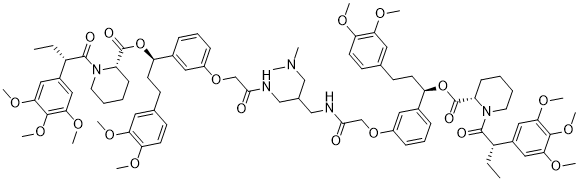
AP20187 (B/B Homodimerizer) is a novel cell-permeable and chemical inducer of dimerization, used to dimerize FK506-binding protein (FKBP) fusion proteins and initiate biological signaling cascades and gene expression or disrupt protein-protein interactions. AP20187-mediated activation of a chimeric insulin receptor results in insulin-like actions in skeletal muscle and liver of diabetic mice.
Physicochemical Properties
| Molecular Formula | C82H107N5O20 |
| Molecular Weight | 1482.7485 |
| Exact Mass | 1481.75 |
| CAS # | 195514-80-8 |
| PubChem CID | 78357784 |
| Appearance | White to yellow solid powder |
| LogP | 11.882 |
| Hydrogen Bond Donor Count | 2 |
| Hydrogen Bond Acceptor Count | 21 |
| Rotatable Bond Count | 42 |
| Heavy Atom Count | 107 |
| Complexity | 2450 |
| Defined Atom Stereocenter Count | 6 |
| SMILES | CC[C@@H](C1=CC(=C(C(=C1)OC)OC)OC)C(=O)N2CCCC[C@H]2C(=O)O[C@H](CCC3=CC(=C(C=C3)OC)OC)C4=CC(=CC=C4)OCC(=O)NCC(CNC(=O)COC5=CC=CC(=C5)[C@@H](CCC6=CC(=C(C=C6)OC)OC)OC(=O)[C@@H]7CCCCN7C(=O)[C@@H](CC)C8=CC(=C(C(=C8)OC)OC)OC)CN(C)C |
| InChi Key | NSBGUMKAXUXKGI-BPNHAYRBSA-N |
| InChi Code | InChI=1S/C82H107N5O20/c1-15-61(57-43-71(98-9)77(102-13)72(44-57)99-10)79(90)86-37-19-17-27-63(86)81(92)106-65(33-29-52-31-35-67(94-5)69(39-52)96-7)55-23-21-25-59(41-55)104-50-75(88)83-47-54(49-85(3)4)48-84-76(89)51-105-60-26-22-24-56(42-60)66(34-30-53-32-36-68(95-6)70(40-53)97-8)107-82(93)64-28-18-20-38-87(64)80(91)62(16-2)58-45-73(100-11)78(103-14)74(46-58)101-12/h21-26,31-32,35-36,39-46,54,61-66H,15-20,27-30,33-34,37-38,47-51H2,1-14H3,(H,83,88)(H,84,89)/t61-,62-,63-,64-,65+,66+/m0/s1 |
| Chemical Name | (1R,1'R)-(((((2-((dimethylamino)methyl)propane-1,3-diyl)bis(azanediyl))bis(2-oxoethane-2,1-diyl))bis(oxy))bis(3,1-phenylene))bis(3-(3,4-dimethoxyphenyl)propane-1,1-diyl) (2S,2'S)-bis(1-((S)-2-(3,4,5-trimethoxyphenyl)butanoyl)piperidine-2-carboxylate) |
| Synonyms | AP20187 AP-20187 AP 20187. |
| HS Tariff Code | 2934.99.9001 |
| Storage |
Powder-20°C 3 years 4°C 2 years In solvent -80°C 6 months -20°C 1 month |
| Shipping Condition | Room temperature (This product is stable at ambient temperature for a few days during ordinary shipping and time spent in Customs) |
Biological Activity
| ln Vitro | AP20187 (B/B Homodimerizer) (100 nM) treatment of LNCaP cells resulted in a considerable decrease in ro-iCaspase-9 levels and a significant weakening of caspase-9 processing activity [2]. |
| ln Vivo | Real-time PCR analysis showed that AP20187 (B/B homodimer) (0.5 mg/kg, 2 mg/kg or 5 mg/kg) treatment significantly enhanced PLP/Fv2E-PERK in PID12 CHOP mRNA levels in the CNS of Fv2E. AP20187 therapy significantly decreased EAE-induced myelin damage during these procedures. AP20187 (B/B Homodimerizer) therapy dramatically reduced the number of degenerated axons and enhanced axonal density in PLP/Fv2E-PERK anatomical lumbar demyelinating lesions [2]. |
| References |
[1]. Photocleavable dimerizer for the rapid reversal of molecular trap antagonists. J Biol Chem. 2014 Feb 21;289(8):4546-52. [2]. Oligodendrocyte-specific activation of PERK signaling protects mice against experimental autoimmune encephalomyelitis. J Neurosci. 2013 Apr 3;33(14):5980-91. [3]. The Role of Proprotein Convertase Subtilisin/Kexin Type 9 in Nephrotic Syndrome-Associated Hypercholesterolemia. Circulation. 2016 Jul 5;134(1):61-72. |
| Additional Infomation | AP20187 is a tertiary amino compound that is 2-(aminomethyl)-N,N-dimethylpropane-1,3-diamine in which the primary ammino groups have each been acylated by condensation with the carboxy group of 2-{3-[(1R)-3-(3,4-dimethoxyphenyl)-1-hydroxypropyl]phenoxy}acetic acid, the hydroxy groups of which have been esterified by condensation with the carboxy group of L-pipecolic acid, the nitrogen of which has been acylated by condensation with (2S)-2-(3,4,5-trimethoxyphenyl)butyric acid. It is a synthetic, cell-permeable ligand that can be used to induce homodimerization of fusion proteins containing the DmrB domain. It has a role as a ligand. It is a N-acylpiperidine, a carboxylic ester, an aromatic ether and a tertiary amino compound. |
Solubility Data
| Solubility (In Vitro) |
Ethanol : ~150 mg/mL (~101.16 mM) DMSO : ≥ 57 mg/mL (~38.44 mM) |
| Solubility (In Vivo) |
Solubility in Formulation 1: 6 mg/mL (4.05 mM) in 10% EtOH + 40% PEG300 + 5% Tween80 + 45% Saline (add these co-solvents sequentially from left to right, and one by one), clear solution; with sonication. For example, if 1 mL of working solution is to be prepared, you can add 100 μL of 60.0 mg/mL clear EtOH stock solution to 400 μL PEG300 and mix evenly; then add 50 μL Tween-80 to the above solution and mix evenly; then add 450 μL normal saline to adjust the volume to 1 mL. Preparation of saline: Dissolve 0.9 g of sodium chloride in 100 mL ddH₂ O to obtain a clear solution. Solubility in Formulation 2: 6 mg/mL (4.05 mM) in 10% EtOH + 90% (20% SBE-β-CD in Saline) (add these co-solvents sequentially from left to right, and one by one), suspension solution; with ultrasonication. For example, if 1 mL of working solution is to be prepared, you can add 100 μL of 60.0 mg/mL clear EtOH stock solution to 900 μL of 20% SBE-β-CD physiological saline solution and mix evenly. Preparation of 20% SBE-β-CD in Saline (4°C,1 week): Dissolve 2 g SBE-β-CD in 10 mL saline to obtain a clear solution. Solubility in Formulation 3: ≥ 2.5 mg/mL (1.69 mM) (saturation unknown) in 10% DMSO + 40% PEG300 + 5% Tween80 + 45% Saline (add these co-solvents sequentially from left to right, and one by one), clear solution. For example, if 1 mL of working solution is to be prepared, you can add 100 μL of 25.0 mg/mL clear DMSO stock solution to 400 μL PEG300 and mix evenly; then add 50 μL Tween-80 to the above solution and mix evenly; then add 450 μL normal saline to adjust the volume to 1 mL. Preparation of saline: Dissolve 0.9 g of sodium chloride in 100 mL ddH₂ O to obtain a clear solution. Solubility in Formulation 4: ≥ 2.5 mg/mL (1.69 mM) (saturation unknown) in 10% DMSO + 90% Corn Oil (add these co-solvents sequentially from left to right, and one by one), clear solution. For example, if 1 mL of working solution is to be prepared, you can add 100 μL of 25.0 mg/mL clear DMSO stock solution to 900 μL corn oil and mix evenly. Solubility in Formulation 5: 2.4 mg/mL (1.62 mM) in 4% ethanol 10% PEG-400 2% Tween80 + 84%water. (add these co-solvents sequentially from left to right, and one by one), clear solution; with ultrasonication. (Please use freshly prepared in vivo formulations for optimal results.) |
| Preparing Stock Solutions | 1 mg | 5 mg | 10 mg | |
| 1 mM | 0.6744 mL | 3.3721 mL | 6.7442 mL | |
| 5 mM | 0.1349 mL | 0.6744 mL | 1.3488 mL | |
| 10 mM | 0.0674 mL | 0.3372 mL | 0.6744 mL |