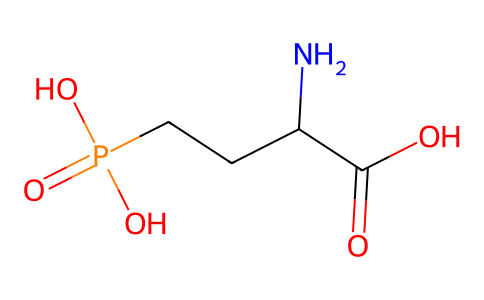
Physicochemical Properties
| Molecular Formula | C4H10NO5P |
| Molecular Weight | 183.0997 |
| Exact Mass | 183.03 |
| Elemental Analysis | C, 26.24; H, 5.51; N, 7.65; O, 43.69; P, 16.92 |
| CAS # | 20263-07-4 |
| PubChem CID | 2207 |
| Appearance | Typically exists as solid at room temperature |
| Density | 1.628g/cm3 |
| Boiling Point | 491.7ºC at 760mmHg |
| Melting Point | 225ºC |
| Flash Point | 251.2ºC |
| Vapour Pressure | 5.18E-11mmHg at 25°C |
| Index of Refraction | 1.545 |
| LogP | -5.5 |
| Hydrogen Bond Donor Count | 4 |
| Hydrogen Bond Acceptor Count | 6 |
| Rotatable Bond Count | 4 |
| Heavy Atom Count | 11 |
| Complexity | 187 |
| Defined Atom Stereocenter Count | 0 |
| SMILES | OC(C(CCP(=O)(O)O)N)=O |
| InChi Key | DDOQBQRIEWHWBT-UHFFFAOYSA-N |
| InChi Code | InChI=1S/C4H10NO5P/c5-3(4(6)7)1-2-11(8,9)10/h3H,1-2,5H2,(H,6,7)(H2,8,9,10) |
| Chemical Name | 2-amino-4-phosphonobutanoic acid |
| Synonyms | 6323-99-5; 2-amino-4-phosphonobutanoic acid; 2-Amino-4-phosphonobutyric acid; DL-AP4; 20263-07-4; DL-2-Amino-4-phosphonobutyric acid; Butanoic acid, 2-amino-4-phosphono-; (+/-)-2-Amino-4-phosphonobutyric acid; |
| HS Tariff Code | 2934.99.9001 |
| Storage |
Powder-20°C 3 years 4°C 2 years In solvent -80°C 6 months -20°C 1 month |
| Shipping Condition | Room temperature (This product is stable at ambient temperature for a few days during ordinary shipping and time spent in Customs) |
Biological Activity
| Targets | Metabotropic glutamate receptors (mGluR) |
| ln Vitro | Glutamate and L-AP4 inhibited forskolin-stimulated cyclic AMP (cAMP) production in baby hamster kidney (BHK) cells transfected with the type IV metabotropic receptor (mGluR4). In situ hybridization revealed a high level of mRNA for the mGluR4 in the entorhinal cortex, but not in the dentate gyrus. These data demonstrate that mGluR4 receptors are negatively coupled to the cAMP cascade, and suggest that the mGluR4 receptor may be the previously described presynaptic L-AP4 receptor [1]. |
| ln Vivo | Four experiments were performed to assess the effects of ON channel blockade with the glutamate analog 2-amino-4-phosphonobutyrate (APB) on brightness and contrast perception in monkeys. In Experiment 1, we demonstrate that stimuli brighter than background (incremental stimuli) appear less bright following ON channel blockade. This decrease in brightness is not enough to account for the previously observed threshold increase for detection of incremental stimuli following APB administration (Schiller et al., 1986; Dolan & Schiller, 1989). Experiment 2 examines the role of the ON and OFF channels in the interaction between local contrast and apparent brightness. The phenomenon of simultaneous contrast was examined under normal conditions and following APB administration. We find that even following ON channel blockade, the brightness of a stimulus is determined primarily by its contrast with its immediate background. This indicates that the lateral processes involved in simultaneous contrast can operate even when one channel has been compromised. In Experiment 3, we examined the role of the ON channel in detection of stimuli that appear by virtue of changes in background vs. foreground luminance. We find that the ON channel selectively conveys information pertaining not only to the temporal nature that defines the stimulus as incremental but also to the spatial features that define it as incremental. In Experiment 4, we test the hypothesis that incremental and decremental temporal luminance ramps are differentially processed by the ON and OFF channels to a higher degree than are step-luminance changes. We find that the detection of incremental ramps is no more affected than is the detection of incremental steps following APB administration [2]. |
| References |
[1]. L-2-amino-4-phosphonobutyrate (L-AP4) is an agonist at the type IV metabotropic glutamate receptor which is negatively coupled to adenylate cyclase. Eur J Pharmacol. 1992 Nov 2;227(3):361-2. [2]. , Effects of ON channel blockade with 2-amino-4-phosphonobutyrate (APB) on brightness and contrast perception in monkeys. Vis Neurosci. 1994 Jan-Feb;11(1):23-32. |
Solubility Data
| Solubility (In Vitro) | May dissolve in DMSO (in most cases), if not, try other solvents such as H2O, Ethanol, or DMF with a minute amount of products to avoid loss of samples |
| Solubility (In Vivo) |
Note: Listed below are some common formulations that may be used to formulate products with low water solubility (e.g. < 1 mg/mL), you may test these formulations using a minute amount of products to avoid loss of samples. Injection Formulations (e.g. IP/IV/IM/SC) Injection Formulation 1: DMSO : Tween 80: Saline = 10 : 5 : 85 (i.e. 100 μL DMSO stock solution → 50 μL Tween 80 → 850 μL Saline) *Preparation of saline: Dissolve 0.9 g of sodium chloride in 100 mL ddH ₂ O to obtain a clear solution. Injection Formulation 2: DMSO : PEG300 :Tween 80 : Saline = 10 : 40 : 5 : 45 (i.e. 100 μL DMSO → 400 μLPEG300 → 50 μL Tween 80 → 450 μL Saline) Injection Formulation 3: DMSO : Corn oil = 10 : 90 (i.e. 100 μL DMSO → 900 μL Corn oil) Example: Take the Injection Formulation 3 (DMSO : Corn oil = 10 : 90) as an example, if 1 mL of 2.5 mg/mL working solution is to be prepared, you can take 100 μL 25 mg/mL DMSO stock solution and add to 900 μL corn oil, mix well to obtain a clear or suspension solution (2.5 mg/mL, ready for use in animals). Injection Formulation 4: DMSO : 20% SBE-β-CD in saline = 10 : 90 [i.e. 100 μL DMSO → 900 μL (20% SBE-β-CD in saline)] *Preparation of 20% SBE-β-CD in Saline (4°C,1 week): Dissolve 2 g SBE-β-CD in 10 mL saline to obtain a clear solution. Injection Formulation 5: 2-Hydroxypropyl-β-cyclodextrin : Saline = 50 : 50 (i.e. 500 μL 2-Hydroxypropyl-β-cyclodextrin → 500 μL Saline) Injection Formulation 6: DMSO : PEG300 : castor oil : Saline = 5 : 10 : 20 : 65 (i.e. 50 μL DMSO → 100 μLPEG300 → 200 μL castor oil → 650 μL Saline) Injection Formulation 7: Ethanol : Cremophor : Saline = 10: 10 : 80 (i.e. 100 μL Ethanol → 100 μL Cremophor → 800 μL Saline) Injection Formulation 8: Dissolve in Cremophor/Ethanol (50 : 50), then diluted by Saline Injection Formulation 9: EtOH : Corn oil = 10 : 90 (i.e. 100 μL EtOH → 900 μL Corn oil) Injection Formulation 10: EtOH : PEG300:Tween 80 : Saline = 10 : 40 : 5 : 45 (i.e. 100 μL EtOH → 400 μLPEG300 → 50 μL Tween 80 → 450 μL Saline) Oral Formulations Oral Formulation 1: Suspend in 0.5% CMC Na (carboxymethylcellulose sodium) Oral Formulation 2: Suspend in 0.5% Carboxymethyl cellulose Example: Take the Oral Formulation 1 (Suspend in 0.5% CMC Na) as an example, if 100 mL of 2.5 mg/mL working solution is to be prepared, you can first prepare 0.5% CMC Na solution by measuring 0.5 g CMC Na and dissolve it in 100 mL ddH2O to obtain a clear solution; then add 250 mg of the product to 100 mL 0.5% CMC Na solution, to make the suspension solution (2.5 mg/mL, ready for use in animals). Oral Formulation 3: Dissolved in PEG400 Oral Formulation 4: Suspend in 0.2% Carboxymethyl cellulose Oral Formulation 5: Dissolve in 0.25% Tween 80 and 0.5% Carboxymethyl cellulose Oral Formulation 6: Mixing with food powders Note: Please be aware that the above formulations are for reference only. InvivoChem strongly recommends customers to read literature methods/protocols carefully before determining which formulation you should use for in vivo studies, as different compounds have different solubility properties and have to be formulated differently. (Please use freshly prepared in vivo formulations for optimal results.) |
| Preparing Stock Solutions | 1 mg | 5 mg | 10 mg | |
| 1 mM | 5.4615 mL | 27.3075 mL | 54.6150 mL | |
| 5 mM | 1.0923 mL | 5.4615 mL | 10.9230 mL | |
| 10 mM | 0.5461 mL | 2.7307 mL | 5.4615 mL |