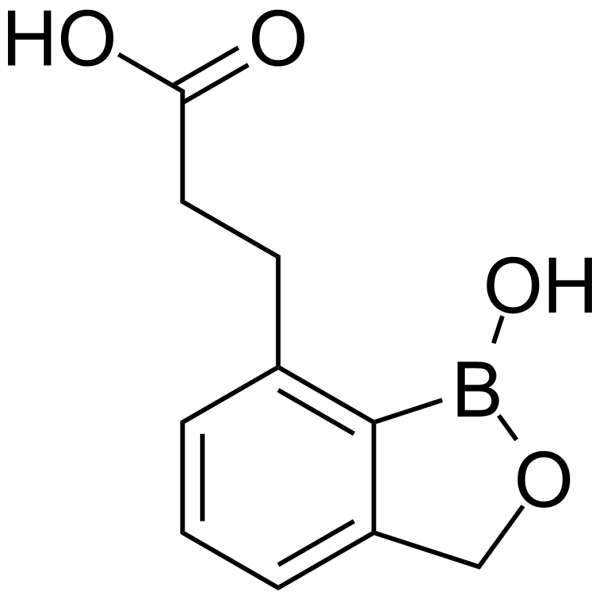
Physicochemical Properties
| Molecular Formula | C10H11BO4 |
| Molecular Weight | 206.002943277359 |
| Exact Mass | 206.075 |
| CAS # | 1268335-33-6 |
| PubChem CID | 50898347 |
| Appearance | White to off-white solid powder |
| Hydrogen Bond Donor Count | 2 |
| Hydrogen Bond Acceptor Count | 4 |
| Rotatable Bond Count | 3 |
| Heavy Atom Count | 15 |
| Complexity | 246 |
| Defined Atom Stereocenter Count | 0 |
| InChi Key | CEVOKIPNIZQANN-UHFFFAOYSA-N |
| InChi Code | InChI=1S/C10H11BO4/c12-9(13)5-4-7-2-1-3-8-6-15-11(14)10(7)8/h1-3,14H,4-6H2,(H,12,13) |
| Chemical Name | 3-(1-hydroxy-3H-2,1-benzoxaborol-7-yl)propanoic acid |
| Synonyms | AN 3661; AN-3661 |
| HS Tariff Code | 2934.99.9001 |
| Storage |
Powder-20°C 3 years 4°C 2 years In solvent -80°C 6 months -20°C 1 month |
| Shipping Condition | Room temperature (This product is stable at ambient temperature for a few days during ordinary shipping and time spent in Customs) |
Biological Activity
| ln Vitro | In vitro tests using fresh Ugandan field isolates (mean ex vivo IC50=64 nM) reveal that AN3661 is active at nanomolar (IC50=20-56 nM) concentrations against laboratory strains of P. falciparum known to be susceptible (3D7) or resistant (W2, Dd2, K1, HB3, FCR3, and TM90C2B). With a CC50 of 60.5 μM against Jurkat cells, AN3661 demonstrated low cytotoxicity against mammalian cell lines. All other CC50 values were greater than the maximum dose tested, which was 25 μM or above [1]. Transcripts of Plasmodium falciparum are not as stable when AN3661 is present [1]. |
| ln Vivo | In mice with a 4-day ED90 of 0.34 mg/kg, AN3661 (50-200 mg.kg; oral; once daily for 4 days) suppresses Plasmodium berghei infection[1]. Starting on the third day of infection, AN3661 was given orally for four days. Four days after therapy commenced, the ED90 was 0.57 mg/kg[1]. |
| Animal Protocol |
Animal/Disease Models: Plasmodium berghei infected mice (malaria model) [1] Doses: 50, 100, 200 mg/kg Route of Administration: Oral; one time/day for 4 days Experimental Results: Parasitaemia was quickly controlled, ED90 is 0.34 mg/kg. Daily doses of 50 mg/kg and 100 mg/kg prolonged survival of mice, and mice treated with 200 mg/kg daily demonstrated long-term healing effects. |
| References | [1]. Sonoiki E, et al. A potent antimalarial benzoxaborole targets a Plasmodium falciparum cleavage and polyadenylation specificity factor homologue. Nat Commun. 2017;8:14574. Published 2017 Mar 6. |
Solubility Data
| Solubility (In Vitro) | DMSO : ~250 mg/mL (~1213.59 mM) |
| Solubility (In Vivo) |
Solubility in Formulation 1: ≥ 2.08 mg/mL (10.10 mM) (saturation unknown) in 10% DMSO + 40% PEG300 + 5% Tween80 + 45% Saline (add these co-solvents sequentially from left to right, and one by one), clear solution. For example, if 1 mL of working solution is to be prepared, you can add 100 μL of 20.8 mg/mL clear DMSO stock solution to 400 μL PEG300 and mix evenly; then add 50 μL Tween-80 to the above solution and mix evenly; then add 450 μL normal saline to adjust the volume to 1 mL. Preparation of saline: Dissolve 0.9 g of sodium chloride in 100 mL ddH₂ O to obtain a clear solution. Solubility in Formulation 2: ≥ 2.08 mg/mL (10.10 mM) (saturation unknown) in 10% DMSO + 90% (20% SBE-β-CD in Saline) (add these co-solvents sequentially from left to right, and one by one), clear solution. For example, if 1 mL of working solution is to be prepared, you can add 100 μL of 20.8 mg/mL clear DMSO stock solution to 900 μL of 20% SBE-β-CD physiological saline solution and mix evenly. Preparation of 20% SBE-β-CD in Saline (4°C,1 week): Dissolve 2 g SBE-β-CD in 10 mL saline to obtain a clear solution. Solubility in Formulation 3: ≥ 2.08 mg/mL (10.10 mM) (saturation unknown) in 10% DMSO + 90% Corn Oil (add these co-solvents sequentially from left to right, and one by one), clear solution. For example, if 1 mL of working solution is to be prepared, you can add 100 μL of 20.8 mg/mL clear DMSO stock solution to 900 μL of corn oil and mix evenly. (Please use freshly prepared in vivo formulations for optimal results.) |
| Preparing Stock Solutions | 1 mg | 5 mg | 10 mg | |
| 1 mM | 4.8544 mL | 24.2718 mL | 48.5437 mL | |
| 5 mM | 0.9709 mL | 4.8544 mL | 9.7087 mL | |
| 10 mM | 0.4854 mL | 2.4272 mL | 4.8544 mL |