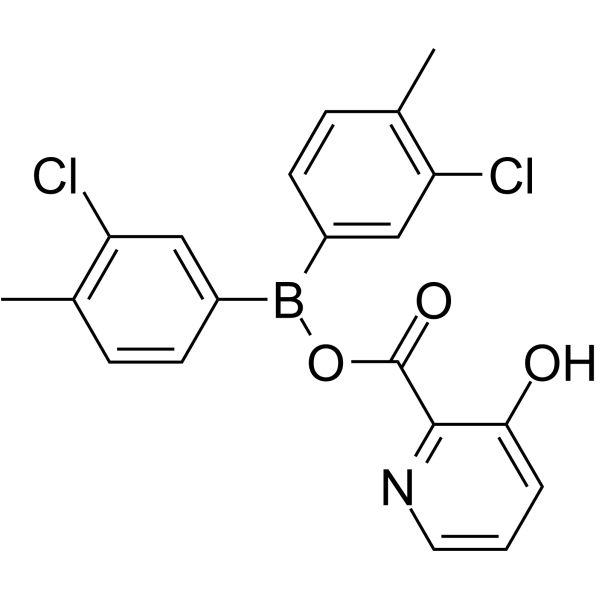
Physicochemical Properties
| Molecular Formula | C20H16BCL2NO3 |
| Molecular Weight | 400.062943458557 |
| Exact Mass | 399.06 |
| Elemental Analysis | C, 60.05; H, 4.03; B, 2.70; Cl, 17.72; N, 3.50; O, 12.00 |
| CAS # | 872044-70-7 |
| PubChem CID | 11704019 |
| Appearance | Solid powder |
| LogP | 3.673 |
| Hydrogen Bond Donor Count | 1 |
| Hydrogen Bond Acceptor Count | 4 |
| Rotatable Bond Count | 5 |
| Heavy Atom Count | 27 |
| Complexity | 486 |
| Defined Atom Stereocenter Count | 0 |
| SMILES | ClC1=C(C)C=CC(B(C2C=CC(C)=C(C=2)Cl)OC(C2C(=CC=CN=2)O)=O)=C1 |
| InChi Key | ZTLSOLUCMQEGEA-UHFFFAOYSA-N |
| InChi Code | InChI=1S/C20H16BCl2NO3/c1-12-5-7-14(10-16(12)22)21(15-8-6-13(2)17(23)11-15)27-20(26)19-18(25)4-3-9-24-19/h3-11,25H,1-2H3 |
| Chemical Name | bis(3-chloro-4-methylphenyl)boranyl 3-hydroxypyridine-2-carboxylate |
| Synonyms | AN-0128; CRM-0005; ONT-0001; AN0128; CRM0005; ONT0001; AN 0128; CRM 0005; ONT 0001 |
| HS Tariff Code | 2934.99.9001 |
| Storage |
Powder-20°C 3 years 4°C 2 years In solvent -80°C 6 months -20°C 1 month Note: This product requires protection from light (avoid light exposure) during transportation and storage. |
| Shipping Condition | Room temperature (This product is stable at ambient temperature for a few days during ordinary shipping and time spent in Customs) |
Biological Activity
| ln Vitro | AN0128 (compound 2g; 10 μM; 24-48 hours) has a potent inhibitory effect on human peripheral blood mononuclear cells (PBMCs) when it comes to the production of proinflammatory cytokines (TNF-α, IL-1β), but not on the release of IFN-γ or IL-4 without inhibition [1]. |
| ln Vivo | AN0128 (1%, 5%; administered topically daily for 7 days) significantly inhibits the production of inflammatory infiltrates and minimizes bone loss [2]. |
| Animal Protocol |
Animal/Disease Models: Experimental periodontitis in 12weeks old male SD (SD (Sprague-Dawley)) rats (weight 275 to 300 g each) [2] Doses: 1% AN0128 in 40% Transcutol P, 40% PBS and 20% ethanol vehicle Daily topical application for 7 days. Experimental Results: Similar to ketorolac, bone area and bone volume increased by 50% and 35% respectively, and bone loss and inflammation were diminished by 38% and 42% respectively. Animal/Disease Models: Experimental periodontitis in 12weeks old male SD (SD (Sprague-Dawley)) rats (weight 275 to 300 g each) [2] Doses: Use with Total Toothpaste 5% Route of Administration: Apply daily via cotton-tipped applicator . Results for 7 days: better than Total toothpaste, increasing bone mass by 33% and reducing bone loss by 47%. |
| References |
[1]. Identification of a novel boron-containing antibacterial agent (AN0128) with anti-inflammatory activity, for the potential treatment of cutaneous diseases. Bioorg Med Chem Lett. 2006 Dec 1;16(23):5963-7. [2]. Inhibition of experimental periodontitis by a topical boron-based antimicrobial. J Dent Res. 2008 Feb;87(2):148-52. |
| Additional Infomation |
AN0128 is a novel compound that contains a boron atom within a borinic acid complex. AN0128 has broad spectrum activity against a wide variety of Gram positive bacteria, including many that are known skin colonizers. Of particular importance is P. acnes and its causal role in acne vulgaris. The rise in antibiotic resistance of P. acnes to standard antibiotics necessitates the development of new treatment agents. AN0128 is a good candidate for a topical antibiotic and is currently being developed by Anacor as a novel therapeutic for acne and atopic dermatitis. Drug Indication Investigated for use/treatment in acne, atopic dermatitis, pediatric indications, and psoriasis and psoriatic disorders. Mechanism of Action AN0128 inhibits the release of pro-inflammatory cytokines, including TNF- alpha, without affecting the normal immune response. |
Solubility Data
| Solubility (In Vitro) | DMSO : ~125 mg/mL (~312.45 mM) |
| Solubility (In Vivo) |
Solubility in Formulation 1: ≥ 2.08 mg/mL (5.20 mM) (saturation unknown) in 10% DMSO + 40% PEG300 + 5% Tween80 + 45% Saline (add these co-solvents sequentially from left to right, and one by one), clear solution. For example, if 1 mL of working solution is to be prepared, you can add 100 μL of 20.8 mg/mL clear DMSO stock solution to 400 μL PEG300 and mix evenly; then add 50 μL Tween-80 to the above solution and mix evenly; then add 450 μL normal saline to adjust the volume to 1 mL. Preparation of saline: Dissolve 0.9 g of sodium chloride in 100 mL ddH₂ O to obtain a clear solution. Solubility in Formulation 2: ≥ 2.08 mg/mL (5.20 mM) (saturation unknown) in 10% DMSO + 90% Corn Oil (add these co-solvents sequentially from left to right, and one by one), clear solution. For example, if 1 mL of working solution is to be prepared, you can add 100 μL of 20.8 mg/mL clear DMSO stock solution to 900 μL of corn oil and mix evenly. (Please use freshly prepared in vivo formulations for optimal results.) |
| Preparing Stock Solutions | 1 mg | 5 mg | 10 mg | |
| 1 mM | 2.4996 mL | 12.4981 mL | 24.9963 mL | |
| 5 mM | 0.4999 mL | 2.4996 mL | 4.9993 mL | |
| 10 mM | 0.2500 mL | 1.2498 mL | 2.4996 mL |