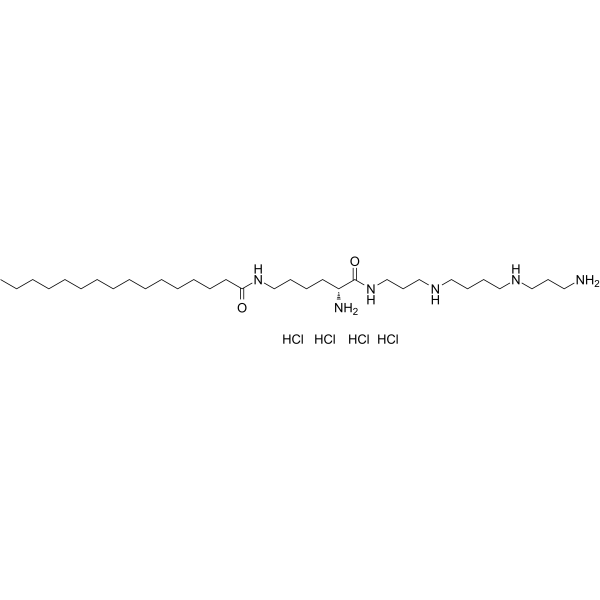
Physicochemical Properties
| Molecular Formula | C32H72CL4N6O2 |
| Molecular Weight | 714.77 |
| CAS # | 2444815-84-1 |
| Appearance | Off-white to light yellow solid powder |
| HS Tariff Code | 2934.99.9001 |
| Storage |
Powder-20°C 3 years 4°C 2 years In solvent -80°C 6 months -20°C 1 month Note: Please store this product in a sealed and protected environment (e.g. under nitrogen), avoid exposure to moisture and light. |
| Shipping Condition | Room temperature (This product is stable at ambient temperature for a few days during ordinary shipping and time spent in Customs) |
Biological Activity
| Targets | Polyamine transport[1] |
| ln Vitro | The NB cell lines BE(2)-C, SMS-KCNR, and SH-SY5Y show cytotoxicity when treated with AMXT-1501 tetrahydrochloride (0.39-50 µM; 48 hours); the IC50 values for SMS-KCNR are 17.72 µM, BE(2)-C is 17.69 µM, and SH-SY5Y is 14.13 µM[2]. The AMXT-1501 tetrahydrochloride (2.5 µM) and DFMO (2.5 mM) are applied to BE(2)-C, SMS-KCNR, and SH-SY5Y cells either separately or in combination (AMXT-1501 tetrahydrochloride 2.5 µM + DFMO 2.5 mM). The levels of cleaved PARP, cleaved caspase 3, and noncleaved PARP do not change significantly after 96 hours of exposure to either AMXT-1501 tetrahydrochloride or DFMO. However, cells treated with the combination of AMXT-1501 tetrahydrochloride and DFMO show a decrease in noncleaved PARP and an increase in cleaved PARP and cleaved caspase 3[2]. |
| ln Vivo | AMXT-1501 tetrahydrochloride (3 mg/kg; subcutaneous injection; daily; 28 days) by itself is adequate to moderately postpone the onset of EAE, but it is unable to prevent animals from reaching the endpoint. Nonetheless, the tetrahydrochloride AMXT-1501 and DFMO alone are adequate to reduce the polyamine pool in T cells, which in turn inhibits T cell proliferation and effector function in vivo[3]. |
| Cell Assay |
Cell Viability Assay[2] Cell Types: BE(2)-C, SMS‐KCNR and SH‐SY5Y cells Tested Concentrations: 0.39 µM, 1 µM, 3.1 µM, 10 µM, 31 µM, 50 µM Incubation Duration: 48 hrs (hours) Experimental Results: AMXT-1501 tetrahydrochloride demonstrated cytotoxicity against this panel of NB cell lines. Western Blot Analysis[2] Cell Types: BE(2)‐C, SMS‐KCNR and SH‐SY5Y cells Tested Concentrations: 2.5 µM Incubation Duration: 72 hrs (hours) Experimental Results: Combination treatment with DFMO diminished the amount of noncleaved PARP and increased the amount of cleaved PARP and cleaved caspase 3 in all three cell lines. |
| Animal Protocol |
Animal/Disease Models: C57BL/6 (WT) and ODC knockout strain (ODC cKO) mice bearing experimental autoimmune encephalomyelitis (EAE) model [ 3] Doses: 3 mg/kg Route of Administration: subcutaneous (sc) injection; every day; 28 days Experimental Results: Displayed a delayed disease onset initially, but eventually proceeded with pathologic development and reached the endpoint. |
| References |
[1]. Polyamine-blocking therapy reverses immunosuppression in the tumor microenvironment. Cancer Immunol Res. 2014 Mar;2(3):274-85. [2]. AMXT‐1501, a novel polyamine transport inhibitor, synergizes with DFMO in inhibiting neuroblastoma cell proliferation by targeting both ornithine decarboxylase and polyamine transport. Int J Cancer. 2013 Sep 15;133(6):1323-33. [3]. De novo synthesis and salvage pathway coordinately regulate polyamine homeostasis and determine T cell proliferation and function. Sci Adv. 2020 Dec 16;6(51):eabc4275. |
Solubility Data
| Solubility (In Vitro) | H2O :~83.33 mg/mL (~116.58 mM) |
| Solubility (In Vivo) |
Solubility in Formulation 1: 50 mg/mL (69.95 mM) in PBS (add these co-solvents sequentially from left to right, and one by one), clear solution; with sonication. (Please use freshly prepared in vivo formulations for optimal results.) |
| Preparing Stock Solutions | 1 mg | 5 mg | 10 mg | |
| 1 mM | 1.3991 mL | 6.9953 mL | 13.9905 mL | |
| 5 mM | 0.2798 mL | 1.3991 mL | 2.7981 mL | |
| 10 mM | 0.1399 mL | 0.6995 mL | 1.3991 mL |