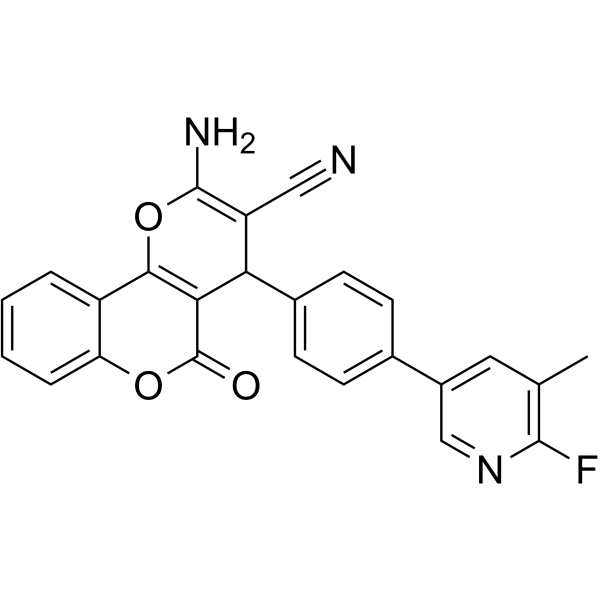
Physicochemical Properties
| Molecular Formula | C25H16FN3O3 |
| Molecular Weight | 425.411249160767 |
| Exact Mass | 425.117 |
| CAS # | 2254434-33-6 |
| PubChem CID | 142491885 |
| Appearance | Off-white to light yellow solid powder |
| LogP | 4.4 |
| Hydrogen Bond Donor Count | 1 |
| Hydrogen Bond Acceptor Count | 7 |
| Rotatable Bond Count | 2 |
| Heavy Atom Count | 32 |
| Complexity | 882 |
| Defined Atom Stereocenter Count | 0 |
| InChi Key | QYTOMCGQPLOOOC-UHFFFAOYSA-N |
| InChi Code | InChI=1S/C25H16FN3O3/c1-13-10-16(12-29-23(13)26)14-6-8-15(9-7-14)20-18(11-27)24(28)32-22-17-4-2-3-5-19(17)31-25(30)21(20)22/h2-10,12,20H,28H2,1H3 |
| Chemical Name | 2-amino-4-[4-(6-fluoro-5-methylpyridin-3-yl)phenyl]-5-oxo-4H-pyrano[3,2-c]chromene-3-carbonitrile |
| HS Tariff Code | 2934.99.9001 |
| Storage |
Powder-20°C 3 years 4°C 2 years In solvent -80°C 6 months -20°C 1 month Note: Please store this product in a sealed and protected environment, avoid exposure to moisture. |
| Shipping Condition | Room temperature (This product is stable at ambient temperature for a few days during ordinary shipping and time spent in Customs) |
Biological Activity
| ln Vitro | In CMS4 CRC cells, AMPC inhibits cell growth; in SW620 (high TFF3 expression), Caco-2, and SW480 (low TFF3 expression) cells, the IC50 values are 2.63 μM, 4.65 μM, and 69.69 μM, respectively[1]. In SW620 and Caco2 cells, 1-10 μM dramatically lowers the overall cellular levels of TFF3 in a dose-dependent manner[1]. By inhibiting TFF3, AMPC causes apoptosis in a dose-dependent manner. In comparison to control cells, it also causes a decrease in the S-phase population and an increase in caspase 3/7 activity[1]. |
| ln Vivo | When mice are treated with AMPC (intraperitoneal injection; 40 mg/kg; once daily), their tumor volume significantly decreases in comparison to mice treated with saline starting on day 11. In SW620 tumors, AMPC causes greater regions of tumor necrosis and an increase in the area of cells exhibiting apoptotic characteristics. In vivo, AMPC also dramatically lowers serum and tumor TFF3 levels. |
| Animal Protocol |
Animal/Disease Models: SW620 cells are subcutaneously (sc) injected into nude mice[1] Doses: 40 mg/kg Route of Administration: intraperitoneal (ip) injection; 40 mg/kg; one time/day Experimental Results: Lead to tumor decrease in vivo. Results in a marked reduction of Ki67 expression in tumor. |
| References | [1]. Ru-Mei Chen, et al. Pharmacological Inhibition of TFF3 Enhances Sensitivity of CMS4 Colorectal Carcinoma to 5-Fluorouracil through Inhibition of p44/42 MAPK. Int J Mol Sci. 2019 Dec 9;20(24):6215 |
Solubility Data
| Solubility (In Vitro) | DMSO: 115 mg/mL (270.33 mM) |
| Solubility (In Vivo) |
Solubility in Formulation 1: ≥ 6 mg/mL (14.10 mM) (saturation unknown) in 10% DMSO + 40% PEG300 + 5% Tween80 + 45% Saline (add these co-solvents sequentially from left to right, and one by one), clear solution. For example, if 1 mL of working solution is to be prepared, you can add 100 μL of 60.0 mg/mL clear DMSO stock solution to 400 μL PEG300 and mix evenly; then add 50 μL Tween-80 to the above solution and mix evenly; then add 450 μL normal saline to adjust the volume to 1 mL. Preparation of saline: Dissolve 0.9 g of sodium chloride in 100 mL ddH₂ O to obtain a clear solution. Solubility in Formulation 2: ≥ 2.5 mg/mL (5.88 mM) (saturation unknown) in 10% DMSO + 90% Corn Oil (add these co-solvents sequentially from left to right, and one by one), clear solution. For example, if 1 mL of working solution is to be prepared, you can add 100 μL of 25.0 mg/mL clear DMSO stock solution to 900 μL of corn oil and mix evenly. (Please use freshly prepared in vivo formulations for optimal results.) |
| Preparing Stock Solutions | 1 mg | 5 mg | 10 mg | |
| 1 mM | 2.3507 mL | 11.7534 mL | 23.5067 mL | |
| 5 mM | 0.4701 mL | 2.3507 mL | 4.7013 mL | |
| 10 mM | 0.2351 mL | 1.1753 mL | 2.3507 mL |