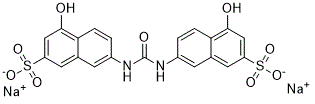
AMI-1 (AMI 1) disodium salt is a novel, cell-permeable and selective inhibitor of Histone Methyltransferase (HMT) with anti-inflammatory activity. It inhibits HMT with an IC50 of 3.0 μM and 8.8 μM for yeast Hmt1p and human PRMT1, respectively.
Physicochemical Properties
| Molecular Formula | C21H14N2NA2O9S2 | |
| Molecular Weight | 548.45 | |
| Exact Mass | 547.993 | |
| CAS # | 20324-87-2 | |
| Related CAS # | AMI-1 free acid;134-47-4 | |
| PubChem CID | 88489 | |
| Appearance | Light brown to brown solid powder | |
| LogP | 5.164 | |
| Hydrogen Bond Donor Count | 4 | |
| Hydrogen Bond Acceptor Count | 9 | |
| Rotatable Bond Count | 2 | |
| Heavy Atom Count | 36 | |
| Complexity | 859 | |
| Defined Atom Stereocenter Count | 0 | |
| InChi Key | MOUNHKKCIGVIDI-UHFFFAOYSA-L | |
| InChi Code | InChI=1S/C21H16N2O9S2.2Na/c24-19-9-15(33(27,28)29)7-11-5-13(1-3-17(11)19)22-21(26)23-14-2-4-18-12(6-14)8-16(10-20(18)25)34(30,31)32;;/h1-10,24-25H,(H2,22,23,26)(H,27,28,29)(H,30,31,32);;/q;2*+1/p-2 | |
| Chemical Name |
|
|
| Synonyms |
|
|
| HS Tariff Code | 2934.99.9001 | |
| Storage |
Powder-20°C 3 years 4°C 2 years In solvent -80°C 6 months -20°C 1 month Note: Please store this product in a sealed and protected environment, avoid exposure to moisture. |
|
| Shipping Condition | Room temperature (This product is stable at ambient temperature for a few days during ordinary shipping and time spent in Customs) |
Biological Activity
| ln Vitro | The in vitro methylation reactions carried out by the five recombinantly active PRMTs (PRMT1, -3, -4, and -6 as well as Hmt1p) can be inhibited by AMI-1[2]. AMI-1 inhibits type II PRMT5 in addition to type I PRMTs (PRMT1, 3, 4, and 6)[2]. AMI-1 does not compete with AdoMet for the binding site and selectively inhibits the methyltransferase activity of arginine in vitro, but not that of lysine[3]. Cellular proteins and GFP-Npl3 methylation are both inhibited by AMI-1[3]. In vitro, sarcoma in S180 and U2OS cells is inhibited by AMI-1 (0.6-2.4 mM; 48-96 hours) in a time- and dose-dependent manner[4]. AMI-1 (1.2–2.4 mM; 48–72 hours) induces apoptosis in cells, which lowers the viability of S180 cells[4]. |
| ln Vivo | AMI-1 reduces S180 viability in vivo at a dose of 0.5 mg intraperitoneally every day for seven days[4]. ?In a tumor xenograft model, AMI-1 (0.5 mg; intratumorally; daily; for 7 days) downregulates PRMT5 but does not control PRMT7 expression[4]. ?In a tumor xenograft model, AMI-1 (0.5 mg; intratumorally; daily; for 7 days) reduces the levels of H4R3me2s and H3R8me2s[4]. |
| Cell Assay |
Cell Viability Assay[4] Cell Types: S180 cells, U2OS cells Tested Concentrations: 0.6 mM, 1.2 mM, 2.4 mM Incubation Duration: 48 hrs (hours), 72 hrs (hours), 96 hrs (hours) Experimental Results: Inhibited the cell viability. Increased the percentages of cells undergoing apoptosis. |
| Animal Protocol |
Animal/Disease Models: 6-7 weeks old male Kunming mice (18-22 g), with S180 cells xenograft[4] Doses: 0.5 mg Route of Administration: Intratumorally, daily, for 7 days Experimental Results: diminished tumor weight. |
| References |
[1]. Targeting protein arginine methyltransferase 5 inhibits colorectal cancer growth by decreasing arginine methylation of eIF4E and FGFR3. Oncotarget. 2015 Sep 8;6(26):22799-811. [2]. Arginine Methyltransferase inhibitor-1 Inhibits Sarcoma Viability in vitro and in vivo. Oncol Lett. 2018 Aug;16(2):2161-2166. [3]. Small Molecule Regulators of Protein Arginine Methyltransferases. J Biol Chem. 2004 Jun 4;279(23):23892-9. |
Solubility Data
| Solubility (In Vitro) |
|
|||
| Solubility (In Vivo) |
Solubility in Formulation 1: ≥ 2.5 mg/mL (4.56 mM) (saturation unknown) in 10% DMSO + 40% PEG300 + 5% Tween80 + 45% Saline (add these co-solvents sequentially from left to right, and one by one), clear solution. For example, if 1 mL of working solution is to be prepared, you can add 100 μL of 25.0 mg/mL clear DMSO stock solution to 400 μL PEG300 and mix evenly; then add 50 μL Tween-80 to the above solution and mix evenly; then add 450 μL normal saline to adjust the volume to 1 mL. Preparation of saline: Dissolve 0.9 g of sodium chloride in 100 mL ddH₂ O to obtain a clear solution. Solubility in Formulation 2: ≥ 2.5 mg/mL (4.56 mM) (saturation unknown) in 10% DMSO + 90% (20% SBE-β-CD in Saline) (add these co-solvents sequentially from left to right, and one by one), clear solution. For example, if 1 mL of working solution is to be prepared, you can add 100 μL of 25.0 mg/mL clear DMSO stock solution to 900 μL of 20% SBE-β-CD physiological saline solution and mix evenly. Preparation of 20% SBE-β-CD in Saline (4°C,1 week): Dissolve 2 g SBE-β-CD in 10 mL saline to obtain a clear solution. Solubility in Formulation 3: PBS: 22mg/mL Solubility in Formulation 4: 100 mg/mL (182.33 mM) in PBS (add these co-solvents sequentially from left to right, and one by one), clear solution; with ultrasonication (<60°C). (Please use freshly prepared in vivo formulations for optimal results.) |
| Preparing Stock Solutions | 1 mg | 5 mg | 10 mg | |
| 1 mM | 1.8233 mL | 9.1166 mL | 18.2332 mL | |
| 5 mM | 0.3647 mL | 1.8233 mL | 3.6466 mL | |
| 10 mM | 0.1823 mL | 0.9117 mL | 1.8233 mL |