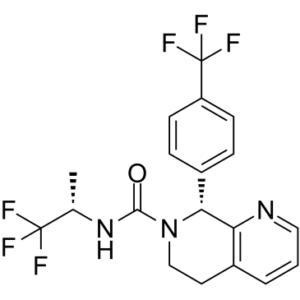
AMG2850 is a novel, potent, orally bioavailable and selective small molecule antagonist of transient receptor potential melastatin 8 (TRPM8). TRPM8 has been implicated in pain and migraine based on dorsal root- and trigeminal ganglion-enriched expression, upregulation in preclinical models of pain, knockout mouse studies, and human genetics. AMG2850 is potent in vitro at rat TRPM8 (IC90 against icilin activation of 204 ± 28 nM), highly selective (>100-fold IC90 over TRPV1 and TRPA1 channels), and orally bioavailable (F po > 40 %). When tested in a skin-nerve preparation, AMG2850 blocked menthol-induced action potentials but not mechanical activation in C fibers. AMG2850 exhibited significant target coverage in vivo in a TRPM8-mediated icilin-induced wet-dog shake (WDS) model in rats (at 10 mg/kg p.o.). However, AMG2850 did not produce a significant therapeutic effect in rat models of inflammatory mechanical hypersensitivity or neuropathic tactile allodynia at doses up to 100 mg/kg. The lack of efficacy suggests that either TRPM8 does not play a role in mediating pain in these models or that a higher level of target coverage is required. The potential of TRPM8 antagonists as migraine therapeutics is yet to be determined.
Physicochemical Properties
| Molecular Formula | C19H17F6N3O |
| Molecular Weight | 417.348205327988 |
| Exact Mass | 417.127 |
| CAS # | 1470018-52-0 |
| PubChem CID | 90655362 |
| Appearance | White to off-white solid powder |
| LogP | 4.2 |
| Hydrogen Bond Donor Count | 1 |
| Hydrogen Bond Acceptor Count | 8 |
| Rotatable Bond Count | 2 |
| Heavy Atom Count | 29 |
| Complexity | 573 |
| Defined Atom Stereocenter Count | 2 |
| SMILES | FC([C@H](C)NC(N1CCC2C=CC=NC=2[C@H]1C1C=CC(C(F)(F)F)=CC=1)=O)(F)F |
| InChi Key | DDBWYSSPWMXBIY-MEDUHNTESA-N |
| InChi Code | InChI=1S/C19H17F6N3O/c1-11(18(20,21)22)27-17(29)28-10-8-12-3-2-9-26-15(12)16(28)13-4-6-14(7-5-13)19(23,24)25/h2-7,9,11,16H,8,10H2,1H3,(H,27,29)/t11-,16+/m0/s1 |
| Chemical Name | (8R)-8-[4-(trifluoromethyl)phenyl]-N-[(2S)-1,1,1-trifluoropropan-2-yl]-6,8-dihydro-5H-1,7-naphthyridine-7-carboxamide |
| Synonyms | AMG-2850; AMG 2850; AMG2850 |
| HS Tariff Code | 2934.99.9001 |
| Storage |
Powder-20°C 3 years 4°C 2 years In solvent -80°C 6 months -20°C 1 month |
| Shipping Condition | Room temperature (This product is stable at ambient temperature for a few days during ordinary shipping and time spent in Customs) |
Biological Activity
| ln Vitro | AMG2850 is potent in vitro at rat TRPM8 (IC90 against icilin activation of 204 ± 28 nM), highly selective (>100-fold IC90 over TRPV1 and TRPA1 channels), and orally bioavailable (F po > 40 %). When tested in a skin-nerve preparation, AMG2850 blocked menthol-induced action potentials but not mechanical activation in C fibers. |
| ln Vivo | AMG2850 exhibited significant target coverage in vivo in a TRPM8-mediated icilin-induced wet-dog shake (WDS) model in rats (at 10 mg/kg p.o.). However, AMG2850 did not produce a significant therapeutic effect in rat models of inflammatory mechanical hypersensitivity or neuropathic tactile allodynia at doses up to 100 mg/kg. |
| Cell Assay |
To determine the ability to block agonist activation of TRPM8, AMG2850 was incubated with CHO cells expressing the TRP channel for 2 min before the addition of agonist and 45Ca2+ and cells were washed after a further incubation of 2 min to determine the 45Ca2+ uptake. [1] For treatment with TRPM8 inhibitors, the receptive field of each C fiber was isolated with a metal ring (4-mm diameter) sealed to the skin and incubated in vehicle (0.1 % DMSO or 0.003 % DMSO) or 10 μM AMG2850 for 10 min. AMG2850 was dissolved to the final concentration in 0.1 % DMSO. A baseline recording was taken during the final 2 min of compound incubation to measure any ongoing action potentials. [1] |
| Animal Protocol | After measuring basal threshold, animals were treated (p.o.) with vehicle (5 % Tween 80 ) or TRPM8 antagonist (AMG2850 at 100 mg/kg), or gabapentin (200 mg/kg). |
| References |
[1]. AMG2850, a potent and selective TRPM8 antagonist, is not effective in rat models of inflammatory mechanical hypersensitivity and neuropathic tactile allodynia. Naunyn Schmiedebergs Arch Pharmacol. 2015 Apr;388(4):465-76. |
Solubility Data
| Solubility (In Vitro) | DMSO : ~100 mg/mL (~239.61 mM) |
| Solubility (In Vivo) |
Solubility in Formulation 1: ≥ 2.5 mg/mL (5.99 mM) (saturation unknown) in 10% DMSO + 90% Corn Oil (add these co-solvents sequentially from left to right, and one by one), clear solution. For example, if 1 mL of working solution is to be prepared, you can add 100 μL of 25.0 mg/mL clear DMSO stock solution to 900 μL of corn oil and mix evenly. (Please use freshly prepared in vivo formulations for optimal results.) |
| Preparing Stock Solutions | 1 mg | 5 mg | 10 mg | |
| 1 mM | 2.3961 mL | 11.9804 mL | 23.9607 mL | |
| 5 mM | 0.4792 mL | 2.3961 mL | 4.7921 mL | |
| 10 mM | 0.2396 mL | 1.1980 mL | 2.3961 mL |