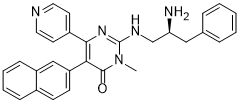
AMG-548 is a novel, orally bioactive, potent and selective inhibitor of p38α with Ki of 0.5 nM. It has some selectivity over p38β (Ki=36 nM) but exhibits >1000-fold selectivity against 36 other kinases, and it inhibits whole blood LPS-stimulated TNFα. AMG-548 has shown to be efficacious in acute and chronic models of arthritis.
Physicochemical Properties
| Molecular Formula | C29H27N5O |
| Molecular Weight | 461.557585954666 |
| Exact Mass | 461.222 |
| CAS # | 864249-60-5 |
| Related CAS # | AMG-548 dihydrochloride;2518299-32-4;AMG-548 hydrochloride;2437438-16-7 |
| PubChem CID | 11167112 |
| Appearance | Light yellow to yellow solid powder |
| LogP | 5.417 |
| Hydrogen Bond Donor Count | 2 |
| Hydrogen Bond Acceptor Count | 4 |
| Rotatable Bond Count | 7 |
| Heavy Atom Count | 35 |
| Complexity | 795 |
| Defined Atom Stereocenter Count | 1 |
| SMILES | CN1C(=O)C(=C(N=C1NC[C@H](CC2=CC=CC=C2)N)C3=CC=NC=C3)C4=CC5=CC=CC=C5C=C4 |
| InChi Key | RQVKVJIRFKVPBF-VWLOTQADSA-N |
| InChi Code | InChI=1S/C29H27N5O/c1-34-28(35)26(24-12-11-21-9-5-6-10-23(21)18-24)27(22-13-15-31-16-14-22)33-29(34)32-19-25(30)17-20-7-3-2-4-8-20/h2-16,18,25H,17,19,30H2,1H3,(H,32,33)/t25-/m0/s1 |
| Chemical Name | 4(3H)-Pyrimidinone, 2-(((2S)-2-amino-3-phenylpropyl)amino)-3-methyl-5-(2-naphthalenyl)-6-(4-pyridinyl)- |
| Synonyms | AMG 548 AMG-548 AMG548 UNII-PGR0H531I4 |
| HS Tariff Code | 2934.99.9001 |
| Storage |
Powder-20°C 3 years 4°C 2 years In solvent -80°C 6 months -20°C 1 month |
| Shipping Condition | Room temperature (This product is stable at ambient temperature for a few days during ordinary shipping and time spent in Customs) |
Biological Activity
| ln Vitro | For p38γ (Ki=2600 nM) and p38δ (ki=4100 nM), AMG-548 exhibits >1000-fold selectivity. For JNK2 (ki=39 nM) and JNK3 (ki=61 nM), AMG-548 exhibits a modest level of selectivity. Additionally, AMG-548 is very effective in blocking TNFa (IC50=3 nM) and IL1b (IC50=7 nM) that are triggered by LPS, as well as TNFa-induced IL-8 (IC50=0.7 nM) and IL-1b-induced IL in whole blood human -6 (IC5050=1.3 nM)[1]. hDvl2 transition is inhibited by AMG-548 (10 μM) [2]. |
| ln Vivo | The F of AMG-548 was 62% in rats and 47% in dogs. The t1/2 of rats is 4.6 hours while that of dogs is 7.3 hours [1]. |
| References |
[1]. MAP kinase p38 inhibitors: clinical results and an intimate look at their interactions with p38alphaprotein. Curr Med Chem. 2005;12(25):2979-94. [2]. Inhibition of Wnt/β-catenin signaling by p38 MAP kinase inhibitors is explained by cross-reactivity with casein kinase Iδ/ɛ. Chem Biol. 2011 Apr 22;18(4):485-94. |
Solubility Data
| Solubility (In Vitro) | May dissolve in DMSO (in most cases), if not, try other solvents such as H2O, Ethanol, or DMF with a minute amount of products to avoid loss of samples |
| Solubility (In Vivo) |
Note: Listed below are some common formulations that may be used to formulate products with low water solubility (e.g. < 1 mg/mL), you may test these formulations using a minute amount of products to avoid loss of samples. Injection Formulations (e.g. IP/IV/IM/SC) Injection Formulation 1: DMSO : Tween 80: Saline = 10 : 5 : 85 (i.e. 100 μL DMSO stock solution → 50 μL Tween 80 → 850 μL Saline) *Preparation of saline: Dissolve 0.9 g of sodium chloride in 100 mL ddH ₂ O to obtain a clear solution. Injection Formulation 2: DMSO : PEG300 :Tween 80 : Saline = 10 : 40 : 5 : 45 (i.e. 100 μL DMSO → 400 μLPEG300 → 50 μL Tween 80 → 450 μL Saline) Injection Formulation 3: DMSO : Corn oil = 10 : 90 (i.e. 100 μL DMSO → 900 μL Corn oil) Example: Take the Injection Formulation 3 (DMSO : Corn oil = 10 : 90) as an example, if 1 mL of 2.5 mg/mL working solution is to be prepared, you can take 100 μL 25 mg/mL DMSO stock solution and add to 900 μL corn oil, mix well to obtain a clear or suspension solution (2.5 mg/mL, ready for use in animals). Injection Formulation 4: DMSO : 20% SBE-β-CD in saline = 10 : 90 [i.e. 100 μL DMSO → 900 μL (20% SBE-β-CD in saline)] *Preparation of 20% SBE-β-CD in Saline (4°C,1 week): Dissolve 2 g SBE-β-CD in 10 mL saline to obtain a clear solution. Injection Formulation 5: 2-Hydroxypropyl-β-cyclodextrin : Saline = 50 : 50 (i.e. 500 μL 2-Hydroxypropyl-β-cyclodextrin → 500 μL Saline) Injection Formulation 6: DMSO : PEG300 : castor oil : Saline = 5 : 10 : 20 : 65 (i.e. 50 μL DMSO → 100 μLPEG300 → 200 μL castor oil → 650 μL Saline) Injection Formulation 7: Ethanol : Cremophor : Saline = 10: 10 : 80 (i.e. 100 μL Ethanol → 100 μL Cremophor → 800 μL Saline) Injection Formulation 8: Dissolve in Cremophor/Ethanol (50 : 50), then diluted by Saline Injection Formulation 9: EtOH : Corn oil = 10 : 90 (i.e. 100 μL EtOH → 900 μL Corn oil) Injection Formulation 10: EtOH : PEG300:Tween 80 : Saline = 10 : 40 : 5 : 45 (i.e. 100 μL EtOH → 400 μLPEG300 → 50 μL Tween 80 → 450 μL Saline) Oral Formulations Oral Formulation 1: Suspend in 0.5% CMC Na (carboxymethylcellulose sodium) Oral Formulation 2: Suspend in 0.5% Carboxymethyl cellulose Example: Take the Oral Formulation 1 (Suspend in 0.5% CMC Na) as an example, if 100 mL of 2.5 mg/mL working solution is to be prepared, you can first prepare 0.5% CMC Na solution by measuring 0.5 g CMC Na and dissolve it in 100 mL ddH2O to obtain a clear solution; then add 250 mg of the product to 100 mL 0.5% CMC Na solution, to make the suspension solution (2.5 mg/mL, ready for use in animals). Oral Formulation 3: Dissolved in PEG400 Oral Formulation 4: Suspend in 0.2% Carboxymethyl cellulose Oral Formulation 5: Dissolve in 0.25% Tween 80 and 0.5% Carboxymethyl cellulose Oral Formulation 6: Mixing with food powders Note: Please be aware that the above formulations are for reference only. InvivoChem strongly recommends customers to read literature methods/protocols carefully before determining which formulation you should use for in vivo studies, as different compounds have different solubility properties and have to be formulated differently. (Please use freshly prepared in vivo formulations for optimal results.) |
| Preparing Stock Solutions | 1 mg | 5 mg | 10 mg | |
| 1 mM | 2.1666 mL | 10.8328 mL | 21.6657 mL | |
| 5 mM | 0.4333 mL | 2.1666 mL | 4.3331 mL | |
| 10 mM | 0.2167 mL | 1.0833 mL | 2.1666 mL |