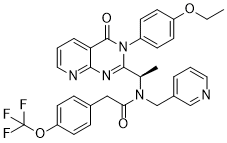
AMG-487 (AMG487) is a novel, potent, selective and oral antagonist of chemokine receptor 3 CXCR3 with potential immunomodulatory and antiinflammatory activities. It has IC50s of 8.0 and 8.2 nM for I-IP-10 and I-ITAC, respectively, which inhibits the binding of CXCL10 and CXCL11 to CXCR3. I-IP-10 and I-ITAC, two chemokines, are prevented from binding to CXCR3 by AMG 487. AMG 487 has been shown in the cellular assays to inhibit CXCR3-mediated cell migration, with IC50 values for I-IP-10, I-ITAC, and MIG of 8 nM, 15 nM, and 36 nM, respectively.
Physicochemical Properties
| Molecular Formula | C32H28F3N5O4 |
| Molecular Weight | 603.591037750244 |
| Exact Mass | 603.209 |
| Elemental Analysis | C, 63.68; H, 4.68; F, 9.44; N, 11.60; O, 10.60 |
| CAS # | 473719-41-4 |
| Related CAS # | AMG 487 (S-enantiomer); 473720-30-8; (±)-AMG 487; 947536-03-0 |
| PubChem CID | 24957182 |
| Appearance | White to yellow solid powder |
| LogP | 5.805 |
| Hydrogen Bond Donor Count | 0 |
| Hydrogen Bond Acceptor Count | 10 |
| Rotatable Bond Count | 10 |
| Heavy Atom Count | 44 |
| Complexity | 997 |
| Defined Atom Stereocenter Count | 1 |
| SMILES | O=C(N([C@@H](C1=NC2=NC=CC=C2C(N1C3=CC=C(OCC)C=C3)=O)C)CC4=CC=CN=C4)CC5=CC=C(OC(F)(F)F)C=C5 |
| InChi Key | WQTKNBPCJKRYPA-OAQYLSRUSA-N |
| InChi Code | InChI=1S/C32H28F3N5O4/c1-3-43-25-14-10-24(11-15-25)40-30(38-29-27(31(40)42)7-5-17-37-29)21(2)39(20-23-6-4-16-36-19-23)28(41)18-22-8-12-26(13-9-22)44-32(33,34)35/h4-17,19,21H,3,18,20H2,1-2H3/t21-/m1/s1 |
| Chemical Name | N-[(1R)-1-[3-(4-ethoxyphenyl)-4-oxopyrido[2,3-d]pyrimidin-2-yl]ethyl]-N-(pyridin-3-ylmethyl)-2-[4-(trifluoromethoxy)phenyl]acetamide |
| Synonyms | AMG487; AMG-487; AMG 487 |
| HS Tariff Code | 2934.99.9001 |
| Storage |
Powder-20°C 3 years 4°C 2 years In solvent -80°C 6 months -20°C 1 month |
| Shipping Condition | Room temperature (This product is stable at ambient temperature for a few days during ordinary shipping and time spent in Customs) |
Biological Activity
| Targets | 125I-IP10-CXCR3 ( IC50 = 8 nM ); 125I-ITAC-CXCR3 ( IC50 = 8.2 nM ) | |
| ln Vitro |
|
|
| ln Vivo |
|
|
| Enzyme Assay |
|
|
| Cell Assay |
|
|
| Animal Protocol |
|
|
| References |
[1]. Discovery and optimization of a series of quinazolinone-derived antagonists of CXCR3. Bioorg Med Chem Lett. 2007 Jun 15;17(12):3339-43. [2]. Antagonism of CXCR3 inhibits lung metastasis in a murine model of metastatic breast cancer. Cancer Res. 2006 Aug 1;66(15):7701-7. [3]. Organ-specific inhibition of metastatic colon carcinoma by CXCR3 antagonism. Br J Cancer. 2009 Jun 2;100(11):1755-64. |
Solubility Data
| Solubility (In Vitro) |
DMSO: ~100 mg/mL (~165.7 mM) Ethanol: ~100 mg/mL |
| Solubility (In Vivo) |
Solubility in Formulation 1: ≥ 2.5 mg/mL (4.14 mM) (saturation unknown) in 10% DMSO + 40% PEG300 + 5% Tween80 + 45% Saline (add these co-solvents sequentially from left to right, and one by one), clear solution. For example, if 1 mL of working solution is to be prepared, you can add 100 μL of 25.0 mg/mL clear DMSO stock solution to 400 μL PEG300 and mix evenly; then add 50 μL Tween-80 to the above solution and mix evenly; then add 450 μL normal saline to adjust the volume to 1 mL. Preparation of saline: Dissolve 0.9 g of sodium chloride in 100 mL ddH₂ O to obtain a clear solution. Solubility in Formulation 2: 2.5 mg/mL (4.14 mM) in 10% DMSO + 90% (20% SBE-β-CD in Saline) (add these co-solvents sequentially from left to right, and one by one), suspension solution; with ultrasonication. For example, if 1 mL of working solution is to be prepared, you can add 100 μL of 25.0 mg/mL clear DMSO stock solution to 900 μL of 20% SBE-β-CD physiological saline solution and mix evenly. Preparation of 20% SBE-β-CD in Saline (4°C,1 week): Dissolve 2 g SBE-β-CD in 10 mL saline to obtain a clear solution. Solubility in Formulation 3: ≥ 2.5 mg/mL (4.14 mM) (saturation unknown) in 10% DMSO + 90% Corn Oil (add these co-solvents sequentially from left to right, and one by one), clear solution. For example, if 1 mL of working solution is to be prepared, you can add 100 μL of 25.0 mg/mL clear DMSO stock solution to 900 μL of corn oil and mix evenly.. Solubility in Formulation 4: 5%DMSO + 40%PEG300 + 5%Tween 80 + 50%ddH2O: 5.0mg/ml (8.28mM) Solubility in Formulation 5: 5 mg/mL (8.28 mM) in 20% HP-β-CD in Saline (add these co-solvents sequentially from left to right, and one by one), Suspened solution; with ultrasonication. Preparation of saline: Dissolve 0.9 g of sodium chloride in 100 mL ddH₂ O to obtain a clear solution. (Please use freshly prepared in vivo formulations for optimal results.) |
| Preparing Stock Solutions | 1 mg | 5 mg | 10 mg | |
| 1 mM | 1.6568 mL | 8.2838 mL | 16.5675 mL | |
| 5 mM | 0.3314 mL | 1.6568 mL | 3.3135 mL | |
| 10 mM | 0.1657 mL | 0.8284 mL | 1.6568 mL |