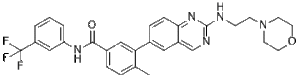
AMG-47a (AMG47a) is a novel, potent inhibitor of Lck and T cell proliferation which exhibits anti-inflammatory activity with ED50 of 11 mg/kg in the anti-CD3 induced production of IL-2 in mice. The Ras family of small GTPases, with KRAS being the most frequently mutated gene in cancer, has a significant unmet therapeutic need because there are currently no efficient targeted therapies available. AMG-47a may facilitate the KRAS oncoprotein's breakdown. While having no effect on EGFP protein in cells, AMG-47a specifically decreased the amounts of EGFP-KRASG12V protein.
Physicochemical Properties
| Molecular Formula | C29H28F3N5O2 |
| Molecular Weight | 535.5601 |
| Exact Mass | 535.219 |
| Elemental Analysis | C, 65.04; H, 5.27; F, 10.64; N, 13.08; O, 5.97 |
| CAS # | 882663-88-9 |
| Related CAS # | 882663-88-9 |
| PubChem CID | 16086114 |
| Appearance | Light yellow to yellow solid powder |
| Density | 1.3±0.1 g/cm3 |
| Index of Refraction | 1.637 |
| LogP | 5.38 |
| Hydrogen Bond Donor Count | 2 |
| Hydrogen Bond Acceptor Count | 9 |
| Rotatable Bond Count | 7 |
| Heavy Atom Count | 39 |
| Complexity | 795 |
| Defined Atom Stereocenter Count | 0 |
| SMILES | O=C(C1C=C(C2C=C3C(N=C(NCCN4CCOCC4)N=C3)=CC=2)C(C)=CC=1)NC1C=C(C(F)(F)F)C=CC=1 |
| InChi Key | DVRSTRMZTAPMKO-UHFFFAOYSA-N |
| InChi Code | InChI=1S/C29H28F3N5O2/c1-19-5-6-21(27(38)35-24-4-2-3-23(17-24)29(30,31)32)16-25(19)20-7-8-26-22(15-20)18-34-28(36-26)33-9-10-37-11-13-39-14-12-37/h2-8,15-18H,9-14H2,1H3,(H,35,38)(H,33,34,36) |
| Chemical Name | 4-methyl-3-[2-(2-morpholin-4-ylethylamino)quinazolin-6-yl]-N-[3-(trifluoromethyl)phenyl]benzamide |
| Synonyms | AMG-47a; AMG47; AMG-47; AMG 47; AMG 47a; AMG47a |
| HS Tariff Code | 2934.99.9001 |
| Storage |
Powder-20°C 3 years 4°C 2 years In solvent -80°C 6 months -20°C 1 month |
| Shipping Condition | Room temperature (This product is stable at ambient temperature for a few days during ordinary shipping and time spent in Customs) |
Biological Activity
| Targets | Lck (IC50 = 0.2 nM); VEGF2 (IC50 = 1 nM); p38α (IC50 = 3 nM); Jak3 (IC50 = 72 nM); MLR (IC50 = 30 nM); IL-2 (IC50 = 21 nM) |
| ln Vitro |
Secondary analysis of hit compounds AMG-47a and Ponatinib Two of the strongest hits were Ponatinib, a pan BCR-ABL kinase inhibitor, and AMG-47a, a potential Lck kinase inhibitor. In the primary screen these compounds decreased EGFP-KRASG12V signal by ∼40% at 1 µM. Concentrations of AMG-47a above 1 uM increased EGFP-KRASG12V signal, possibly because of higher concentrations of this compound lead to more apoptotic cells with higher autofluorescence. We thus decided to move forward with doses of AMG-47a and Ponatinib at near the maximally effective concentrations in validation assays. We first confirmed that these compounds decreased fluorescence signal in the HeLa EGFP-KRASG12V cells by flow cytometry. A 48-hour treatment of cells by AMG-47a and Ponatinib led to a 30–40% decrease in EGFP signal in these cells ; treating cells for 3 and 5 days yielded similar results . To test for the selectivity of these compounds, we generated HeLa cells expressing EGFP from the same inducible vector as controls and used these cells in a counter-screen. We reasoned that the HeLa EGFP cells would be sensitive to compounds that show non-specific inhibitory activities against the doxycycline-inducible promoter, against general RNA transcription and protein translation, or against the fluorescence or stability of EGFP. Using flow cytometry, we observed that Torin-1 indeed decreased the fluorescence signal in the HeLa EGFP cells, likely through its inhibition of general protein translation. On the other hand, Ponatinib and AMG-47a did not affect EGFP levels in these cells . We further assessed the effect of Ponatinib, AMG-47a, and Torin-1 on the fluorescence of HeLa cells expressing EGFP-KRASWT and found that they also decreased EGFP-KRASWT signal . Thus these compounds do not appear to discriminate between mutant and WT KRAS proteins. Lastly, we tested the loss of EGFP-KRASG12V proteins directly by western blot. As a positive control, we transfected a KRAS siRNA into HeLa EGFP-KRASG12V cells and observed a dose-dependent reduction in EGFP-KRASG12V protein levels. Both AMG-47a and Ponatinib had a modest effect on EGFP-KRASG12V protein levels after 3 days. In the primary screen, the loss of EGFP-KRASG12V signal plateaued at ∼50% for AMG-47a and ∼55% for Ponatinib, though we were only able to consistently detect a 20–30% reduction in western blot protein levels. Although this decrease was small, both compounds had no effect on the levels of the control EGFP protein . Together these results support the notion that AMG-47a and Ponatinib selectively affect the levels of EGFP-KRASG12V protein in the cell.[2] |
| References |
[1]. Discovery of aminoquinazolines as potent, orally bioavailable inhibitors of Lck: synthesis, SAR, and in vivo anti-inflammatory activity. J Med Chem. 2006 Sep 21;49(19):5671-86. [2]. A high-throughput assay for small molecule destabilizers of the KRAS oncoprotein. PLoS One. 2014 Aug 5;9(8):e103836. |
Solubility Data
| Solubility (In Vitro) | DMSO: ≥ 34 mg/mL (~63.5 mM) |
| Solubility (In Vivo) |
Note: Listed below are some common formulations that may be used to formulate products with low water solubility (e.g. < 1 mg/mL), you may test these formulations using a minute amount of products to avoid loss of samples. Injection Formulations (e.g. IP/IV/IM/SC) Injection Formulation 1: DMSO : Tween 80: Saline = 10 : 5 : 85 (i.e. 100 μL DMSO stock solution → 50 μL Tween 80 → 850 μL Saline) *Preparation of saline: Dissolve 0.9 g of sodium chloride in 100 mL ddH ₂ O to obtain a clear solution. Injection Formulation 2: DMSO : PEG300 :Tween 80 : Saline = 10 : 40 : 5 : 45 (i.e. 100 μL DMSO → 400 μLPEG300 → 50 μL Tween 80 → 450 μL Saline) Injection Formulation 3: DMSO : Corn oil = 10 : 90 (i.e. 100 μL DMSO → 900 μL Corn oil) Example: Take the Injection Formulation 3 (DMSO : Corn oil = 10 : 90) as an example, if 1 mL of 2.5 mg/mL working solution is to be prepared, you can take 100 μL 25 mg/mL DMSO stock solution and add to 900 μL corn oil, mix well to obtain a clear or suspension solution (2.5 mg/mL, ready for use in animals). Injection Formulation 4: DMSO : 20% SBE-β-CD in saline = 10 : 90 [i.e. 100 μL DMSO → 900 μL (20% SBE-β-CD in saline)] *Preparation of 20% SBE-β-CD in Saline (4°C,1 week): Dissolve 2 g SBE-β-CD in 10 mL saline to obtain a clear solution. Injection Formulation 5: 2-Hydroxypropyl-β-cyclodextrin : Saline = 50 : 50 (i.e. 500 μL 2-Hydroxypropyl-β-cyclodextrin → 500 μL Saline) Injection Formulation 6: DMSO : PEG300 : castor oil : Saline = 5 : 10 : 20 : 65 (i.e. 50 μL DMSO → 100 μLPEG300 → 200 μL castor oil → 650 μL Saline) Injection Formulation 7: Ethanol : Cremophor : Saline = 10: 10 : 80 (i.e. 100 μL Ethanol → 100 μL Cremophor → 800 μL Saline) Injection Formulation 8: Dissolve in Cremophor/Ethanol (50 : 50), then diluted by Saline Injection Formulation 9: EtOH : Corn oil = 10 : 90 (i.e. 100 μL EtOH → 900 μL Corn oil) Injection Formulation 10: EtOH : PEG300:Tween 80 : Saline = 10 : 40 : 5 : 45 (i.e. 100 μL EtOH → 400 μLPEG300 → 50 μL Tween 80 → 450 μL Saline) Oral Formulations Oral Formulation 1: Suspend in 0.5% CMC Na (carboxymethylcellulose sodium) Oral Formulation 2: Suspend in 0.5% Carboxymethyl cellulose Example: Take the Oral Formulation 1 (Suspend in 0.5% CMC Na) as an example, if 100 mL of 2.5 mg/mL working solution is to be prepared, you can first prepare 0.5% CMC Na solution by measuring 0.5 g CMC Na and dissolve it in 100 mL ddH2O to obtain a clear solution; then add 250 mg of the product to 100 mL 0.5% CMC Na solution, to make the suspension solution (2.5 mg/mL, ready for use in animals). Oral Formulation 3: Dissolved in PEG400 Oral Formulation 4: Suspend in 0.2% Carboxymethyl cellulose Oral Formulation 5: Dissolve in 0.25% Tween 80 and 0.5% Carboxymethyl cellulose Oral Formulation 6: Mixing with food powders Note: Please be aware that the above formulations are for reference only. InvivoChem strongly recommends customers to read literature methods/protocols carefully before determining which formulation you should use for in vivo studies, as different compounds have different solubility properties and have to be formulated differently. (Please use freshly prepared in vivo formulations for optimal results.) |
| Preparing Stock Solutions | 1 mg | 5 mg | 10 mg | |
| 1 mM | 1.8672 mL | 9.3360 mL | 18.6720 mL | |
| 5 mM | 0.3734 mL | 1.8672 mL | 3.7344 mL | |
| 10 mM | 0.1867 mL | 0.9336 mL | 1.8672 mL |