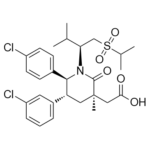
AMG 232 (AMG-232; AMG232) is a novel, potent, selective, orally bioavailable and piperidinone-based inhibitor of MDM2-p53 protein-protein interaction with anticancer activity. It inhibits MDM2-p53 interaction with an IC50 of 0.6 nM. AMG 232 binds to MDM2 with a Kd of 0.045 nM. AMG 232 is currently being evaluated in human clinical trials for the treatment of cancer. p53 is a critical tumor suppressor and is the most frequently inactivated gene in human cancer. Inhibition of the interaction of p53 with its negative regulator MDM2 represents a promising clinical strategy to treat p53 wild-type tumors. AMG 232 is a potential best-in-class inhibitor of the MDM2-p53 interaction and is currently in clinical trials for multiple tumor indications.
Physicochemical Properties
| Molecular Formula | C28H35CL2NO5S |
| Molecular Weight | 568.5522 |
| Exact Mass | 567.161 |
| CAS # | 1352066-68-2 |
| Related CAS # | (3S,5S,6R)-Navtemadlin;2459946-14-4;Navtemadlin-d7 |
| PubChem CID | 58573469 |
| Appearance | White to light yellow solid powder |
| LogP | 7.398 |
| Hydrogen Bond Donor Count | 1 |
| Hydrogen Bond Acceptor Count | 5 |
| Rotatable Bond Count | 9 |
| Heavy Atom Count | 37 |
| Complexity | 912 |
| Defined Atom Stereocenter Count | 4 |
| SMILES | CC(C)[C@@H](CS(=O)(=O)C(C)C)N1[C@@H]([C@H](C[C@](C1=O)(C)CC(=O)O)C2=CC(=CC=C2)Cl)C3=CC=C(C=C3)Cl |
| InChi Key | DRLCSJFKKILATL-YWCVFVGNSA-N |
| InChi Code | InChI=1S/C28H35Cl2NO5S/c1-17(2)24(16-37(35,36)18(3)4)31-26(19-9-11-21(29)12-10-19)23(20-7-6-8-22(30)13-20)14-28(5,27(31)34)15-25(32)33/h6-13,17-18,23-24,26H,14-16H2,1-5H3,(H,32,33)/t23-,24-,26-,28-/m1/s1 |
| Chemical Name | 2-((3R,5R,6S)-5-(3-chlorophenyl)-6-(4-chlorophenyl)-1-((S)-1-(isopropylsulfonyl)-3-methylbutan-2-yl)-3-methyl-2-oxopiperidin-3-yl)acetic acid |
| Synonyms | AMG232; AMG-232; AMG 232. |
| HS Tariff Code | 2934.99.9001 |
| Storage |
Powder-20°C 3 years 4°C 2 years In solvent -80°C 6 months -20°C 1 month Note: This product is not stable in solution, please use freshly prepared working solution for optimal results. |
| Shipping Condition | Room temperature (This product is stable at ambient temperature for a few days during ordinary shipping and time spent in Customs) |
Biological Activity
| ln Vitro | In three p53 wild-type tumor cell lines, navtemadlin (AMG 232) (10 μM) promotes p53 signaling and suppresses tumor cell growth [1]. The growth of non-MDM2-amplified HCT116 colorectal cells is efficiently inhibited by navtemadlin (IC50=10 nM)[3]. |
| ln Vivo | In vitro, navtemadlin (AMG 232) (10, 25, 75 mg/kg, once day, oral) stimulates the p53 pathway [1]. Navtemadlin (10, 25, 75 mg/kg, orally administered once daily) efficiently suppresses the growth of tumor xenografts in mice [1]. Navtemadlin (10, 25, 75 mg/kg, orally administered once daily) causes apoptosis and inhibits DNA synthesis in vivo [1]. With an ED50 of 16 mg/kg, navtemadlin inhibits tumor growth in a dose-dependent manner[2]. |
| Cell Assay |
Cell viability assay[1] Cell Types: SJSA-1, HCT116, ACHN, NCI-H460, MOLM-13, RKO, MCF7, 22RV1, HT-29, PC-3, NCI-H82, NCI-SNU1, MG-63 , NCI-H2452, SW982, C32, SK-HEP-1, A375, RT4, RPMI2650, MDA-MB-134-VI, NCI-H2347 and A427 cells. Tested Concentrations: 0-10μM. Incubation Duration: 72 hrs (hours). Experimental Results: p53 signaling was induced and tumor cell proliferation inhibited in three p53 wild-type tumor cell lines (SJSA-1, HCT116, and ACHN). It resulted in a 9.76- to 34.9-fold enhancement of p21 mRNA induction, with IC50 values ranging from 12.8 to 46.8 nM. |
| Animal Protocol |
Animal/Disease Models: Cancer model based on female athymic nude mice (n=10/group) [1]. Doses: 10, 25, 75 mg/kg. Route of Administration: Take one time/day orally by gavage. Experimental Results: All models Dramatically inhibited tumor growth. SJSA-1 is an MDM2-amplified osteosarcoma model that is most sensitive to AMG 232 treatment, with an ED50 of 9.1 mg/kg. In the highest dose group of 75 mg/kg, 10/10 tumors had completely regressed and were undetectable after 10 days of treatment. |
| References |
[1]. The MDM2 Inhibitor AMG 232 Demonstrates Robust Antitumor Efficacy and Potentiates the Activity of p53-Inducing Cytotoxic Agents. Mol Cancer Ther. 2015 Mar;14(3):649-58. [2]. Discovery of a small molecule MDM2 inhibitor (AMG 232) for treating cancer. J Med Chem. 2014 Aug 14;57(15):6332-41. |
| Additional Infomation |
Navtemadlin (AMG-232) is under investigation in clinical trial NCT03041688 (MDM2 Inhibitor AMG-232 and Decitabine in Treating Patients With Relapsed, Refractory, or Newly-Diagnosed Acute Myeloid Leukemia). Navtemadlin is an orally available inhibitor of MDM2 (murine double minute 2), with potential antineoplastic activity. Upon oral administration,navtemadlin binds to the MDM2 protein and prevents its binding to the transcriptional activation domain of the tumor suppressor protein p53. By preventing this MDM2-p53 interaction, the transcriptional activity of p53 is restored. This leads to p53-mediated induction of tumor cell apoptosis. MDM2, a zinc finger protein and a negative regulator of the p53 pathway, is overexpressed in cancer cells; it plays a key role in cancer cell proliferation and survival. |
Solubility Data
| Solubility (In Vitro) |
DMSO : ≥ 50 mg/mL (~87.94 mM) H2O : ≥ 0.1 mg/mL (~0.18 mM) |
| Solubility (In Vivo) |
Solubility in Formulation 1: ≥ 2.5 mg/mL (4.40 mM) (saturation unknown) in 10% DMSO + 40% PEG300 + 5% Tween80 + 45% Saline (add these co-solvents sequentially from left to right, and one by one), clear solution. For example, if 1 mL of working solution is to be prepared, you can add 100 μL of 25.0 mg/mL clear DMSO stock solution to 400 μL PEG300 and mix evenly; then add 50 μL Tween-80 to the above solution and mix evenly; then add 450 μL normal saline to adjust the volume to 1 mL. Preparation of saline: Dissolve 0.9 g of sodium chloride in 100 mL ddH₂ O to obtain a clear solution. Solubility in Formulation 2: ≥ 2.5 mg/mL (4.40 mM) (saturation unknown) in 10% DMSO + 90% Corn Oil (add these co-solvents sequentially from left to right, and one by one), clear solution. For example, if 1 mL of working solution is to be prepared, you can add 100 μL of 25.0 mg/mL clear DMSO stock solution to 900 μL of corn oil and mix evenly. Solubility in Formulation 3: ≥ 2.5 mg/mL (4.40 mM) (saturation unknown) in 5% DMSO + 40% PEG300 + 5% Tween80 + 50% Saline (add these co-solvents sequentially from left to right, and one by one), clear solution. Preparation of saline: Dissolve 0.9 g of sodium chloride in 100 mL ddH₂ O to obtain a clear solution. Solubility in Formulation 4: 1.5 mg/mL (2.64 mM) in PBS (add these co-solvents sequentially from left to right, and one by one), clear solution; with ultrasonication. Solubility in Formulation 5: 10 mg/mL (17.59 mM) in 50% PEG300 50% Saline (add these co-solvents sequentially from left to right, and one by one), suspension solution; with ultrasonication. Preparation of saline: Dissolve 0.9 g of sodium chloride in 100 mL ddH₂ O to obtain a clear solution. (Please use freshly prepared in vivo formulations for optimal results.) |
| Preparing Stock Solutions | 1 mg | 5 mg | 10 mg | |
| 1 mM | 1.7589 mL | 8.7943 mL | 17.5886 mL | |
| 5 mM | 0.3518 mL | 1.7589 mL | 3.5177 mL | |
| 10 mM | 0.1759 mL | 0.8794 mL | 1.7589 mL |