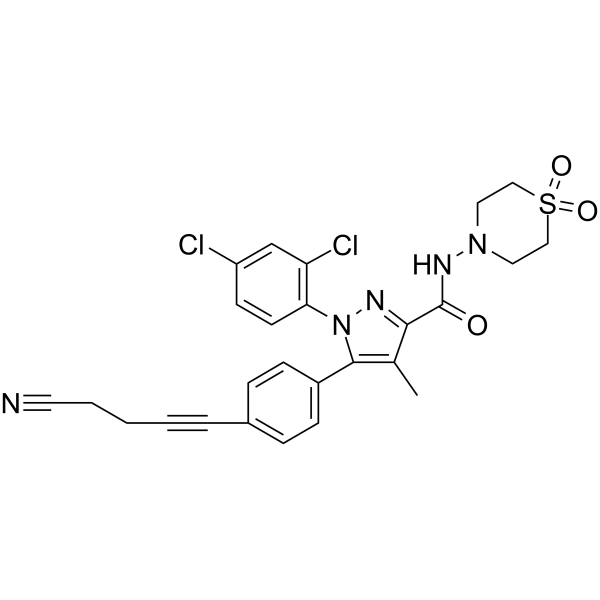
AM6545 is a member of the class of pyrazoles that is 1H-pyrazole substituted by 2,4-dichlorophenyl, N-(1,1-dioxidothiomorpholin-4-yl)aminoacyl, methyl, and 4-(4-cyanobut-1-yn-1-yl)phenyl groups at positions 1, 3, 4 and 5, respectively. It is a cannabinoid receptor 1 antagonist and a potential appetite suppressant. It has a role as a CB1 receptor antagonist, an appetite depressant and an anti-obesity agent. It is a dichlorobenzene, a member of pyrazoles, a member of thiomorpholines, a carbohydrazide, a nitrile, an arylacetylene and a sulfone.
Physicochemical Properties
| Molecular Formula | C26H23CL2N5O3S |
| Molecular Weight | 556.463522195816 |
| Exact Mass | 555.09 |
| CAS # | 1245626-05-4 |
| PubChem CID | 46912919 |
| Appearance | White to off-white solid powder |
| LogP | 5.778 |
| Hydrogen Bond Donor Count | 1 |
| Hydrogen Bond Acceptor Count | 6 |
| Rotatable Bond Count | 6 |
| Heavy Atom Count | 37 |
| Complexity | 1020 |
| Defined Atom Stereocenter Count | 0 |
| SMILES | CC1=C(N(N=C1C(NN2CCS(=O)(CC2)=O)=O)C3=C(Cl)C=C(Cl)C=C3)C4=CC=C(C=C4)C#CCCC#N |
| InChi Key | XBHQLFVDGLPBCK-UHFFFAOYSA-N |
| InChi Code | InChI=1S/C26H23Cl2N5O3S/c1-18-24(26(34)31-32-13-15-37(35,36)16-14-32)30-33(23-11-10-21(27)17-22(23)28)25(18)20-8-6-19(7-9-20)5-3-2-4-12-29/h6-11,17H,2,4,13-16H2,1H3,(H,31,34) |
| Chemical Name | 5-[4-(4-cyanobut-1-ynyl)phenyl]-1-(2,4-dichlorophenyl)-N-(1,1-dioxo-1,4-thiazinan-4-yl)-4-methylpyrazole-3-carboxamide |
| Synonyms | AM6545; AM 6545; AM-6545; CHEMBL3341898; 5-(4-[4-cyanobut-1-ynyl]phenyl)-1-(2,4-dichlorophenyl)-4-methyl-N-(1,1-dioxo-thiomorpholino)-1H-pyrazole-3-carboxamide; 5-[4-(4-Cyanobut-1-yn-1-yl)phenyl]-1-(2,4-dichlorophenyl)-N-(1,1-dioxo-1lambda~6~,4-thiazinan-4-yl)-4-methyl-1H-pyrazole-3-carboxamide; 5-[4-(4-cyanobut-1-ynyl)phenyl]-1-(2,4-dichlorophenyl)-N-(1,1-dioxo-1,4-thiazinan-4-yl)-4-methylpyrazole-3-carboxamide; |
| HS Tariff Code | 2934.99.9001 |
| Storage |
Powder-20°C 3 years 4°C 2 years In solvent -80°C 6 months -20°C 1 month |
| Shipping Condition | Room temperature (This product is stable at ambient temperature for a few days during ordinary shipping and time spent in Customs) |
Biological Activity
| Targets | Cannabinoid receptor/CB receptor |
| ln Vitro | AM6545 binds to CB(1) receptors with a K(i) of 1.7 nM and CB(2) receptors with a K(i) of 523 nM. AM6545 is a neutral antagonist, having no effect on cAMP levels in transfected cells and was less centrally penetrant than AM4113, a comparable CB(1) receptor antagonist[1]. |
| ln Vivo | AM6545 reversed the effects of WIN55212-2 in an assay of colonic motility. In contrast to AM251, AM6545 did not produce conditioned gaping or conditioned taste avoidance in rats. In rats and mice, AM6545 dose-dependently reduced food intake and induced a sustained reduction in body weight. The effect on food intake was maintained in rats with a complete subdiaphragmatic vagotomy. AM6545 inhibited food intake in CB(1) receptor gene-deficient mice, but not in CB(1)/CB(2) receptor double knockout mice[1]. |
| Enzyme Assay |
Cannabinoid receptor binding assay[1] AM6545 was tested for its affinity for the cannabinoid receptors using membrane preparations made from rat brain (CB1) or HEK293 cells expressing either mouse CB2 (mCB2) or human CB2 (hCB2) and [3H]CP-55,940, as previously described (Morse et al., 1995; Lan et al., 1999; McLaughlin et al., 2006)[1]. |
| Cell Assay |
cAMP assay The binding of an inverse agonist to cannabinoid receptors raises levels of intracellular cyclic AMP (cAMP) whereas a neutral antagonist has no effect on cAMP levels (Janero and Makriyannis, 2009). We looked at the effect of AM6545 on forskolin-induced cAMP levels to determine whether it is a neutral antagonist. The effects of an inverse agonist, AM251, were also investigated as a positive control. Intracellular cAMP levels were measured with a competitive binding assay using intact HEK293 cells expressing hCB1 or hCB2 as previously described (McLaughlin et al., 2006). After lysing the cells and centrifugation, a cAMP assay kit (Sigma-Aldrich, St. Louis, MO, USA) was used to determine cAMP released in the resulting supernatant.[1] |
| Animal Protocol |
Brain penetration assay[1] Rats (280–310 g) were killed (sodium pentobarbital, 80–100 mg·kg−1, i.p.) 1, 3 and 5 h after receiving an i.p. injection of vehicle (4% DMSO, 1% Tween 80 in physiological saline; n = 2), AM6545 (10 mg·kg−1; n = 4) or AM4113 (10 mg·kg−1; n = 4). In further experiments, female C57BL/6 mice (18.5–21.0 g) were administered an i.p. injection of vehicle (n = 2) or AM6545 (5 mg·kg−1; n = 4) and were killed 1, 3 and 17 h post-injection. From both rats and mice, blood was collected and centrifuged for plasma, and brains were removed. All samples were flash-frozen in liquid nitrogen and stored at −80°C. Tissues (plasma or brain) were extracted following published procedures (Folch et al., 1957) and analysed in SRM mode after APCI+ ionization using a Thermo-Finnigan Quantum Ultra triple quadrupole mass spectrometer with an Agilent 1100 HPLC front-end. Compounds were eluted from the Phenomenex Gemini C18 column (2 × 50 mm, 5 µ) with a C18 guard column using a gradient elution consisting of 0.1% formic acid in both methanol (A) and water (B). The detection limits in this assay for AM6545 were: rat plasma, 9 ng·mL−1; mouse plasma, 2.6 ng·mL−1 and for AM4113, in rat plasma, 1.5 ng·mL−1. For brain samples, the corresponding lower limits were AM6545 (rat) 7.5 ng·g−1 (mouse) 5.4 ng·g−1 and AM4113 (rat) 5.3 ng·g−1. Colonic propulsion assay[1] Cannabinoid agonists slow GI transit and thus the actions of AM6545 on WIN55212-2-induced slowing of colonic propulsion was used to confirm the functional blockade of peripheral CB1 receptors by AM6545 (Pinto et al., 2002). Male C57BL/6 mice (19–26 g) were lightly anesthetized with isoflurane (4% in air) before a 2.5 mm spherical glass bead was inserted 2 cm intrarectally. The time to the expulsion of the bead was recorded. AM6545 (10 mg·kg−1, n = 5–10 or 20 mg·kg−1, n = 6–7) or vehicle (4% DMSO, 1% Tween 80 in physiological saline, n = 9–18) was injected i.p. 60 min prior to the administration of WIN55212-2 (1 mg·kg−1, n = 7–16), loperamide (1 mg·kg−1, n = 5–9) or vehicle (n = 7–18). Twenty minutes later, colonic propulsion was measured. Doses of WIN55212-2 (Pinto et al., 2002) and loperamide (Yamada and Onoda, 1993) were based on previous work. |
| References |
[1]. A novel peripherally restricted cannabinoid receptor antagonist, AM6545, reduces food intake and body weight, but does not cause malaise, in rodents. Br J Pharmacol. 2010 Oct;161(3):629-42. |
| Additional Infomation | Background and purpose: Cannabinoid CB(1) receptor antagonists reduce food intake and body weight, but clinical use in humans is limited by effects on the CNS. We have evaluated a novel cannabinoid antagonist (AM6545) designed to have limited CNS penetration, to see if it would inhibit food intake in rodents, without aversive effects. Experimental approach: Cannabinoid receptor binding studies, cAMP assays, brain penetration studies and gastrointestinal motility studies were carried out to assess the activity profile of AM6545. The potential for AM6545 to induce malaise in rats and the actions of AM6545 on food intake and body weight were also investigated. Key results: AM6545 binds to CB(1) receptors with a K(i) of 1.7 nM and CB(2) receptors with a K(i) of 523 nM. AM6545 is a neutral antagonist, having no effect on cAMP levels in transfected cells and was less centrally penetrant than AM4113, a comparable CB(1) receptor antagonist. AM6545 reversed the effects of WIN55212-2 in an assay of colonic motility. In contrast to AM251, AM6545 did not produce conditioned gaping or conditioned taste avoidance in rats. In rats and mice, AM6545 dose-dependently reduced food intake and induced a sustained reduction in body weight. The effect on food intake was maintained in rats with a complete subdiaphragmatic vagotomy. AM6545 inhibited food intake in CB(1) receptor gene-deficient mice, but not in CB(1)/CB(2) receptor double knockout mice. Conclusions and implications: Peripherally active, cannabinoid receptor antagonists with limited brain penetration may be useful agents for the treatment of obesity and its complications. [1] |
Solubility Data
| Solubility (In Vitro) | May dissolve in DMSO (in most cases), if not, try other solvents such as H2O, Ethanol, or DMF with a minute amount of products to avoid loss of samples |
| Solubility (In Vivo) |
Note: Listed below are some common formulations that may be used to formulate products with low water solubility (e.g. < 1 mg/mL), you may test these formulations using a minute amount of products to avoid loss of samples. Injection Formulations (e.g. IP/IV/IM/SC) Injection Formulation 1: DMSO : Tween 80: Saline = 10 : 5 : 85 (i.e. 100 μL DMSO stock solution → 50 μL Tween 80 → 850 μL Saline) *Preparation of saline: Dissolve 0.9 g of sodium chloride in 100 mL ddH ₂ O to obtain a clear solution. Injection Formulation 2: DMSO : PEG300 :Tween 80 : Saline = 10 : 40 : 5 : 45 (i.e. 100 μL DMSO → 400 μLPEG300 → 50 μL Tween 80 → 450 μL Saline) Injection Formulation 3: DMSO : Corn oil = 10 : 90 (i.e. 100 μL DMSO → 900 μL Corn oil) Example: Take the Injection Formulation 3 (DMSO : Corn oil = 10 : 90) as an example, if 1 mL of 2.5 mg/mL working solution is to be prepared, you can take 100 μL 25 mg/mL DMSO stock solution and add to 900 μL corn oil, mix well to obtain a clear or suspension solution (2.5 mg/mL, ready for use in animals). Injection Formulation 4: DMSO : 20% SBE-β-CD in saline = 10 : 90 [i.e. 100 μL DMSO → 900 μL (20% SBE-β-CD in saline)] *Preparation of 20% SBE-β-CD in Saline (4°C,1 week): Dissolve 2 g SBE-β-CD in 10 mL saline to obtain a clear solution. Injection Formulation 5: 2-Hydroxypropyl-β-cyclodextrin : Saline = 50 : 50 (i.e. 500 μL 2-Hydroxypropyl-β-cyclodextrin → 500 μL Saline) Injection Formulation 6: DMSO : PEG300 : castor oil : Saline = 5 : 10 : 20 : 65 (i.e. 50 μL DMSO → 100 μLPEG300 → 200 μL castor oil → 650 μL Saline) Injection Formulation 7: Ethanol : Cremophor : Saline = 10: 10 : 80 (i.e. 100 μL Ethanol → 100 μL Cremophor → 800 μL Saline) Injection Formulation 8: Dissolve in Cremophor/Ethanol (50 : 50), then diluted by Saline Injection Formulation 9: EtOH : Corn oil = 10 : 90 (i.e. 100 μL EtOH → 900 μL Corn oil) Injection Formulation 10: EtOH : PEG300:Tween 80 : Saline = 10 : 40 : 5 : 45 (i.e. 100 μL EtOH → 400 μLPEG300 → 50 μL Tween 80 → 450 μL Saline) Oral Formulations Oral Formulation 1: Suspend in 0.5% CMC Na (carboxymethylcellulose sodium) Oral Formulation 2: Suspend in 0.5% Carboxymethyl cellulose Example: Take the Oral Formulation 1 (Suspend in 0.5% CMC Na) as an example, if 100 mL of 2.5 mg/mL working solution is to be prepared, you can first prepare 0.5% CMC Na solution by measuring 0.5 g CMC Na and dissolve it in 100 mL ddH2O to obtain a clear solution; then add 250 mg of the product to 100 mL 0.5% CMC Na solution, to make the suspension solution (2.5 mg/mL, ready for use in animals). Oral Formulation 3: Dissolved in PEG400 Oral Formulation 4: Suspend in 0.2% Carboxymethyl cellulose Oral Formulation 5: Dissolve in 0.25% Tween 80 and 0.5% Carboxymethyl cellulose Oral Formulation 6: Mixing with food powders Note: Please be aware that the above formulations are for reference only. InvivoChem strongly recommends customers to read literature methods/protocols carefully before determining which formulation you should use for in vivo studies, as different compounds have different solubility properties and have to be formulated differently. (Please use freshly prepared in vivo formulations for optimal results.) |
| Preparing Stock Solutions | 1 mg | 5 mg | 10 mg | |
| 1 mM | 1.7971 mL | 8.9854 mL | 17.9707 mL | |
| 5 mM | 0.3594 mL | 1.7971 mL | 3.5941 mL | |
| 10 mM | 0.1797 mL | 0.8985 mL | 1.7971 mL |