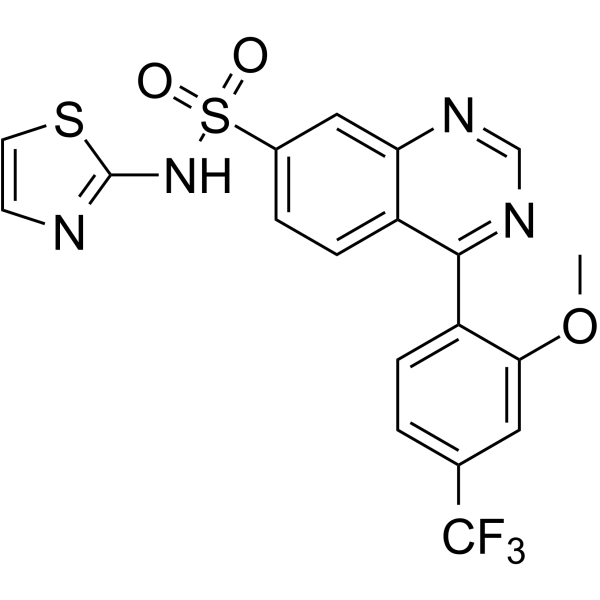
Physicochemical Properties
| Molecular Formula | C19H13F3N4O3S2 |
| Molecular Weight | 466.456731557846 |
| Exact Mass | 466.038 |
| CAS # | 1443373-17-8 |
| PubChem CID | 86687532 |
| Appearance | White to off-white solid powder |
| LogP | 3.9 |
| Hydrogen Bond Donor Count | 1 |
| Hydrogen Bond Acceptor Count | 11 |
| Rotatable Bond Count | 5 |
| Heavy Atom Count | 31 |
| Complexity | 721 |
| Defined Atom Stereocenter Count | 0 |
| SMILES | COC1=CC(C(F)(F)F)=CC=C1C2=NC=NC3=CC(S(=O)(NC4=NC=CS4)=O)=CC=C32 |
| InChi Key | VSUDRCZPHWUXEW-UHFFFAOYSA-N |
| InChi Code | InChI=1S/C19H13F3N4O3S2/c1-29-16-8-11(19(20,21)22)2-4-14(16)17-13-5-3-12(9-15(13)24-10-25-17)31(27,28)26-18-23-6-7-30-18/h2-10H,1H3,(H,23,26) |
| Chemical Name | 4-[2-methoxy-4-(trifluoromethyl)phenyl]-N-(1,3-thiazol-2-yl)quinazoline-7-sulfonamide |
| HS Tariff Code | 2934.99.9001 |
| Storage |
Powder-20°C 3 years 4°C 2 years In solvent -80°C 6 months -20°C 1 month |
| Shipping Condition | Room temperature (This product is stable at ambient temperature for a few days during ordinary shipping and time spent in Customs) |
Biological Activity
| ln Vitro | Similar inhibition of human, mouse, canine, and cynomolgus NaV1.7 was seen in heterologous cells; however, efficacy against rat NaV1.7 was diminished. Compared to Nav1.3, Nav1.4, Nav1.5, and Nav1.8, AM-2099 is about 100 times more selective; nevertheless, Nav1.1, Nav1.2, and Nav1.6 are less selective. AM-2099 does not show more than 50% inhibition against the broad CEREP panel (10 µM) and the 100 kinase panel (1 µM), and it has a low affinity for hERG (>30 µM). [1]. |
| ln Vivo | AM-2099 has excellent pharmacokinetic characteristics in rats and dogs. In rats, AM-2099 demonstrated low overall clearance and intermediate Vdss and half-life. In contrast, AM-2099 showed very poor clearance, low Vdss, and long half-life (18 hours) when administered to dogs. AM-2099 revealed a dosage-dependent increase in plasma exposure and a dose-dependent reduction in scratching times compared to vehicle-treated rats, with a statistically significant reduction found at the 60 mg/kg dose [1 ]. |
| References |
[1]. Sulfonamides as Selective NaV1.7 Inhibitors: Optimizing Potency and Pharmacokinetics to Enable in Vivo Target Engagement. ACS Med Chem Lett. 2016 Sep 21;7(12):1062-1067. |
Solubility Data
| Solubility (In Vitro) | DMSO : ≥ 150 mg/mL (~321.57 mM) |
| Solubility (In Vivo) |
Solubility in Formulation 1: ≥ 2.5 mg/mL (5.36 mM) (saturation unknown) in 10% DMSO + 40% PEG300 + 5% Tween80 + 45% Saline (add these co-solvents sequentially from left to right, and one by one), clear solution. For example, if 1 mL of working solution is to be prepared, you can add 100 μL of 25.0 mg/mL clear DMSO stock solution to 400 μL PEG300 and mix evenly; then add 50 μL Tween-80 to the above solution and mix evenly; then add 450 μL normal saline to adjust the volume to 1 mL. Preparation of saline: Dissolve 0.9 g of sodium chloride in 100 mL ddH₂ O to obtain a clear solution. Solubility in Formulation 2: ≥ 2.5 mg/mL (5.36 mM) (saturation unknown) in 10% DMSO + 90% (20% SBE-β-CD in Saline) (add these co-solvents sequentially from left to right, and one by one), clear solution. For example, if 1 mL of working solution is to be prepared, you can add 100 μL of 25.0 mg/mL clear DMSO stock solution to 900 μL of 20% SBE-β-CD physiological saline solution and mix evenly. Preparation of 20% SBE-β-CD in Saline (4°C,1 week): Dissolve 2 g SBE-β-CD in 10 mL saline to obtain a clear solution. (Please use freshly prepared in vivo formulations for optimal results.) |
| Preparing Stock Solutions | 1 mg | 5 mg | 10 mg | |
| 1 mM | 2.1438 mL | 10.7190 mL | 21.4381 mL | |
| 5 mM | 0.4288 mL | 2.1438 mL | 4.2876 mL | |
| 10 mM | 0.2144 mL | 1.0719 mL | 2.1438 mL |