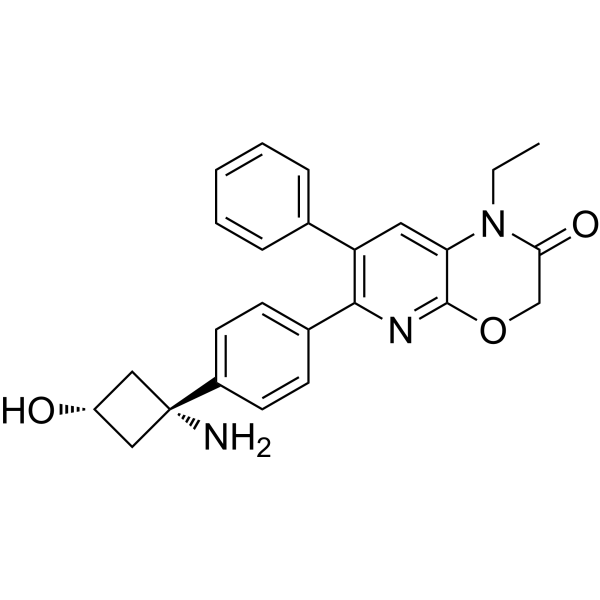
Physicochemical Properties
| Molecular Formula | C25H25N3O3 |
| Molecular Weight | 415.48 |
| Exact Mass | 415.189 |
| CAS # | 1313439-71-2 |
| PubChem CID | 68299673 |
| Appearance | Off-white to light yellow solid powder |
| LogP | 2.6 |
| Hydrogen Bond Donor Count | 2 |
| Hydrogen Bond Acceptor Count | 5 |
| Rotatable Bond Count | 4 |
| Heavy Atom Count | 31 |
| Complexity | 638 |
| Defined Atom Stereocenter Count | 0 |
| SMILES | O1CC(=O)N(CC)C2=CC(C3=CC=CC=C3)=C(C3=CC=C([C@@]4(N)C[C@H](O)C4)C=C3)N=C12 |
| InChi Key | BPHCAPAOSHZYJY-UHFFFAOYSA-N |
| InChi Code | InChI=1S/C25H25N3O3/c1-2-28-21-12-20(16-6-4-3-5-7-16)23(27-24(21)31-15-22(28)30)17-8-10-18(11-9-17)25(26)13-19(29)14-25/h3-12,19,29H,2,13-15,26H2,1H3 |
| Chemical Name | 6-[4-(1-amino-3-hydroxycyclobutyl)phenyl]-1-ethyl-7-phenylpyrido[2,3-b][1,4]oxazin-2-one |
| HS Tariff Code | 2934.99.9001 |
| Storage |
Powder-20°C 3 years 4°C 2 years In solvent -80°C 6 months -20°C 1 month |
| Shipping Condition | Room temperature (This product is stable at ambient temperature for a few days during ordinary shipping and time spent in Customs) |
Biological Activity
| ln Vitro | ALM301 (0.001-10 µM; 72 h) raises the sub-G0 population in a dose-dependent manner, inhibiting the growth of cancer cells, with PI3KCA mutant MCF-7 cells being the most sensitive [1]. With an EC50 value of 0.47 µM, ALM301 (1 µM; 1 hour) suppresses AKT phosphorylation in MCF-7 for as long as 48 hours [1]. |
| ln Vivo | ALM301 (10, 30 and 100 mg/kg; oral; single dosage) suppresses pAKTS473 in cancers and decreases tumor growth [1]. ALM301 (3 or 10 mg/kg; oral; once daily for 49 days) has showed increased tumor suppressive capabilities when paired with tamoxifen [1]. |
| Cell Assay |
Cell proliferation experiment [1] Cell Types: MCF-7, T47D, NCI-H460, HCT116 and other cancer cells Tested Concentrations: 0.001-10 µM Incubation Duration: 72 h Experimental Results: Inhibited cancer cell proliferation, PI3KCA mutant MCF-7 cells were the most sensitive , IC50 is 2.25 µM. Western Blot Analysis[1] Cell Types: MCF-7 Tested Concentrations: 0.001-10 µM Incubation Duration: 1, 4, 24 and 48 hrs (hours) Experimental Results: Inhibition of pAKT and pGSK3β at various concentrations and time points for up to 48 hrs (hours). |
| Animal Protocol |
Animal/Disease Models: balb/c (Bagg ALBino) mouse (carrying A549 xenografts) [1] Doses: 10, 30, and 100 mg/kg Route of Administration: Oral; Single Dose Experimental Results: Dose-dependent increase in total plasma concentrations, resulting in 24 hrs (hrs (hours)) There was almost complete loss of measurable pAKTS473 in tumors at all time points. Tumor growth inhibition (TGI) was 23%, 31% and 41% at doses of 10, 30 and 100 mg/kg, respectively. Animal/Disease Models: balb/c (Bagg ALBino) mouse (carrying PIK3CA mutant MCF-7 xenografts) [1] Doses: 3 or 10 mg/kg Route of Administration: Oral; one time/day for 49 days Experimental Results: vs. tamoxifen When combined with fenfen (5 mg/kg; one time/day), significant tumor regression was seen at 3 mg/kg and 50% at 10 mg/kg, respectively. |
| References |
[1]. Identification and development of a subtype-selective allosteric AKT inhibitor suitable for clinical development. Sci Rep. 2022 Sep 20;12(1):15715. |
| Additional Infomation | VAD-044 is an allosteric AKT inhibitor developed by Vaderis Therapeutics AG. It is being investigated for the treatment of Hereditary Hemorrhagic Telangiectasia. |
Solubility Data
| Solubility (In Vitro) | DMSO : ~50 mg/mL (~120.34 mM) |
| Solubility (In Vivo) |
Solubility in Formulation 1: ≥ 2.5 mg/mL (6.02 mM) (saturation unknown) in 10% DMSO + 40% PEG300 + 5% Tween80 + 45% Saline (add these co-solvents sequentially from left to right, and one by one), clear solution. For example, if 1 mL of working solution is to be prepared, you can add 100 μL of 25.0 mg/mL clear DMSO stock solution to 400 μL PEG300 and mix evenly; then add 50 μL Tween-80 to the above solution and mix evenly; then add 450 μL normal saline to adjust the volume to 1 mL. Preparation of saline: Dissolve 0.9 g of sodium chloride in 100 mL ddH₂ O to obtain a clear solution. Solubility in Formulation 2: ≥ 2.5 mg/mL (6.02 mM) (saturation unknown) in 10% DMSO + 90% Corn Oil (add these co-solvents sequentially from left to right, and one by one), clear solution. For example, if 1 mL of working solution is to be prepared, you can add 100 μL of 25.0 mg/mL clear DMSO stock solution to 900 μL of corn oil and mix evenly. (Please use freshly prepared in vivo formulations for optimal results.) |
| Preparing Stock Solutions | 1 mg | 5 mg | 10 mg | |
| 1 mM | 2.4069 mL | 12.0343 mL | 24.0685 mL | |
| 5 mM | 0.4814 mL | 2.4069 mL | 4.8137 mL | |
| 10 mM | 0.2407 mL | 1.2034 mL | 2.4069 mL |