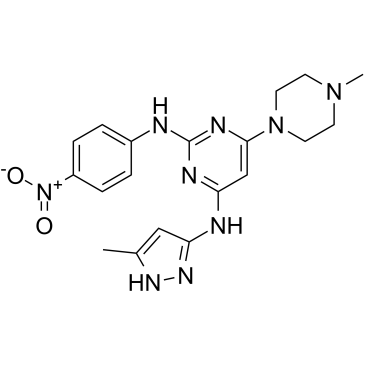
Physicochemical Properties
| Molecular Formula | C19H23N9O2 |
| Molecular Weight | 409.445021867752 |
| Exact Mass | 409.197 |
| Elemental Analysis | C, 55.73; H, 5.66; N, 30.79; O, 7.81 |
| CAS # | 1432515-73-5 |
| Related CAS # | 1432515-73-5 |
| PubChem CID | 72194397 |
| Appearance | White to yellow solid powder |
| LogP | 3.1 |
| Hydrogen Bond Donor Count | 3 |
| Hydrogen Bond Acceptor Count | 9 |
| Rotatable Bond Count | 5 |
| Heavy Atom Count | 30 |
| Complexity | 561 |
| Defined Atom Stereocenter Count | 0 |
| InChi Key | UNKOUVAYOLLXER-UHFFFAOYSA-N |
| InChi Code | InChI=1S/C19H23N9O2/c1-13-11-17(25-24-13)21-16-12-18(27-9-7-26(2)8-10-27)23-19(22-16)20-14-3-5-15(6-4-14)28(29)30/h3-6,11-12H,7-10H2,1-2H3,(H3,20,21,22,23,24,25) |
| Chemical Name | 6-(4-methylpiperazin-1-yl)-4-N-(5-methyl-1H-pyrazol-3-yl)-2-N-(4-nitrophenyl)pyrimidine-2,4-diamine |
| Synonyms | AKI-603; AKI603; AKI 603 |
| HS Tariff Code | 2934.99.9001 |
| Storage |
Powder-20°C 3 years 4°C 2 years In solvent -80°C 6 months -20°C 1 month |
| Shipping Condition | Room temperature (This product is stable at ambient temperature for a few days during ordinary shipping and time spent in Customs) |
Biological Activity
| Targets | Aurora A (IC50 = 12.3 nM) |
| ln Vitro |
AKI603 (0.039-0.6 μM; 48 hours) significantly reduces leukemia cell division[1]. AKI603 (0.039-0.6 μM; 48 hours) has a dose-dependent effect on the phosphorylation of AurA in the NB4, K562, and Jurkat cell lines, but has no effect on the amount of total AurA protein[1]. AKI603 suppresses the growth and colony formation of CML cells resistant to imatinib[1]. AKI603 (0.3-0.6 μM; 48 hours) induces cell cycle arrest with polyploidy accumulation in imatinib-resistant CML cells, inhibiting their ability to proliferate and form colonies[1]. AKI603-induced inhibition of AurA causes leukemia cell senescence in BCR-ABL wild type and T315I mutation cells[1]. AKI603 exhibits inhibitory activities on breast cancer cell proliferation, such as SUM149 (IC50=2.04), BT549 (IC50=0.86), MCF-7 (IC50=0.97), MCF-7-Epi (IC50=21.01), Sk-br-3 (IC50=0.73), MDA-MB-231 (IC50=3.49), MDA-MB-453 (MTT, IC50=0.18; Cell counting, IC50=0.19), MDA-MB-468 (MTT, IC50=0.15; Cell counting, IC50=0.17)[2]. |
| ln Vivo |
AKI603 (12.5–25 mg/kg; intraperitoneally; every 2 days; for 14 days) prevents xenografted KBM5–T315I cells from growing in nude mice.[1] AKI603 shows a moderate oral bioavailability (rat 28.7%) and a Cmax of 202.4 μg/L after oral administration (rat 25 mg/kg)[3]. AKI603 has a terminal elimination half-life of 8.9 hours (rat 2.5 mg/kg) after intravenous administration[3]. |
| Cell Assay |
Cell Line: U937 cells, HL-60 cells, NB4 cells, KBM5 cells, K562 cells, Jurkat cells Concentration: 0.039 μM, 0.078 μM, 0.16 μM, 0.3 μM, 0.6 μM Incubation Time: 48 hours Result: Inhibited all the tested cell lines. |
| Animal Protocol |
Female BALB/c nude mice, with KBM5-T315I cells xenografted[1] 12.5 mg/kg, 25 mg/kg Intraperitoneal injection, every 2 days, for 14 days |
| References |
[1]. Aurora A Kinase Inhibitor AKI603 Induces Cellular Senescence in Chronic Myeloid Leukemia Cells Harboring T315I Mutation. Sci Rep. 2016 Nov 8;6:35533. [2]. A novel small molecule aurora kinase inhibitor attenuates breast tumor-initiating cells and overcomes drug resistance. Mol Cancer Ther. 2014 Aug;13(8):1991-2003. [3]. Determination of a novel Aurora-A (AurA) kinase AKI603 by UPLC-MS/MS and its application to a bioavailability study in rat. J Pharm Biomed Anal. 2016 Jun 5;125:303-9. |
Solubility Data
| Solubility (In Vitro) | DMSO: 82~16.125 mg/mL (200.3~305.3 mM) |
| Solubility (In Vivo) |
Solubility in Formulation 1: 6.25 mg/mL (15.26 mM) in 10% DMSO + 40% PEG300 +5% Tween-80 + 45% Saline (add these co-solvents sequentially from left to right, and one by one), suspension solution; with sonication. For example, if 1 mL of working solution is to be prepared, you can add 100 μL of 62.5 mg/mL clear DMSO stock solution to 400 μL PEG300 and mix evenly; then add 50 μL Tween-80 + to the above solution and mix evenly; then add 450 μL normal saline to adjust the volume to 1 mL. Preparation of saline: Dissolve 0.9 g of sodium chloride in 100 mL ddH₂ O to obtain a clear solution. (Please use freshly prepared in vivo formulations for optimal results.) |
| Preparing Stock Solutions | 1 mg | 5 mg | 10 mg | |
| 1 mM | 2.4423 mL | 12.2115 mL | 24.4230 mL | |
| 5 mM | 0.4885 mL | 2.4423 mL | 4.8846 mL | |
| 10 mM | 0.2442 mL | 1.2212 mL | 2.4423 mL |