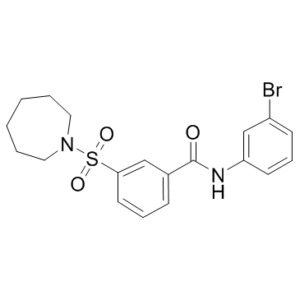
AK-7 (also known as AK7, CS-3223 and GL-8955) is a novel, selective, cell- and brain-permeable SITR2 inhibitor with the potential to be used for the treatment of Parkinson's disease and Huntington's disease (HD). It inihbits SIRT2 with an IC50 of 15.5 μM. AK-7 decreases brain atrophy and improves motor function in Huntington's disease models. Inhibition of sirtuin 2 (SIRT2) deacetylase mediates protective effects in cell and invertebrate models of Parkinson's disease and Huntington's disease (HD). Compound AK-7 treatment resulted in improved motor function, extended survival, and reduced brain atrophy and is associated with marked reduction of aggregated mutant huntingtin, a hallmark of HD pathology. These results provide preclinical validation of SIRT2 inhibition as a potential therapeutic target for HD and support the further development of SIRT2 inhibitors for testing in humans.
Physicochemical Properties
| Molecular Formula | C19H21BRN2O3S | |
| Molecular Weight | 437.35 | |
| Exact Mass | 436.045 | |
| CAS # | 420831-40-9 | |
| Related CAS # |
|
|
| PubChem CID | 1328033 | |
| Appearance | White to off-white solid powder | |
| Density | 1.5±0.1 g/cm3 | |
| Index of Refraction | 1.631 | |
| LogP | 4.93 | |
| Hydrogen Bond Donor Count | 1 | |
| Hydrogen Bond Acceptor Count | 4 | |
| Rotatable Bond Count | 4 | |
| Heavy Atom Count | 26 | |
| Complexity | 570 | |
| Defined Atom Stereocenter Count | 0 | |
| InChi Key | IYAYHZZWYNXHEQ-UHFFFAOYSA-N | |
| InChi Code | InChI=1S/C19H21BrN2O3S/c20-16-8-6-9-17(14-16)21-19(23)15-7-5-10-18(13-15)26(24,25)22-11-3-1-2-4-12-22/h5-10,13-14H,1-4,11-12H2,(H,21,23) | |
| Chemical Name |
|
|
| Synonyms |
|
|
| HS Tariff Code | 2934.99.9001 | |
| Storage |
Powder-20°C 3 years 4°C 2 years In solvent -80°C 6 months -20°C 1 month |
|
| Shipping Condition | Room temperature (This product is stable at ambient temperature for a few days during ordinary shipping and time spent in Customs) |
Biological Activity
| ln Vitro | In both wild-type mouse hippocampus slice cultures and native N2a neuroblastoma cells, AK-7 (10 μM) lowers cholesterol levels. Neuroprotective effects of AK-7 (1 μM) on striatal neurons involved in Huntington's disease (HD) have been reported [1]. In primary midbrain cultures, the fraction of DA neurons is decreased by AK-7 (12.5 μM) [3]. |
| ln Vivo | In both wild-type and HD mice, AK-7 (15 mg/kg/dose, intraperitoneal) penetrates the brain [1]. In R6/2 HD mice, AK-7 (10, 20 mg/kg, intraperitoneally) prolongs survival and improves behavioral and neuropathological characteristics. In R6/2 mice, AK-7 (20 mg/kg) ameliorates HD neuropathology. In R6/2 brains, AK-7 also lessens polyglutamine aggregation. Additionally, the locomotor performance of 140CAG mice treated with AK-7 changed in a way that was comparable to that of untreated wild-type mice [2]. The most effective dose was 20 mg/kg, which also differed considerably from untreated 140CAG mice. |
| References |
[1]. A brain-permeable small molecule reduces neuronal cholesterol by inhibiting activity of sirtuin 2 deacetylase. ACS Chem Biol. 2011 Jun 17;6(6):540-6. [2]. The sirtuin 2 inhibitor AK-7 is neuroprotective in Huntington's disease mouse models. Cell Rep. 2012 Dec 27;2(6):1492-7. [3]. Sirtuin 2 enhances dopaminergic differentiation via the AKT/GSK-3β/β-catenin pathway. Neurobiol Aging. 2017 Aug;56:7-16. |
Solubility Data
| Solubility (In Vitro) |
|
|||
| Solubility (In Vivo) |
Solubility in Formulation 1: ≥ 2.5 mg/mL (5.72 mM) (saturation unknown) in 10% DMSO + 40% PEG300 + 5% Tween80 + 45% Saline (add these co-solvents sequentially from left to right, and one by one), clear solution. For example, if 1 mL of working solution is to be prepared, you can add 100 μL of 25.0 mg/mL clear DMSO stock solution to 400 μL PEG300 and mix evenly; then add 50 μL Tween-80 to the above solution and mix evenly; then add 450 μL normal saline to adjust the volume to 1 mL. Preparation of saline: Dissolve 0.9 g of sodium chloride in 100 mL ddH₂ O to obtain a clear solution. Solubility in Formulation 2: ≥ 2.5 mg/mL (5.72 mM) (saturation unknown) in 10% DMSO + 90% Corn Oil (add these co-solvents sequentially from left to right, and one by one), clear solution. For example, if 1 mL of working solution is to be prepared, you can add 100 μL of 25.0 mg/mL clear DMSO stock solution to 900 μL of corn oil and mix evenly. (Please use freshly prepared in vivo formulations for optimal results.) |
| Preparing Stock Solutions | 1 mg | 5 mg | 10 mg | |
| 1 mM | 2.2865 mL | 11.4325 mL | 22.8650 mL | |
| 5 mM | 0.4573 mL | 2.2865 mL | 4.5730 mL | |
| 10 mM | 0.2286 mL | 1.1432 mL | 2.2865 mL |