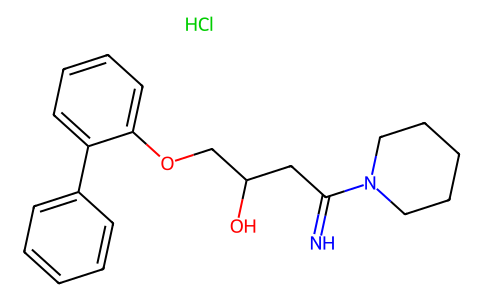
Physicochemical Properties
| Molecular Formula | C21H26N2O2.HCL |
| Molecular Weight | 374.90428 |
| Exact Mass | 374.176 |
| CAS # | 179388-65-9 |
| PubChem CID | 9907616 |
| Appearance | Typically exists as solid at room temperature |
| Boiling Point | 524ºC at 760mmHg |
| Flash Point | 270.7ºC |
| Vapour Pressure | 8.3E-12mmHg at 25°C |
| LogP | 4.786 |
| Hydrogen Bond Donor Count | 3 |
| Hydrogen Bond Acceptor Count | 3 |
| Rotatable Bond Count | 7 |
| Heavy Atom Count | 26 |
| Complexity | 403 |
| Defined Atom Stereocenter Count | 0 |
| SMILES | Cl.OC(CC(N1CCCCC1)=N)COC1=CC=CC=C1C1C=CC=CC=1 |
| InChi Key | WWHGFIXWBLHHQB-UHFFFAOYSA-N |
| InChi Code | InChI=1S/C21H26N2O2.ClH/c22-21(23-13-7-2-8-14-23)15-18(24)16-25-20-12-6-5-11-19(20)17-9-3-1-4-10-17;/h1,3-6,9-12,18,22,24H,2,7-8,13-16H2;1H |
| Chemical Name | 4-imino-1-(2-phenylphenoxy)-4-piperidin-1-ylbutan-2-ol;hydrochloride |
| Synonyms | AH 11110 HYDROCHLORIDE; 179388-65-9; AH 11110; AH 11110A; AH11110A;AH-11110A; 4-imino-1-(2-phenylphenoxy)-4-piperidin-1-ylbutan-2-ol hydrochloride; 1-Piperidinepropanol, alpha-[([1,1'-biphenyl]-2-yloxy)methyl]-gamma-imino-, hydrochloride (1:1); 4-imino-1-(2-phenylphenoxy)-4-piperidin-1-ylbutan-2-ol;hydrochloride; |
| HS Tariff Code | 2934.99.9001 |
| Storage |
Powder-20°C 3 years 4°C 2 years In solvent -80°C 6 months -20°C 1 month |
| Shipping Condition | Room temperature (This product is stable at ambient temperature for a few days during ordinary shipping and time spent in Customs) |
Biological Activity
| Targets | alpha(1B)-adrenoceptor |
| ln Vitro | The potency of the putatively alpha(1B)-adrenoceptor selective drug, 1-[biphenyl-2-yloxy]-4-imino-4-piperidin-1-yl-butan-2-ol (AH 11110A), to antagonize contraction upon stimulation of alpha(1A)-adrenoceptors in rat vas deferens and rat perfused kidney, alpha(1B)-adrenoceptors in guinea-pig spleen, mouse spleen and rabbit aorta, and alpha(1D)-adrenoceptors in rat aorta and pulmonary artery was evaluated and compared to that of a number of subtype-discriminating antagonists. N-[3-[4-(2-Methoxyphenyl)-1-piperazinyl]propyl]-3-methyl-4-oxo-2-phenyl-4H-1-benzopyran-8-carboxamide (Rec 15/2739) and (+/-)-1,3,5-trimethyl-6-[[3-[4-((2,3-dihydro-2-hydroxymethyl)-1,4-benzodioxin-5-yl)-1-piperazinyl]propyl]amino]-2,4(1H,3H)-pyrimidinedione (B8805-033) were confirmed as selective for alpha(1A)-adrenoceptors, 8-[2-[4-(2-methoxyphenyl)-1-piperazinyl]ethyl]-8-azaspiro[4.5]decane-7,9-dione (BMY 7378), 8-[2-(1,4-benzodioxan-2-ylmethylamino)ethyl]-8-azaspiro[4.5]decane-7,9-dione (MDL 73005EF), and cystazosin were found to be selective for alpha(1D)-adrenoceptors, whereas spiperone was weakly selective for alpha(1B)-over alpha(1A)-adrenoceptors. However, from the functional affinity profile obtained for AH 11110A at alpha(1A)-adrenoceptors (pA(2)=6.41 in rat vas deferens), alpha(1B)-adrenoceptors (pA(2)=5.40-6.54) and alpha(1D)-adrenoceptors (pA(2)=5.47-5.48), the affinity and presumed selectivity previously obtained for AH 11110A in radioligand binding studies at native alpha(1B)- and cloned alpha(1b)-adrenoceptors (pK(i)=7.10-7.73) could not be confirmed. Additionally, AH11110A enhanced the general contractility of rat vas deferens, produced a bell-shaped dose-response curve of vasodilation in perfused rat kidney, and its antagonism in most other tissues was not simply competitive. The affinity of AH11110A for prejunctional alpha(2)-adrenoceptors in rabbit vas deferens (pA(2)=5.44) was not much lower than that displayed for alpha(1)-adrenoceptor subtypes, revealing that AH11110A, besides alpha(1)-adrenoceptors, also interacts with alpha(2)-adrenoceptors, and thus may be unsuitable for alpha-adrenoceptor subtype characterization, at least in smooth muscle containing functional studies. [1] |
| References | [1]. Failure of AH11110A to functionally discriminate between alpha(1)-adrenoceptor subtypes A, B and D or between alpha(1)- and alpha(2)-adrenoceptors. Eur J Pharmacol . 2001 Mar;415(2-3):265-76. |
Solubility Data
| Solubility (In Vitro) | May dissolve in DMSO (in most cases), if not, try other solvents such as H2O, Ethanol, or DMF with a minute amount of products to avoid loss of samples |
| Solubility (In Vivo) |
Note: Listed below are some common formulations that may be used to formulate products with low water solubility (e.g. < 1 mg/mL), you may test these formulations using a minute amount of products to avoid loss of samples. Injection Formulations (e.g. IP/IV/IM/SC) Injection Formulation 1: DMSO : Tween 80: Saline = 10 : 5 : 85 (i.e. 100 μL DMSO stock solution → 50 μL Tween 80 → 850 μL Saline) *Preparation of saline: Dissolve 0.9 g of sodium chloride in 100 mL ddH ₂ O to obtain a clear solution. Injection Formulation 2: DMSO : PEG300 :Tween 80 : Saline = 10 : 40 : 5 : 45 (i.e. 100 μL DMSO → 400 μLPEG300 → 50 μL Tween 80 → 450 μL Saline) Injection Formulation 3: DMSO : Corn oil = 10 : 90 (i.e. 100 μL DMSO → 900 μL Corn oil) Example: Take the Injection Formulation 3 (DMSO : Corn oil = 10 : 90) as an example, if 1 mL of 2.5 mg/mL working solution is to be prepared, you can take 100 μL 25 mg/mL DMSO stock solution and add to 900 μL corn oil, mix well to obtain a clear or suspension solution (2.5 mg/mL, ready for use in animals). Injection Formulation 4: DMSO : 20% SBE-β-CD in saline = 10 : 90 [i.e. 100 μL DMSO → 900 μL (20% SBE-β-CD in saline)] *Preparation of 20% SBE-β-CD in Saline (4°C,1 week): Dissolve 2 g SBE-β-CD in 10 mL saline to obtain a clear solution. Injection Formulation 5: 2-Hydroxypropyl-β-cyclodextrin : Saline = 50 : 50 (i.e. 500 μL 2-Hydroxypropyl-β-cyclodextrin → 500 μL Saline) Injection Formulation 6: DMSO : PEG300 : castor oil : Saline = 5 : 10 : 20 : 65 (i.e. 50 μL DMSO → 100 μLPEG300 → 200 μL castor oil → 650 μL Saline) Injection Formulation 7: Ethanol : Cremophor : Saline = 10: 10 : 80 (i.e. 100 μL Ethanol → 100 μL Cremophor → 800 μL Saline) Injection Formulation 8: Dissolve in Cremophor/Ethanol (50 : 50), then diluted by Saline Injection Formulation 9: EtOH : Corn oil = 10 : 90 (i.e. 100 μL EtOH → 900 μL Corn oil) Injection Formulation 10: EtOH : PEG300:Tween 80 : Saline = 10 : 40 : 5 : 45 (i.e. 100 μL EtOH → 400 μLPEG300 → 50 μL Tween 80 → 450 μL Saline) Oral Formulations Oral Formulation 1: Suspend in 0.5% CMC Na (carboxymethylcellulose sodium) Oral Formulation 2: Suspend in 0.5% Carboxymethyl cellulose Example: Take the Oral Formulation 1 (Suspend in 0.5% CMC Na) as an example, if 100 mL of 2.5 mg/mL working solution is to be prepared, you can first prepare 0.5% CMC Na solution by measuring 0.5 g CMC Na and dissolve it in 100 mL ddH2O to obtain a clear solution; then add 250 mg of the product to 100 mL 0.5% CMC Na solution, to make the suspension solution (2.5 mg/mL, ready for use in animals). Oral Formulation 3: Dissolved in PEG400 Oral Formulation 4: Suspend in 0.2% Carboxymethyl cellulose Oral Formulation 5: Dissolve in 0.25% Tween 80 and 0.5% Carboxymethyl cellulose Oral Formulation 6: Mixing with food powders Note: Please be aware that the above formulations are for reference only. InvivoChem strongly recommends customers to read literature methods/protocols carefully before determining which formulation you should use for in vivo studies, as different compounds have different solubility properties and have to be formulated differently. (Please use freshly prepared in vivo formulations for optimal results.) |
| Preparing Stock Solutions | 1 mg | 5 mg | 10 mg | |
| 1 mM | 2.6674 mL | 13.3369 mL | 26.6738 mL | |
| 5 mM | 0.5335 mL | 2.6674 mL | 5.3348 mL | |
| 10 mM | 0.2667 mL | 1.3337 mL | 2.6674 mL |