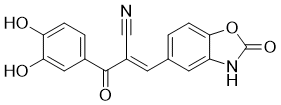
Physicochemical Properties
| Molecular Formula | C17H10N2O5 |
| Molecular Weight | 322.27170419693 |
| Exact Mass | 322.058 |
| CAS # | 638213-98-6 |
| Related CAS # | 638213-98-6; |
| PubChem CID | 9818584 |
| Appearance | Light yellow to yellow solid powder |
| Density | 1.5±0.1 g/cm3 |
| Index of Refraction | 1.728 |
| LogP | 1.72 |
| Hydrogen Bond Donor Count | 3 |
| Hydrogen Bond Acceptor Count | 6 |
| Rotatable Bond Count | 3 |
| Heavy Atom Count | 24 |
| Complexity | 607 |
| Defined Atom Stereocenter Count | 0 |
| SMILES | O1C(NC2C=C(/C=C(\C#N)/C(C3C=CC(=C(C=3)O)O)=O)C=CC1=2)=O |
| InChi Key | IUGRBTCJEYEDIY-VZUCSPMQSA-N |
| InChi Code | InChI=1S/C17H10N2O5/c18-8-11(16(22)10-2-3-13(20)14(21)7-10)5-9-1-4-15-12(6-9)19-17(23)24-15/h1-7,20-21H,(H,19,23)/b11-5+ |
| Chemical Name | (E)-2-(3,4-dihydroxybenzoyl)-3-(2-oxo-3H-1,3-benzoxazol-5-yl)prop-2-enenitrile |
| HS Tariff Code | 2934.99.9001 |
| Storage |
Powder-20°C 3 years 4°C 2 years In solvent -80°C 6 months -20°C 1 month |
| Shipping Condition | Room temperature (This product is stable at ambient temperature for a few days during ordinary shipping and time spent in Customs) |
Biological Activity
| ln Vitro | Insulin therapy for 24 hours after the administration of 5 μM AGL-2263 inhibits IR, and insulin can still phosphorylate ERK1/2 and AKT following IR inhibition [3]. |
| Cell Assay |
Western blot analysis[3] Cell Types: granulosa cells. Tested Concentrations: 5μM. Incubation Duration: 1 hour, followed by 24 hrs (hours) of insulin treatment. Experimental Results: After AGL2263 inhibited IR, insulin still induced the phosphorylation of AKT and ERK1/2. |
| References |
[1]. GDM-associated insulin deficiency hinders the dissociation of SERT from ERp44 and down-regulates placental 5-HT uptake. Proc Natl Acad Sci U S A. 2014 Dec 30;111(52):E5697-705. [2]. Somatic cells initiate primordial follicle activation and govern the development of dormant oocytes in mice. Curr Biol. 2014 Nov 3;24(21):2501-8. [3]. Insulin mitigates apoptosis of porcine follicular granulosa cells by downregulating BimEL. Reprod Biol. 2019 Sep;19(3):293-298. |
Solubility Data
| Solubility (In Vitro) | DMSO : ~100 mg/mL (~310.30 mM) |
| Solubility (In Vivo) |
Solubility in Formulation 1: ≥ 2.08 mg/mL (6.45 mM) (saturation unknown) in 10% DMSO + 40% PEG300 + 5% Tween80 + 45% Saline (add these co-solvents sequentially from left to right, and one by one), clear solution. For example, if 1 mL of working solution is to be prepared, you can add 100 μL of 20.8 mg/mL clear DMSO stock solution to 400 μL PEG300 and mix evenly; then add 50 μL Tween-80 to the above solution and mix evenly; then add 450 μL normal saline to adjust the volume to 1 mL. Preparation of saline: Dissolve 0.9 g of sodium chloride in 100 mL ddH₂ O to obtain a clear solution. Solubility in Formulation 2: ≥ 2.08 mg/mL (6.45 mM) (saturation unknown) in 10% DMSO + 90% (20% SBE-β-CD in Saline) (add these co-solvents sequentially from left to right, and one by one), clear solution. For example, if 1 mL of working solution is to be prepared, you can add 100 μL of 20.8 mg/mL clear DMSO stock solution to 900 μL of 20% SBE-β-CD physiological saline solution and mix evenly. Preparation of 20% SBE-β-CD in Saline (4°C,1 week): Dissolve 2 g SBE-β-CD in 10 mL saline to obtain a clear solution. (Please use freshly prepared in vivo formulations for optimal results.) |
| Preparing Stock Solutions | 1 mg | 5 mg | 10 mg | |
| 1 mM | 3.1030 mL | 15.5149 mL | 31.0299 mL | |
| 5 mM | 0.6206 mL | 3.1030 mL | 6.2060 mL | |
| 10 mM | 0.3103 mL | 1.5515 mL | 3.1030 mL |