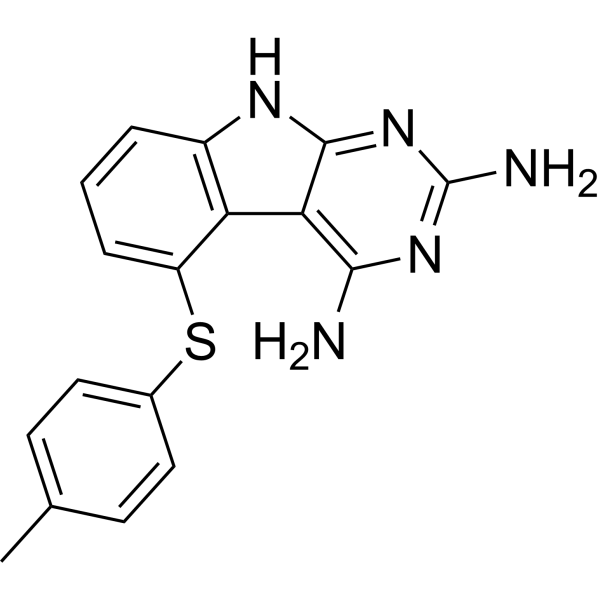
Physicochemical Properties
| Molecular Formula | C17H15N5S |
| Molecular Weight | 321.399501085281 |
| Exact Mass | 321.104 |
| CAS # | 1126602-42-3 |
| PubChem CID | 25218207 |
| Appearance | Typically exists as solid at room temperature |
| LogP | 3.7 |
| Hydrogen Bond Donor Count | 3 |
| Hydrogen Bond Acceptor Count | 5 |
| Rotatable Bond Count | 2 |
| Heavy Atom Count | 23 |
| Complexity | 414 |
| Defined Atom Stereocenter Count | 0 |
| InChi Key | IMNBYLUXBBXZIY-UHFFFAOYSA-N |
| InChi Code | InChI=1S/C17H15N5S/c1-9-5-7-10(8-6-9)23-12-4-2-3-11-13(12)14-15(18)21-17(19)22-16(14)20-11/h2-8H,1H3,(H5,18,19,20,21,22) |
| Chemical Name | 5-(4-methylphenyl)sulfanyl-9H-pyrimido[4,5-b]indole-2,4-diamine |
| HS Tariff Code | 2934.99.9001 |
| Storage |
Powder-20°C 3 years 4°C 2 years In solvent -80°C 6 months -20°C 1 month |
| Shipping Condition | Room temperature (This product is stable at ambient temperature for a few days during ordinary shipping and time spent in Customs) |
Biological Activity
| ln Vitro | In contrast to HUVECs, AG311 (10–40 μM; 0-150 min) interactively promotes breast cancer cell membrane permeability [1]. MDA-MB-435 cells in bone marrow, which lack molecular markers, are sensed by Ag311 (25 μm; 20 min) [1]. In MDA-MB-435 cells, AG311 (25 μM; 20 min) influences calcium and plasma membrane depletion. In MDA-MB-435 cells, AG311 (5–20 μM) quickly causes alterations to the mitochondrial membrane as well as mitochondrial dysfunction [1]. Fluorescence microscopy of cellular mitochondria using AG311 (0-14 μM; 30 h) [1]. |
| ln Vivo | AG311 (23 mM; intratumoral; once daily for 2 days) enhances symmetry in mice [1]. AG311 (45 mg/kg; ip; twice weekly for 30 days) tracks tumor development and lung metastasis [1]. |
| Cell Assay |
Cell viability assay [1] Cell Types: MDA-MB-435, MDA-MB-468, MDA-MB-231, MCF7, PANC-1, A375, U251, SH-SY5Y, A431, B16F10, COLO-205, DU145 , HUVEC and HDF Tested Concentrations: Incubation Duration: 48 hrs (hours) Experimental Results: The IC50 value of MDA-MB-435 (BLBC) is 13.9 μM. In other breast cancer cell lines, IC50 values were similar (MDA-MB-468 and MCF7) or lower (MDA-MB-231) compared to MDAMB-435. HDF was least potent against noncancerous human dermal fibroblasts (IC50 29.3 μM), indicating some degree of selectivity. Cell migration assay[1] Cell Types: 4T1-luc2-GFP TNBC Cell Tested Concentrations: 0, 8, 10, 12, 14 μM Incubation Duration: 30 hrs (hours) Experimental Results: In 4T1-luc2-GFP cells at multiple subtoxic doses Cell migration was Dramatically inhibited. |
| Animal Protocol |
Animal/Disease Models: BALB/cJ mouse, 4T1 triple-negative orthotopic allograft [1] Doses: 23 mM, 1/15 of tumor volume Route of Administration: Intratumoral injection, one time/day for 2 days Experimental Results: Injection The percentage of tumor necrosis was Dramatically higher compared with the control group. Animal/Disease Models: 7weeks old female NCr nu/nu athymic mice, MDA-MB-435 orthotopic xenograft [1] Doses: 45 mg/kg Route of Administration: intraperitoneal (ip) injection, twice a week for 30 days Experimental Results: Primary tumor growth was Dramatically diminished. The animals had fewer lung metastases at the end of the experiment compared to control-treated animals. |
| References |
[1]. A small molecule with anticancer and antimetastatic activities induces rapid mitochondrial-associated necrosis in breast cancer. J Pharmacol Exp Ther. 2015 May;353(2):392-404. |
Solubility Data
| Solubility (In Vitro) | May dissolve in DMSO (in most cases), if not, try other solvents such as H2O, Ethanol, or DMF with a minute amount of products to avoid loss of samples |
| Solubility (In Vivo) |
Note: Listed below are some common formulations that may be used to formulate products with low water solubility (e.g. < 1 mg/mL), you may test these formulations using a minute amount of products to avoid loss of samples. Injection Formulations (e.g. IP/IV/IM/SC) Injection Formulation 1: DMSO : Tween 80: Saline = 10 : 5 : 85 (i.e. 100 μL DMSO stock solution → 50 μL Tween 80 → 850 μL Saline) *Preparation of saline: Dissolve 0.9 g of sodium chloride in 100 mL ddH ₂ O to obtain a clear solution. Injection Formulation 2: DMSO : PEG300 :Tween 80 : Saline = 10 : 40 : 5 : 45 (i.e. 100 μL DMSO → 400 μLPEG300 → 50 μL Tween 80 → 450 μL Saline) Injection Formulation 3: DMSO : Corn oil = 10 : 90 (i.e. 100 μL DMSO → 900 μL Corn oil) Example: Take the Injection Formulation 3 (DMSO : Corn oil = 10 : 90) as an example, if 1 mL of 2.5 mg/mL working solution is to be prepared, you can take 100 μL 25 mg/mL DMSO stock solution and add to 900 μL corn oil, mix well to obtain a clear or suspension solution (2.5 mg/mL, ready for use in animals). Injection Formulation 4: DMSO : 20% SBE-β-CD in saline = 10 : 90 [i.e. 100 μL DMSO → 900 μL (20% SBE-β-CD in saline)] *Preparation of 20% SBE-β-CD in Saline (4°C,1 week): Dissolve 2 g SBE-β-CD in 10 mL saline to obtain a clear solution. Injection Formulation 5: 2-Hydroxypropyl-β-cyclodextrin : Saline = 50 : 50 (i.e. 500 μL 2-Hydroxypropyl-β-cyclodextrin → 500 μL Saline) Injection Formulation 6: DMSO : PEG300 : castor oil : Saline = 5 : 10 : 20 : 65 (i.e. 50 μL DMSO → 100 μLPEG300 → 200 μL castor oil → 650 μL Saline) Injection Formulation 7: Ethanol : Cremophor : Saline = 10: 10 : 80 (i.e. 100 μL Ethanol → 100 μL Cremophor → 800 μL Saline) Injection Formulation 8: Dissolve in Cremophor/Ethanol (50 : 50), then diluted by Saline Injection Formulation 9: EtOH : Corn oil = 10 : 90 (i.e. 100 μL EtOH → 900 μL Corn oil) Injection Formulation 10: EtOH : PEG300:Tween 80 : Saline = 10 : 40 : 5 : 45 (i.e. 100 μL EtOH → 400 μLPEG300 → 50 μL Tween 80 → 450 μL Saline) Oral Formulations Oral Formulation 1: Suspend in 0.5% CMC Na (carboxymethylcellulose sodium) Oral Formulation 2: Suspend in 0.5% Carboxymethyl cellulose Example: Take the Oral Formulation 1 (Suspend in 0.5% CMC Na) as an example, if 100 mL of 2.5 mg/mL working solution is to be prepared, you can first prepare 0.5% CMC Na solution by measuring 0.5 g CMC Na and dissolve it in 100 mL ddH2O to obtain a clear solution; then add 250 mg of the product to 100 mL 0.5% CMC Na solution, to make the suspension solution (2.5 mg/mL, ready for use in animals). Oral Formulation 3: Dissolved in PEG400 Oral Formulation 4: Suspend in 0.2% Carboxymethyl cellulose Oral Formulation 5: Dissolve in 0.25% Tween 80 and 0.5% Carboxymethyl cellulose Oral Formulation 6: Mixing with food powders Note: Please be aware that the above formulations are for reference only. InvivoChem strongly recommends customers to read literature methods/protocols carefully before determining which formulation you should use for in vivo studies, as different compounds have different solubility properties and have to be formulated differently. (Please use freshly prepared in vivo formulations for optimal results.) |
| Preparing Stock Solutions | 1 mg | 5 mg | 10 mg | |
| 1 mM | 3.1114 mL | 15.5569 mL | 31.1139 mL | |
| 5 mM | 0.6223 mL | 3.1114 mL | 6.2228 mL | |
| 10 mM | 0.3111 mL | 1.5557 mL | 3.1114 mL |