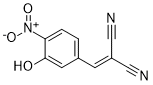
Physicochemical Properties
| Molecular Formula | C₁₀H₅N₃O₃ |
| Molecular Weight | 215.17 |
| Exact Mass | 215.033 |
| Elemental Analysis | C, 55.82; H, 2.34; N, 19.53; O, 22.31 |
| CAS # | 118409-62-4 |
| Related CAS # | 118409-62-4 |
| PubChem CID | 2046 |
| Appearance | Light yellow to yellow solid powder |
| Density | 1.5±0.1 g/cm3 |
| Boiling Point | 381.9±42.0 °C at 760 mmHg |
| Melting Point | 184 °C |
| Flash Point | 184.8±27.9 °C |
| Vapour Pressure | 0.0±0.9 mmHg at 25°C |
| Index of Refraction | 1.689 |
| LogP | 1.66 |
| Hydrogen Bond Donor Count | 1 |
| Hydrogen Bond Acceptor Count | 5 |
| Rotatable Bond Count | 1 |
| Heavy Atom Count | 16 |
| Complexity | 388 |
| Defined Atom Stereocenter Count | 0 |
| SMILES | N#C/C(C#N)=C/C1=CC=C([N+]([O-])=O)C(O)=C1 |
| InChi Key | DUQADSPERJRQBW-UHFFFAOYSA-N |
| InChi Code | InChI=1S/C10H5N3O3/c11-5-8(6-12)3-7-1-2-9(13(15)16)10(14)4-7/h1-4,14H |
| Chemical Name | 2-[(3-hydroxy-4-nitrophenyl)methylidene]propanedinitrile |
| Synonyms | AG 126; AG126; AG-126; UNII-7YA4AMD1JC; Tyrphostin A 10; Tyrphostin AG 126; Tyrphostin A 10; alpha-Cyano-(3-hydroxy-4-nitro)cinnamonitrile |
| HS Tariff Code | 2934.99.9001 |
| Storage |
Powder-20°C 3 years 4°C 2 years In solvent -80°C 6 months -20°C 1 month |
| Shipping Condition | Room temperature (This product is stable at ambient temperature for a few days during ordinary shipping and time spent in Customs) |
Biological Activity
| Targets | ERK1/2 |
| ln Vitro |
AG126 (10 μM; overnight) increases the ARPE-19 cells' viability[2]. AG126 at concentrations greater than 10 μM , they become toxic to ARPE-19 cells and can increase the toxicity of H2O2[2]. AG126 (0.1-100 μM) blocks the growth of BRMECs that is induced by VEGF[4] |
| ln Vivo | AG 126 (intraperitoneal injection; 1-10 mg/kg; 1 h and 6 h after Zymosan treatment) treatment decreases the severity of multiple organ failure (MOF) brought on by Zymosan-induced peritonitis in rats[3]. |
| Animal Protocol |
Male Sprague-Dawley rats treated with Zymosan (500 mg/kg)[3] 10 mg/kg, 3 mg/kg or 1 mg/kg Intraperitoneal injection; 10, 3, or 1 mg/kg; 1 h and 6 h after Zymosan treatment |
| References |
[1]. The tyrosine kinase inhibitor tyrphostin AG126 reduces the development of acute and chronic inflammation. Am J Pathol. 2000 Jul;157(1):145-58. [2]. Oxidative stress causes ERK phosphorylation and cell death in cultured retinal pigment epithelium: prevention of cell death by AG126 and 15-deoxy-delta 12, 14-PGJ2. BMC Ophthalmol. 2003 Mar 21;3:5. [3]. The tyrosine kinase inhibitor tyrphostin AG 126 reduces the multiple organ failure induced by zymosan in the rat. Intensive Care Med. 2002 Jun;28(6):775-88 [4]. Role for extracellular signal-responsive kinase-1 and -2 in retinal angiogenesis. Invest Ophthalmol Vis Sci. 2003 Apr;44(4):1722-31. |
| Additional Infomation |
2-[(3-hydroxy-4-nitrophenyl)methylidene]propanedinitrile is a nitrophenol. Tyrphostin AG 126 is a member of the tyrphostin family of tyrosine kinase inhibitors, that actively blocks lipopolysaccharide-induced production of tumor necrosis factor-a and nitric oxide in macrophages. (NCI) |
Solubility Data
| Solubility (In Vitro) |
DMSO: 43~100 mg/mL (199.9~464.8 mM) Ethanol: ~2 mg/mL (~9.3 mM) |
| Solubility (In Vivo) |
Solubility in Formulation 1: ≥ 2.5 mg/mL (11.62 mM) (saturation unknown) in 10% DMSO + 40% PEG300 +5% Tween-80 + 45% Saline (add these co-solvents sequentially from left to right, and one by one), clear solution. For example, if 1 mL of working solution is to be prepared, you can add 100 μL of 25.0 mg/mL clear DMSO stock solution to 400 μL PEG300 and mix evenly; then add 50 μL Tween-80 + to the above solution and mix evenly; then add 450 μL normal saline to adjust the volume to 1 mL. Preparation of saline: Dissolve 0.9 g of sodium chloride in 100 mL ddH₂ O to obtain a clear solution. (Please use freshly prepared in vivo formulations for optimal results.) |
| Preparing Stock Solutions | 1 mg | 5 mg | 10 mg | |
| 1 mM | 4.6475 mL | 23.2374 mL | 46.4749 mL | |
| 5 mM | 0.9295 mL | 4.6475 mL | 9.2950 mL | |
| 10 mM | 0.4647 mL | 2.3237 mL | 4.6475 mL |