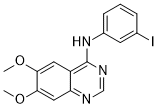
AG-1557 is a novel and potent inhibitor of epidermal growth factor receptor tyrosine (EGFR) kinase. The receptor family of tyrosine kinases includes the EGFR. Receptor tyrosine kinases play a role in the development of blood vessels, invasion, and proliferation of cancer cells. Overexpression of EGFR has been detected in a number of solid tumors in humans. As a result, EGFR has drawn a lot of interest as an anticancer drug target.
Physicochemical Properties
| Molecular Formula | C16H14IN3O2 | |
| Molecular Weight | 407.21 | |
| Exact Mass | 407.013 | |
| Elemental Analysis | C, 47.19; H, 3.47; I, 31.16; N, 10.32; O, 7.86 | |
| CAS # | 189290-58-2 | |
| Related CAS # |
|
|
| PubChem CID | 5328201 | |
| Appearance | Off-white to gray solid powder | |
| Density | 1.7±0.1 g/cm3 | |
| Boiling Point | 492.9±45.0 °C at 760 mmHg | |
| Flash Point | 251.9±28.7 °C | |
| Vapour Pressure | 0.0±1.3 mmHg at 25°C | |
| Index of Refraction | 1.708 | |
| LogP | 4.34 | |
| Hydrogen Bond Donor Count | 1 | |
| Hydrogen Bond Acceptor Count | 5 | |
| Rotatable Bond Count | 4 | |
| Heavy Atom Count | 22 | |
| Complexity | 360 | |
| Defined Atom Stereocenter Count | 0 | |
| SMILES | COC1=C(C=C2C(=C1)C(=NC=N2)NC3=CC=CC(=C3)I)OC |
|
| InChi Key | FGCLAQLIXMAIHT-UHFFFAOYSA-N | |
| InChi Code | InChI=1S/C16H14IN3O2/c1-21-14-7-12-13(8-15(14)22-2)18-9-19-16(12)20-11-5-3-4-10(17)6-11/h3-9H,1-2H3,(H,18,19,20) | |
| Chemical Name | N-(3-iodophenyl)-6,7-dimethoxyquinazolin-4-amine | |
| Synonyms |
|
|
| HS Tariff Code | 2934.99.9001 | |
| Storage |
Powder-20°C 3 years 4°C 2 years In solvent -80°C 6 months -20°C 1 month |
|
| Shipping Condition | Room temperature (This product is stable at ambient temperature for a few days during ordinary shipping and time spent in Customs) |
Biological Activity
| Targets | EGFR (pIC = 8.194) |
| ADME/Pharmacokinetics |
In the described HPLC assay for AG1478, AG-1557 demonstrated high and consistent recovery (>86%) from mouse plasma after a protein precipitation extraction process using cold acetonitrile containing 50 µM of the internal standard. The relative standard deviation (RSD) for the recovery of AG-1557 across multiple samples was 4.3%.[2] A stock solution of AG-1557 in dimethylsulfoxide (DMSO) at 10 mM concentration was found to be stable when stored at -70°C for at least 3 months. Following dilution (1:200) in an acetonitrile-water solution, injections showed consistent peak areas with an inter-assay relative standard deviation (RSD) of less than 9% over a 3-month period.[2] When a 50 µM aqueous solution of AG-1557 (in acetonitrile-water) was repeatedly injected into the HPLC system over a period of 32 hours (more than 40 injections), the peak areas remained consistent with no evidence of carryover between injections, indicating stability in the autosampler under the assay conditions.[2] |
| References |
[1]. Identification of Potential Novel EGFR Inhibitors using a Combination of Pharmacophore and Docking Methods. International Journal of Pharmacy and Pharmaceutical Sciences, ISSN- 0975-1491 Vol 7, Issue 6, 2015 [2]. High-performance liquid chromatographic analysis of the tyrphostin AG1478, a specific inhibitor of the epidermal growth factor receptor tyrosine kinase, in mouse plasma. J Chromatogr B Biomed Sci Appl. 2001 Apr 15;754(1):193-9. |
| Additional Infomation |
AG-1557 (4-(3-iodoanilino)-6,7-dimethoxyquinazoline) was used as the internal standard in a high-performance liquid chromatographic (HPLC) method developed for the analysis of the typhostin AG1478 in mouse plasma.[2] AG-1557 was selected as the internal standard because it is a quinazoline analogue with a structure similar to the analyte (AG1478), it elutes after the analyte under the described chromatographic conditions, it has similar extraction characteristics, and it showed excellent stability in the autosampler over the duration of an assay run.[2] The described chromatographic method utilized a reversed-phase C8 column with a gradient elution of acetonitrile in ammonium acetate buffer. Under these conditions, AG-1557 eluted as a single symmetrical peak with a retention time of 32.5 minutes, which was after the retention time of AG1478 (31.4 minutes).[2] |
Solubility Data
| Solubility (In Vitro) |
|
|||
| Solubility (In Vivo) |
Solubility in Formulation 1: ≥ 2.08 mg/mL (5.11 mM) (saturation unknown) in 10% DMSO + 40% PEG300 + 5% Tween80 + 45% Saline (add these co-solvents sequentially from left to right, and one by one), clear solution. For example, if 1 mL of working solution is to be prepared, you can add 100 μL of 20.8 mg/mL clear DMSO stock solution to 400 μL PEG300 and mix evenly; then add 50 μL Tween-80 to the above solution and mix evenly; then add 450 μL normal saline to adjust the volume to 1 mL. Preparation of saline: Dissolve 0.9 g of sodium chloride in 100 mL ddH₂ O to obtain a clear solution. Solubility in Formulation 2: ≥ 2.08 mg/mL (5.11 mM) (saturation unknown) in 10% DMSO + 90% (20% SBE-β-CD in Saline) (add these co-solvents sequentially from left to right, and one by one), clear solution. For example, if 1 mL of working solution is to be prepared, you can add 100 μL of 20.8 mg/mL clear DMSO stock solution to 900 μL of 20% SBE-β-CD physiological saline solution and mix evenly. Preparation of 20% SBE-β-CD in Saline (4°C,1 week): Dissolve 2 g SBE-β-CD in 10 mL saline to obtain a clear solution. Solubility in Formulation 3: ≥ 2.08 mg/mL (5.11 mM) (saturation unknown) in 10% DMSO + 90% Corn Oil (add these co-solvents sequentially from left to right, and one by one), clear solution. For example, if 1 mL of working solution is to be prepared, you can add 100 μL of 20.8 mg/mL clear DMSO stock solution to 900 μL of corn oil and mix evenly. (Please use freshly prepared in vivo formulations for optimal results.) |
| Preparing Stock Solutions | 1 mg | 5 mg | 10 mg | |
| 1 mM | 2.4557 mL | 12.2787 mL | 24.5574 mL | |
| 5 mM | 0.4911 mL | 2.4557 mL | 4.9115 mL | |
| 10 mM | 0.2456 mL | 1.2279 mL | 2.4557 mL |