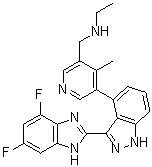
AG-024322 (AG024322) is a novel, potent and ATP-competitive pan-CDK inhibitor with anticancer effects. It is effective against cell cycle kinases CDK1, CDK2, and CDK4 with Ki values in the 1-3 nM range. AG-024322 displays broad-spectrum anti-tumor activity and induces cell apoptosis.
Physicochemical Properties
| Molecular Formula | C23H20F2N6 |
| Molecular Weight | 418.44191 |
| Exact Mass | 418.172 |
| CAS # | 837364-57-5 |
| PubChem CID | 135413565 |
| Appearance | White to off-white solid powder |
| LogP | 1.816 |
| Hydrogen Bond Donor Count | 3 |
| Hydrogen Bond Acceptor Count | 6 |
| Rotatable Bond Count | 5 |
| Heavy Atom Count | 31 |
| Complexity | 611 |
| Defined Atom Stereocenter Count | 0 |
| InChi Key | MEKASOQEXYKAKM-UHFFFAOYSA-N |
| InChi Code | InChI=1S/C23H20F2N6/c1-3-26-9-14-10-27-11-17(12(14)2)13-4-5-19-16(6-13)21(31-30-19)23-28-20-8-15(24)7-18(25)22(20)29-23/h4-8,10-11,26H,3,9H2,1-2H3,(H,28,29)(H,30,31) |
| Chemical Name | N-[[5-[3-(4,6-difluoro-1H-benzimidazol-2-yl)-1H-indazol-5-yl]-4-methylpyridin-3-yl]methyl]ethanamine |
| Synonyms | AG024322 AG 024322 AG-24322 |
| HS Tariff Code | 2934.99.9001 |
| Storage |
Powder-20°C 3 years 4°C 2 years In solvent -80°C 6 months -20°C 1 month |
| Shipping Condition | Room temperature (This product is stable at ambient temperature for a few days during ordinary shipping and time spent in Customs) |
Biological Activity
| Targets |
|
|
| ln Vitro | At concentrations below 3 μM, AG-024322 (0.1-30 μM; 24 hours) is less hazardous. The ATP concentration of human PBMC is used to determine their vitality, and the TC50 value of these cells is 1.4 μM [2]. On HCT-116 cells, AG-024322 (0-120 nM) inhibits cell proliferation. With an IC50 of 120 nM in functional cellular tests, it is marginally less powerful [2]. | |
| ln Vivo | AG-024322 (IV; 2, 6, and 10 mg/kg; 5 days) had a mean plasma AUC (0-24.5) of 2.11 gh/mL and no side effects at 2 mg/kg. produces lymphocyte depletion and whole-blood bone marrow cytopenia at 6 mg/kg. Additionally, at 10 mg/kg, tubular degeneration was caused by vascular injury at the injection site [1]. Established human tumor xenografts are inhibited in growth by AG-024322 (20 mg/kg) by 32% to 86.4% tumor growth inhibition (TGI). It also demonstrates anticancer effects that are dose-dependent [3]. The MV522 tumor model showed 65% TGI caused by AG-024322 (20 mg/kg). At half the maximum tolerable dosage (MTD), it produced 52% TGI, and at 1/4 of the MTD, it just slightly exhibited antitumor activity [3]. | |
| Animal Protocol |
Animal/Disease Models: Male and female cynomolgus monkeys[1] Doses: 2, 6, and 10 mg/kg (Toxicity analysis) Route of Administration: intravenous (iv) infusion; 5 days Experimental Results: Resulted in dose-dependent pancytic bone marrow hypocellularity and lymphoid depletion in lymph nodes , spleen, and/or thymus at >6 mg/kg. |
|
| References |
[1]. Toxicity and toxicokinetics of the cyclin-dependent kinase inhibitor AG-024322 in cynomolgus monkeys following intravenous infusion.Cancer Chemother Pharmacol. 2008 Nov;62(6):1091-101. [2]. Peripheral white blood cell toxicity induced by broad spectrum cyclin-dependent kinase inhibitors.J Appl Toxicol. 2007 Mar-Apr;27(2):133-42. [3]. AG-024322 is a multi-targeted CDK inhibitor with potent antitumor activity in vivo. Cellular and Molecular Biology 53: Cell Cycle Control and Cancer 1. |
|
| Additional Infomation |
AG-024322 has been used in trials studying the treatment of Neoplasms and Lymphoma, Non-Hodgkin. CDK1/2/4 Inhibitor AG-024322 is a cyclin-dependent kinase (CDK) inhibitor with antineoplastic activity. AG-024322 selectively inhibits cyclin-dependent kinases (particularly CDK1,2 and 4), enzymes that regulate cell cycle progression. Inhibition of CDK may result in cell cycle arrest, induction of apoptosis, and inhibition of DNA replication and tumor cell proliferation. |
Solubility Data
| Solubility (In Vitro) | DMSO : ~100 mg/mL (~238.98 mM) |
| Solubility (In Vivo) |
Solubility in Formulation 1: ≥ 2.5 mg/mL (5.97 mM) (saturation unknown) in 10% DMSO + 40% PEG300 + 5% Tween80 + 45% Saline (add these co-solvents sequentially from left to right, and one by one), clear solution. For example, if 1 mL of working solution is to be prepared, you can add 100 μL of 25.0 mg/mL clear DMSO stock solution to 400 μL PEG300 and mix evenly; then add 50 μL Tween-80 to the above solution and mix evenly; then add 450 μL normal saline to adjust the volume to 1 mL. Preparation of saline: Dissolve 0.9 g of sodium chloride in 100 mL ddH₂ O to obtain a clear solution. Solubility in Formulation 2: ≥ 2.5 mg/mL (5.97 mM) (saturation unknown) in 10% DMSO + 90% Corn Oil (add these co-solvents sequentially from left to right, and one by one), clear solution. For example, if 1 mL of working solution is to be prepared, you can add 100 μL of 25.0 mg/mL clear DMSO stock solution to 900 μL of corn oil and mix evenly. (Please use freshly prepared in vivo formulations for optimal results.) |
| Preparing Stock Solutions | 1 mg | 5 mg | 10 mg | |
| 1 mM | 2.3898 mL | 11.9491 mL | 23.8983 mL | |
| 5 mM | 0.4780 mL | 2.3898 mL | 4.7797 mL | |
| 10 mM | 0.2390 mL | 1.1949 mL | 2.3898 mL |