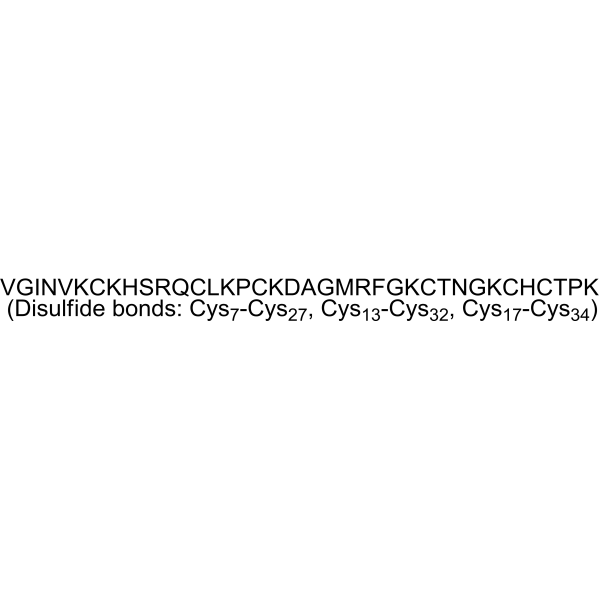
Physicochemical Properties
| Molecular Formula | C169H281N57O46S7 |
| Appearance | Typically exists as solid at room temperature |
| HS Tariff Code | 2934.99.9001 |
| Storage |
Powder-20°C 3 years 4°C 2 years In solvent -80°C 6 months -20°C 1 month |
| Shipping Condition | Room temperature (This product is stable at ambient temperature for a few days during ordinary shipping and time spent in Customs) |
Biological Activity
| Targets | Kv1.3 1.89 pM (IC50) Kv1.1 0.65 nM (IC50) |
| ln Vitro | ADWX 1 (1, 10 nM, 1 h) suppresses human CD4+ CCR7-TEM cell activation only while lowering IL-2 and IFN-γ levels [2]. ADWX 1 (1, 10 nM, 50 min) lowers the levels of [Ca2+] in CD4+ CCR7- TCM cells that are activated and generated from EAE rats [2]. ADWX 1 (1, 10 nM, 1 h) specifically lowers Kv1.3 gene and protein levels and inhibits the activation of NF-κB in myelin basic protein (MBP)-activated CD4+ CCR7- T cells from EAE rats [2]. In CD4+ CCR7- T cells, ADWX 1 (1, 10 nM, 3 days) suppresses Th17 activation but not differentiation [2]. |
| ln Vivo | ADWX 1 (100 μg/kg/day, SC, 3 days) suppresses the production of IL-2 and IFN-γ in addition to inhibiting CCR7-TEM in the experimental autoimmune encephalomyelitis (EAE) model of Sprague-Dawley rats. The illness is improved by cell proliferation [2]. In rats, ADWX 1 (5/10 mg/kg, oral, 2 weeks) did not cause alterations in behavior or tissue pathology (acute toxicity experiment) [2]. |
| Cell Assay |
RT-PCR[2] Cell Types: CD4+ CCR7- T cells from EAE rats Tested Concentrations: 1, 10 nM Incubation Duration: 1 h Experimental Results: Suppressed Kv1.3 gene mRNA expression preferentially. Western Blot Analysis[2] Cell Types: CD4+ CCR7 - T cells from EAE rats Tested Concentrations: 1, 10 nM Incubation Duration: 1 h Experimental Results: Suppressed Kv1.3 protein expression preferentially. |
| Animal Protocol |
Animal/Disease Models: Stable symptoms of acute experimental autoimmune encephalomyelitis (EAE) were induced by immunizing SD (Sprague-Dawley) rats[2]. Doses: 100 μg/kg/day, 3 days Route of Administration: subcutaneous (sc) injection Experimental Results: decreased neurological scores compared with vehicle-treated rats on days 10, 11, 12, 13 and 14. decreased in inflammatory infiltrates and demyelination in the affected spinal cord Dramatically. Inhibited IL-2 and IFN-γ productions. Inhibited the T cell proliferation triggered by high and low concentrations of myelin antigen in a dose-dependent manner. diminished CD4+ CCR7- TEM cells. |
| References |
[1]. Structural basis of a potent peptide inhibitor designed for Kv1.3 channel, a therapeutic target of autoimmune disease. J Biol Chem. 2008 Jul 4;283(27):19058-65. [2]. Selective inhibition of CCR7(-) effector memory T cell activation by a novel peptide targeting Kv1.3 channel in a rat experimental autoimmune encephalomyelitis model. J Biol Chem. 2012 Aug 24;287(35):29479-94. |
Solubility Data
| Solubility (In Vitro) | May dissolve in DMSO (in most cases), if not, try other solvents such as H2O, Ethanol, or DMF with a minute amount of products to avoid loss of samples |
| Solubility (In Vivo) |
Note: Listed below are some common formulations that may be used to formulate products with low water solubility (e.g. < 1 mg/mL), you may test these formulations using a minute amount of products to avoid loss of samples. Injection Formulations (e.g. IP/IV/IM/SC) Injection Formulation 1: DMSO : Tween 80: Saline = 10 : 5 : 85 (i.e. 100 μL DMSO stock solution → 50 μL Tween 80 → 850 μL Saline) *Preparation of saline: Dissolve 0.9 g of sodium chloride in 100 mL ddH ₂ O to obtain a clear solution. Injection Formulation 2: DMSO : PEG300 :Tween 80 : Saline = 10 : 40 : 5 : 45 (i.e. 100 μL DMSO → 400 μLPEG300 → 50 μL Tween 80 → 450 μL Saline) Injection Formulation 3: DMSO : Corn oil = 10 : 90 (i.e. 100 μL DMSO → 900 μL Corn oil) Example: Take the Injection Formulation 3 (DMSO : Corn oil = 10 : 90) as an example, if 1 mL of 2.5 mg/mL working solution is to be prepared, you can take 100 μL 25 mg/mL DMSO stock solution and add to 900 μL corn oil, mix well to obtain a clear or suspension solution (2.5 mg/mL, ready for use in animals). Injection Formulation 4: DMSO : 20% SBE-β-CD in saline = 10 : 90 [i.e. 100 μL DMSO → 900 μL (20% SBE-β-CD in saline)] *Preparation of 20% SBE-β-CD in Saline (4°C,1 week): Dissolve 2 g SBE-β-CD in 10 mL saline to obtain a clear solution. Injection Formulation 5: 2-Hydroxypropyl-β-cyclodextrin : Saline = 50 : 50 (i.e. 500 μL 2-Hydroxypropyl-β-cyclodextrin → 500 μL Saline) Injection Formulation 6: DMSO : PEG300 : castor oil : Saline = 5 : 10 : 20 : 65 (i.e. 50 μL DMSO → 100 μLPEG300 → 200 μL castor oil → 650 μL Saline) Injection Formulation 7: Ethanol : Cremophor : Saline = 10: 10 : 80 (i.e. 100 μL Ethanol → 100 μL Cremophor → 800 μL Saline) Injection Formulation 8: Dissolve in Cremophor/Ethanol (50 : 50), then diluted by Saline Injection Formulation 9: EtOH : Corn oil = 10 : 90 (i.e. 100 μL EtOH → 900 μL Corn oil) Injection Formulation 10: EtOH : PEG300:Tween 80 : Saline = 10 : 40 : 5 : 45 (i.e. 100 μL EtOH → 400 μLPEG300 → 50 μL Tween 80 → 450 μL Saline) Oral Formulations Oral Formulation 1: Suspend in 0.5% CMC Na (carboxymethylcellulose sodium) Oral Formulation 2: Suspend in 0.5% Carboxymethyl cellulose Example: Take the Oral Formulation 1 (Suspend in 0.5% CMC Na) as an example, if 100 mL of 2.5 mg/mL working solution is to be prepared, you can first prepare 0.5% CMC Na solution by measuring 0.5 g CMC Na and dissolve it in 100 mL ddH2O to obtain a clear solution; then add 250 mg of the product to 100 mL 0.5% CMC Na solution, to make the suspension solution (2.5 mg/mL, ready for use in animals). Oral Formulation 3: Dissolved in PEG400 Oral Formulation 4: Suspend in 0.2% Carboxymethyl cellulose Oral Formulation 5: Dissolve in 0.25% Tween 80 and 0.5% Carboxymethyl cellulose Oral Formulation 6: Mixing with food powders Note: Please be aware that the above formulations are for reference only. InvivoChem strongly recommends customers to read literature methods/protocols carefully before determining which formulation you should use for in vivo studies, as different compounds have different solubility properties and have to be formulated differently. (Please use freshly prepared in vivo formulations for optimal results.) |