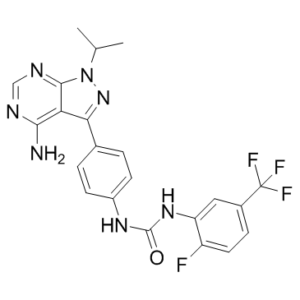
Ad80 is a novel multikinase inhibitor that exhibits potent activity against human RET, BRAF, S6K, and SRC but exhibits much lower activity against mTOR compared to AD57 or AD58. A Ret-kinase-driven Drosophila model of multiple endocrine neoplasia type 2 was used to identify AD57, and kinome-wide drug profiling revealed that AD57 rescues oncogenic Ret-induced lethality while related Ret inhibitors resulted in diminished efficacy and increased toxicity. RET's IC50 value is 4 nM. Human kinase profiles in vitro show that AD80 and AD81 significantly lower mTOR activity than AD57 and AD58 while still inhibiting RET, RAF, SRC, and S6K. In culture, AD80 prevents the growth of MZ-CRC-1 and TT thyroid cancer cells, most likely by inducing apoptosis.
Physicochemical Properties
| Molecular Formula | C22H19F4N7O | |
| Molecular Weight | 473.4262 | |
| Exact Mass | 473.16 | |
| Elemental Analysis | C, 55.81; H, 4.05; F, 16.05; N, 20.71; O, 3.38 | |
| CAS # | 1384071-99-1 | |
| Related CAS # |
|
|
| PubChem CID | 71578106 | |
| Appearance | White to off-white solid powder | |
| LogP | 3.7 | |
| Hydrogen Bond Donor Count | 3 | |
| Hydrogen Bond Acceptor Count | 9 | |
| Rotatable Bond Count | 4 | |
| Heavy Atom Count | 34 | |
| Complexity | 703 | |
| Defined Atom Stereocenter Count | 0 | |
| InChi Key | CYORWDWRQMVGHN-UHFFFAOYSA-N | |
| InChi Code | InChI=1S/C22H19F4N7O/c1-11(2)33-20-17(19(27)28-10-29-20)18(32-33)12-3-6-14(7-4-12)30-21(34)31-16-9-13(22(24,25)26)5-8-15(16)23/h3-11H,1-2H3,(H2,27,28,29)(H2,30,31,34) | |
| Chemical Name | 1-[4-(4-amino-1-propan-2-ylpyrazolo[3,4-d]pyrimidin-3-yl)phenyl]-3-[2-fluoro-5-(trifluoromethyl)phenyl]urea | |
| Synonyms |
|
|
| HS Tariff Code | 2934.99.03.00 | |
| Storage |
Powder-20°C 3 years 4°C 2 years In solvent -80°C 6 months -20°C 1 month |
|
| Shipping Condition | Room temperature (This product is stable at ambient temperature for a few days during ordinary shipping and time spent in Customs) |
Biological Activity
| Targets |
RET V804M (IC50 = 0.4 nM); RET V804L (IC50 = 0.6 nM); Raf; Src; S6 Kinase
Ribosomal Protein S6 Kinase 1 (S6K1) (IC50 = 4 nM for human recombinant S6K1 kinase; Ki = 2 nM; >100-fold selectivity over S6K2, mTOR, AKT, and 30+ other kinases) [1][2] |
| ln Vitro |
AD80 is a polypharmacological agent that exhibits high efficacy and very low toxicity when used against Ret, Raf, Src, Tor, and S6K. In comparison to AD57 and AD58, AD80 and AD81 significantly reduced mTOR activity and inhibited RET, RAF, SRC, and S6K. For inhibiting the Ras-Erk pathway, AD80 works best. MZ-CRC-1 and TT thyroid cancer cells' ability to proliferate in culture is inhibited by AD80, likely due to the induction of apoptosis. An immunoblot analysis shows that these cells have a significant downregulation of phosphorylated Ret and several downstream biomarkers[1]. Along with AXL, a member of the TAM family of tyrosine kinases, AD80 cooperatively inhibits S6K1. A durable suppression of S6K1-induced signaling and protein synthesis is achieved by AD80's avoidance of S6K1 phosphorylation and mTOR co-association[2]. AD80 (0.1-100 nM) dose-dependently inhibited kinase activity of recombinant human S6K1, with 95% inhibition at 20 nM [1] - AD80 selectively suppressed proliferation of PTEN-deficient cancer cell lines: GI50 = 12 nM (PTEN-/- MEFs), GI50 = 15 nM (PC-3 prostate cancer, PTEN-deficient), GI50 = 18 nM (U87MG glioblastoma, PTEN-deficient) after 72 hours; GI50 > 500 nM in PTEN-proficient cells (MCF-7, A549) [2] - AD80 (10 nM) reduced phosphorylation of S6K1 (Thr389) by 85% and its downstream substrate S6 (Ser235/236) by 90% in PC-3 cells, as detected by Western blot; no significant effect on AKT or ERK phosphorylation [2] - AD80 (20 nM) induced apoptotic rate of 35% in PTEN-/- MEFs after 48 hours, as measured by Annexin V-FITC/PI staining; negligible apoptosis in PTEN+/+ MEFs (<5%) [2] - AD80 (5-50 nM) dose-dependently inhibited colony formation of PTEN-deficient U87MG cells by 70% at 30 nM, compared to 15% inhibition in PTEN-proficient U87MG-PTEN cells [2] |
| ln Vivo |
In the Drosophila ptc>dRetMEN2B model, oral administration of either AD80 or AD81 significantly improves the efficacy seen with AD57, with a notable 70–90% of animals developing to adulthood. In a mouse xenograft model, AD80 also encourages improved tumor growth inhibition and minimizes body-weight modulation[1]. In mice transplanted with PTEN-deficient leukemia cells, AD80 rescues 50% of the animals[2]. Nude mice (BALB/c-nu) bearing PTEN-deficient PC-3 prostate cancer xenografts were administered AD80 (20 mg/kg, oral gavage, once daily for 21 days). Tumor growth inhibition rate reached 68%, and median survival was extended from 32 days to 46 days [2] - AD80 (20 mg/kg, po, qd×21) reduced intratumoral p-S6K1 (Thr389) and p-S6 (Ser235/236) expression by 80% and 85% respectively, and increased TUNEL-positive apoptotic cells by 3.2-fold in PC-3 xenografts [2] - In PTEN-deficient mouse embryonic fibroblast (MEF)-derived xenografts, AD80 (15 mg/kg, po, qd×14) showed 62% tumor growth inhibition, while no significant effect was observed in PTEN-proficient MEF xenografts (<10% inhibition) [2] |
| Enzyme Assay |
Ad80 is a novel multikinase inhibitor that exhibits potent activity against human RET, BRAF, S6K, and SRC but exhibits much lower activity against mTOR compared to AD57 or AD58. A Ret-kinase-driven Drosophila model of multiple endocrine neoplasia type 2 was used to identify AD57, and kinome-wide drug profiling revealed that AD57 rescues oncogenic Ret-induced lethality while related Ret inhibitors resulted in diminished efficacy and increased toxicity. RET's IC50 value is 4 nM. Human kinase profiles in vitro show that AD80 and AD81 significantly lower mTOR activity than AD57 and AD58 while still inhibiting RET, RAF, SRC, and S6K. In culture, AD80 prevents the growth of MZ-CRC-1 and TT thyroid cancer cells, most likely by inducing apoptosis. S6K1 kinase activity assay: Recombinant human S6K1 (10 nM) was incubated with ATP (5 μM) and synthetic S6-derived peptide substrate (Ser235/236) in reaction buffer (pH 7.5) at 37°C. Serial concentrations of AD80 (0.01-100 nM) were added, and the mixture was incubated for 60 minutes. Phosphorylated substrate was detected using a luminescence-based assay kit, and IC50/Ki values were calculated by nonlinear regression [1] - Kinase selectivity panel assay: AD80 (1 μM) was tested against 35+ kinases (S6K2, mTOR, AKT, ERK1/2, PI3Kα, etc.). Kinase activity was measured using target-specific substrates and detection systems to confirm selectivity for S6K1 [1] |
| Cell Assay |
MZ-CRC-1 (MEN2B) and TT (MEN2A)cell viability is measured using the MTT assay after cells have been exposed to AD80 (0.2 nM to 20 μM) for 7 days[1]. Antiproliferation assay: PTEN-deficient (PC-3, U87MG, PTEN-/- MEFs) and PTEN-proficient (MCF-7, A549, PTEN+/+ MEFs) cells were cultured in RPMI 1640 or DMEM medium supplemented with fetal bovine serum. Cells were treated with AD80 (0.05-1000 nM) for 72 hours, and cell viability was assessed by MTT assay; GI50 values were derived from dose-response curves [2] - Western blot assay: PC-3 or U87MG cells were treated with AD80 (5-30 nM) for 24 hours. Total protein was extracted, and blots were probed with antibodies against p-S6K1 (Thr389), S6K1, p-S6 (Ser235/236), S6, p-AKT (Ser473), AKT, p-ERK1/2, ERK1/2, and GAPDH (loading control) [2] - Apoptosis assay: PTEN-/- and PTEN+/+ MEFs were treated with AD80 (10-40 nM) for 48 hours, stained with Annexin V-FITC/PI, and apoptotic cells were quantified by flow cytometry [2] - Colony formation assay: PTEN-deficient U87MG and PTEN-proficient U87MG-PTEN cells were seeded in 6-well plates at low density, treated with AD80 (5-50 nM) for 14 days, fixed with methanol, stained with crystal violet, and visible colonies were counted [2] |
| Animal Protocol |
Mice: Mice with established, expanding tumors are divided into groups that receive either a vehicle or a drug treatment. For each experiment (vehicle vs. AD57; vehicle vs. AD80; vehicle vs. Vandetanib), a similar range of tumor sizes is chosen. One time per day, five times per week, oral gavage (PO; per os or by mouth) is used to administer the vehicle, AD57 (20 mg/kg), AD80 (30 mg/kg), or Vandetanib (50 mg/kg). Three times a week, measurements of the body weight and tumor are taken[2]. PTEN-deficient prostate cancer xenograft model: 6-8 weeks old BALB/c-nu nude mice were subcutaneously injected with PC-3 cells (5×10⁶ cells/mouse). When tumors reached 100-150 mm³, mice were randomly divided into control (vehicle) and AD80 groups (20 mg/kg). The drug was dissolved in 0.5% carboxymethylcellulose sodium with 0.1% Tween 80, administered via oral gavage once daily for 21 days. Tumor volume was measured every 3 days; mice were euthanized on day 22, and tumor tissues were collected for immunohistochemical (p-S6K1, p-S6) and TUNEL analysis [2] - MEF-derived xenograft model: PTEN-/- or PTEN+/+ MEFs (1×10⁷ cells/mouse) were subcutaneously injected into nude mice. When tumors reached 100 mm³, mice were treated with AD80 (15 mg/kg, po, qd×14) or vehicle. Tumor growth was monitored, and tumor weight was measured at endpoint [2] |
| Toxicity/Toxicokinetics |
AD80 (≤100 nM) showed low cytotoxicity to normal human prostate epithelial cells (PrEC) and foreskin fibroblasts (HFF), with cell viability >85% after 72 hours [2] - Acute toxicity in mice: Single oral administration of AD80 up to 200 mg/kg did not cause mortality or significant weight loss (<5%) [2] - Subchronic toxicity study (21 days) in nude mice administered AD80 (20 mg/kg/day, po) showed no significant changes in serum ALT, AST, creatinine, or blood urea nitrogen levels; no pathological damage was observed in liver, kidney, heart, or lung [2] |
| References |
[1]. Chemical genetic discovery of targets and anti-targets for cancer polypharmacology.Nature. 2012 Jun 6;486(7401):80-4 [2]. Pharmacologic Targeting of S6K1 in PTEN-Deficient Neoplasia.Cell Rep. 2017 Feb 28;18(9):2088-2095. 2012;7(7):e41343. |
| Additional Infomation |
AD80 is a potent, oral, selective small-molecule inhibitor of S6K1 tyrosine kinase [1][2] - Its anti-tumor mechanism involves specific inhibition of S6K1 phosphorylation and downstream mTORC1 signaling, inducing apoptosis and suppressing proliferation selectively in PTEN-deficient neoplasia (PTEN loss activates mTORC1-S6K1 pathway) [2] - The drug exhibits minimal off-target effects on related kinases (S6K2, mTOR) and PTEN-proficient cells, contributing to its favorable therapeutic index [1][2] - AD80 serves as a tool compound to validate S6K1 as a therapeutic target for PTEN-deficient cancers (e.g., prostate cancer, glioblastoma) [2] - Preclinical data demonstrate its efficacy in PTEN-deficient tumor models, supporting potential development for PTEN-mutant solid tumors [2] |
Solubility Data
| Solubility (In Vitro) |
|
|||
| Solubility (In Vivo) |
|
| Preparing Stock Solutions | 1 mg | 5 mg | 10 mg | |
| 1 mM | 2.1122 mL | 10.5612 mL | 21.1224 mL | |
| 5 mM | 0.4224 mL | 2.1122 mL | 4.2245 mL | |
| 10 mM | 0.2112 mL | 1.0561 mL | 2.1122 mL |