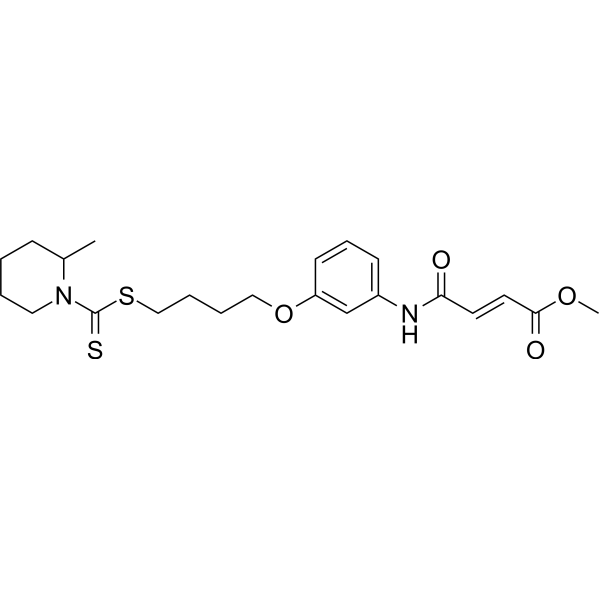
Physicochemical Properties
| Molecular Formula | C22H30N2O4S2 |
| Molecular Weight | 450.61 |
| Appearance | Typically exists as solid at room temperature |
| HS Tariff Code | 2934.99.9001 |
| Storage |
Powder-20°C 3 years 4°C 2 years In solvent -80°C 6 months -20°C 1 month |
| Shipping Condition | Room temperature (This product is stable at ambient temperature for a few days during ordinary shipping and time spent in Customs) |
Biological Activity
| ln Vitro | AChE-IN-24 (compound 4c2) exhibits little inhibition to hBuChE but strong hAChE inhibitory activity, with IC50 values of 0.053 μM[1]. With IC50 values of 0.088 μM and 7.5 μM, respectively, AChE-IN-2 exhibits inhibitory activity for both equine serum butyrylcholinesterase (eqBuChE) and electric eel acetylcholinesterase (eeAChE)[1]. By passive diffusion, AChE-IN-24 (0-0.2 μM) can penetrate the BBB with ease[1]. Nrf2 translocation to the nucleus is accelerated by AChE-IN-2 (0–40 μM), which also speeds up Nrf2 binding to the ARE for transcription[1]. By activating Nrf2 in BV-2 cells, AChE-IN-2 (7 μM) strongly stimulates the production of antioxidant-related enzymes[1]. AChE-IN-2 (1, 3, 7 μM) prevents ROS buildup and shields cells from harm caused by H2O2[1]. Inflammatory reactions are attenuated by AChE-IN-2 (1, 3, 7 μM)[1]. |
| ln Vivo | In KM mice, oral dosages of AChE-IN-24 (compound 4c2) (0, 625, 1250, and 2500 mg/kg) are well tolerated and do not cause toxicity[1]. The cognitive deficit caused by Scopolamine is lessened by AChE-IN-24 (7.5 mg/kg, 15 mg/kg, and 30 mg/kg; once), indicating a potential therapeutic benefit for AD[1]. |
| Cell Assay |
Cell Viability Assay[1] Cell Types: BV-2 microglial cells Tested Concentrations: 0, 2.5, 5, 10, 20 and 40 μM Incubation Duration: 24 h Experimental Results: Not observed significant cytotoxicity. Western Blot Analysis[1] Cell Types: BV-2 microglial cells Tested Concentrations: 7 μM Incubation Duration: 0-15 h Experimental Results: Up-regulated the amount of total Nrf2 in a time-dependent manner, diminished gradually the cytosolic Nrf2 level with its continuous accumulation in the nucleus and increased the total cellular Nrf2 accumulation in concentration-dependently. Increased the protein expression levels of HO-1, NQO1, and GPX4 in a concentration-dependent manner with the biggest upregulation observed at 10 μM and Dramatically increased the protein levels of HO-1, NQO1, and GPX4 reaching the maximum at 9h, 6 h, and 3 h, respectively[1]. |
| Animal Protocol |
Animal/Disease Models: KM mice[1] Doses: 0, 625, 1250, and 2500 mg/kg Route of Administration: oral; 0, 625, 1250, and 2500 mg/kg Experimental Results: Not discovered abnormal behavior and acute toxicity were monitored for the first 4 h after administration, no acute neurological toxicities inclusive of tremor, convulsion, and death and no obvious signs of poisoning in the heart, liver, lungs, kidneys, and brain. Animal/Disease Models: The cognitive deficit mice model[1] Doses: 7.5 mg/kg, 15 mg/kg and 30mg/kg Route of Administration: 7.5 mg/kg, 15 mg/kg and 30mg/kg; once Experimental Results: Reversed the step-down latency and number of errors in a concentration-dependent manner. |
| References | [1]. Jie Guo, et al. A multi-target directed ligands strategy for the treatment of Alzheimer's disease: Dimethyl fumarate plus Tranilast modified Dithiocarbate as AChE inhibitor and Nrf2 activator. Eur J Med Chem. 2022 Aug 11;242:114630. |
Solubility Data
| Solubility (In Vitro) | May dissolve in DMSO (in most cases), if not, try other solvents such as H2O, Ethanol, or DMF with a minute amount of products to avoid loss of samples |
| Solubility (In Vivo) |
Note: Listed below are some common formulations that may be used to formulate products with low water solubility (e.g. < 1 mg/mL), you may test these formulations using a minute amount of products to avoid loss of samples. Injection Formulations (e.g. IP/IV/IM/SC) Injection Formulation 1: DMSO : Tween 80: Saline = 10 : 5 : 85 (i.e. 100 μL DMSO stock solution → 50 μL Tween 80 → 850 μL Saline) *Preparation of saline: Dissolve 0.9 g of sodium chloride in 100 mL ddH ₂ O to obtain a clear solution. Injection Formulation 2: DMSO : PEG300 :Tween 80 : Saline = 10 : 40 : 5 : 45 (i.e. 100 μL DMSO → 400 μLPEG300 → 50 μL Tween 80 → 450 μL Saline) Injection Formulation 3: DMSO : Corn oil = 10 : 90 (i.e. 100 μL DMSO → 900 μL Corn oil) Example: Take the Injection Formulation 3 (DMSO : Corn oil = 10 : 90) as an example, if 1 mL of 2.5 mg/mL working solution is to be prepared, you can take 100 μL 25 mg/mL DMSO stock solution and add to 900 μL corn oil, mix well to obtain a clear or suspension solution (2.5 mg/mL, ready for use in animals). Injection Formulation 4: DMSO : 20% SBE-β-CD in saline = 10 : 90 [i.e. 100 μL DMSO → 900 μL (20% SBE-β-CD in saline)] *Preparation of 20% SBE-β-CD in Saline (4°C,1 week): Dissolve 2 g SBE-β-CD in 10 mL saline to obtain a clear solution. Injection Formulation 5: 2-Hydroxypropyl-β-cyclodextrin : Saline = 50 : 50 (i.e. 500 μL 2-Hydroxypropyl-β-cyclodextrin → 500 μL Saline) Injection Formulation 6: DMSO : PEG300 : castor oil : Saline = 5 : 10 : 20 : 65 (i.e. 50 μL DMSO → 100 μLPEG300 → 200 μL castor oil → 650 μL Saline) Injection Formulation 7: Ethanol : Cremophor : Saline = 10: 10 : 80 (i.e. 100 μL Ethanol → 100 μL Cremophor → 800 μL Saline) Injection Formulation 8: Dissolve in Cremophor/Ethanol (50 : 50), then diluted by Saline Injection Formulation 9: EtOH : Corn oil = 10 : 90 (i.e. 100 μL EtOH → 900 μL Corn oil) Injection Formulation 10: EtOH : PEG300:Tween 80 : Saline = 10 : 40 : 5 : 45 (i.e. 100 μL EtOH → 400 μLPEG300 → 50 μL Tween 80 → 450 μL Saline) Oral Formulations Oral Formulation 1: Suspend in 0.5% CMC Na (carboxymethylcellulose sodium) Oral Formulation 2: Suspend in 0.5% Carboxymethyl cellulose Example: Take the Oral Formulation 1 (Suspend in 0.5% CMC Na) as an example, if 100 mL of 2.5 mg/mL working solution is to be prepared, you can first prepare 0.5% CMC Na solution by measuring 0.5 g CMC Na and dissolve it in 100 mL ddH2O to obtain a clear solution; then add 250 mg of the product to 100 mL 0.5% CMC Na solution, to make the suspension solution (2.5 mg/mL, ready for use in animals). Oral Formulation 3: Dissolved in PEG400 Oral Formulation 4: Suspend in 0.2% Carboxymethyl cellulose Oral Formulation 5: Dissolve in 0.25% Tween 80 and 0.5% Carboxymethyl cellulose Oral Formulation 6: Mixing with food powders Note: Please be aware that the above formulations are for reference only. InvivoChem strongly recommends customers to read literature methods/protocols carefully before determining which formulation you should use for in vivo studies, as different compounds have different solubility properties and have to be formulated differently. (Please use freshly prepared in vivo formulations for optimal results.) |
| Preparing Stock Solutions | 1 mg | 5 mg | 10 mg | |
| 1 mM | 2.2192 mL | 11.0961 mL | 22.1921 mL | |
| 5 mM | 0.4438 mL | 2.2192 mL | 4.4384 mL | |
| 10 mM | 0.2219 mL | 1.1096 mL | 2.2192 mL |