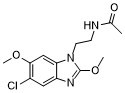
Physicochemical Properties
| Molecular Formula | C13H16CLN3O3 |
| Molecular Weight | 297.7374 |
| Exact Mass | 297.09 |
| Elemental Analysis | C, 52.44; H, 5.42; Cl, 11.91; N, 14.11; O, 16.12 |
| CAS # | 2225836-30-4 |
| Related CAS # | 2225836-30-4 |
| PubChem CID | 139451790 |
| Appearance | White to off-white solid powder |
| LogP | 1.6 |
| Hydrogen Bond Donor Count | 1 |
| Hydrogen Bond Acceptor Count | 4 |
| Rotatable Bond Count | 5 |
| Heavy Atom Count | 20 |
| Complexity | 345 |
| Defined Atom Stereocenter Count | 0 |
| InChi Key | BVSLRGAPRGQWNC-UHFFFAOYSA-N |
| InChi Code | InChI=1S/C13H16ClN3O3/c1-8(18)15-4-5-17-11-7-12(19-2)9(14)6-10(11)16-13(17)20-3/h6-7H,4-5H2,1-3H3,(H,15,18) |
| Chemical Name | N-[2-(5-chloro-2,6-dimethoxybenzimidazol-1-yl)ethyl]acetamide |
| Synonyms | ACH 000143; ACH-000143; ACH000143 |
| HS Tariff Code | 2934.99.9001 |
| Storage |
Powder-20°C 3 years 4°C 2 years In solvent -80°C 6 months -20°C 1 month Note: This product requires protection from light (avoid light exposure) during transportation and storage. |
| Shipping Condition | Room temperature (This product is stable at ambient temperature for a few days during ordinary shipping and time spent in Customs) |
Biological Activity
| Targets | MT1 ( EC50 = 0.06 nM ); MT2 ( EC50 = 0.32 nM ) |
| ln Vivo |
ACH-000143 reduces steatosis and liver triglycerides in diet-induced obese rats[1]. ACH-000143 is not hERG binding, genotoxic, or accompanied by behavioral changes at doses up to 100 mg/kg p.o., indicating that it is a compound that merits more research as a potential medication[1]. ACH-000143 significantly lowers plasma glucose at 10 mg/kg (−16.4%, p < 0.05) and 30 mg/kg (−16.9%, p < 0.01)[1]. |
| Animal Protocol |
High-fat diet rats 10 and 30 mg/kg Orally, once daily for two months. |
| References |
[1]. Discovery of ACH-000143: A Novel Potent and Peripherally Preferred Melatonin Receptor Agonist that Reduces Liver Triglycerides and Steatosis in Diet-Induced Obese Rats. J Med Chem. 2021 Feb 25;64(4):1904-1929. |
Solubility Data
| Solubility (In Vitro) | DMSO: ~50 mg/mL (~167.9 mM) |
| Solubility (In Vivo) |
Solubility in Formulation 1: ≥ 2.5 mg/mL (8.40 mM) (saturation unknown) in 10% DMSO + 40% PEG300 + 5% Tween80 + 45% Saline (add these co-solvents sequentially from left to right, and one by one), clear solution. For example, if 1 mL of working solution is to be prepared, you can add 100 μL of 25.0 mg/mL clear DMSO stock solution to 400 μL PEG300 and mix evenly; then add 50 μL Tween-80 to the above solution and mix evenly; then add 450 μL normal saline to adjust the volume to 1 mL. Preparation of saline: Dissolve 0.9 g of sodium chloride in 100 mL ddH₂ O to obtain a clear solution. Solubility in Formulation 2: ≥ 2.5 mg/mL (8.40 mM) (saturation unknown) in 10% DMSO + 90% (20% SBE-β-CD in Saline) (add these co-solvents sequentially from left to right, and one by one), clear solution. For example, if 1 mL of working solution is to be prepared, you can add 100 μL of 25.0 mg/mL clear DMSO stock solution to 900 μL of 20% SBE-β-CD physiological saline solution and mix evenly. Preparation of 20% SBE-β-CD in Saline (4°C,1 week): Dissolve 2 g SBE-β-CD in 10 mL saline to obtain a clear solution. Solubility in Formulation 3: ≥ 2.5 mg/mL (8.40 mM) (saturation unknown) in 10% DMSO + 90% Corn Oil (add these co-solvents sequentially from left to right, and one by one), clear solution. For example, if 1 mL of working solution is to be prepared, you can add 100 μL of 25.0 mg/mL clear DMSO stock solution to 900 μL of corn oil and mix evenly. (Please use freshly prepared in vivo formulations for optimal results.) |
| Preparing Stock Solutions | 1 mg | 5 mg | 10 mg | |
| 1 mM | 3.3586 mL | 16.7932 mL | 33.5864 mL | |
| 5 mM | 0.6717 mL | 3.3586 mL | 6.7173 mL | |
| 10 mM | 0.3359 mL | 1.6793 mL | 3.3586 mL |