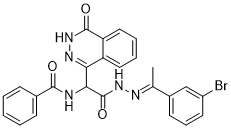
AC-55541 is an agonist of protease-activated receptor (PAR) 2. AC-55541 activated PAR2 signaling in cellular proliferation assays, phosphatidylinositol hydrolysis assays, and Ca(2+) mobilization assays, with potencies ranging from 200 to 1000 nM. Rats receiving AC-55541 intraperitoneally had good absorption, with peak plasma concentrations of micromolar. With elimination half-lives of 6.1 hours, AC-55541 remained stable when metabolized by liver microsomes and was exposed to rats for an extended period of time. The application of AC-55541 or AC-264613 intrapaw caused edema and severe, long-lasting thermal hyperalgesia. These effects were totally inhibited by coadministration of a transient receptor potential vanilloid (TRPV) 1 antagonist or a tachykinin 1 (neurokinin 1) receptor antagonist. Hyperalgesia comparable to that seen with local administration of AC-55541 or AC-264613 was produced when the compounds were administered systemically.
Physicochemical Properties
| Molecular Formula | C25H20BRN5O3 | |
| Molecular Weight | 518.36 | |
| Exact Mass | 517.074 | |
| Elemental Analysis | C, 57.93; H, 3.89; Br, 15.41; N, 13.51; O, 9.26 | |
| CAS # | 916170-19-9 | |
| Related CAS # |
|
|
| PubChem CID | 9589606 | |
| Appearance | White to off-white solid powder | |
| Density | 1.5±0.1 g/cm3 | |
| Index of Refraction | 1.689 | |
| LogP | 4.65 | |
| Hydrogen Bond Donor Count | 3 | |
| Hydrogen Bond Acceptor Count | 5 | |
| Rotatable Bond Count | 6 | |
| Heavy Atom Count | 34 | |
| Complexity | 838 | |
| Defined Atom Stereocenter Count | 0 | |
| SMILES | C(C1=NNC(=O)C2C=CC=CC1=2)(C(=O)N/N=C(/C1C=CC=C(Br)C=1)\C)NC(C1C=CC=CC=1)=O |
|
| InChi Key | UCUHFWIFSHROPY-RWPZCVJISA-N | |
| InChi Code | InChI=1S/C25H20BrN5O3/c1-15(17-10-7-11-18(26)14-17)28-31-25(34)22(27-23(32)16-8-3-2-4-9-16)21-19-12-5-6-13-20(19)24(33)30-29-21/h2-14,22H,1H3,(H,27,32)(H,30,33)(H,31,34)/b28-15+ | |
| Chemical Name | N-[2-[(2E)-2-[1-(3-bromophenyl)ethylidene]hydrazinyl]-2-oxo-1-(4-oxo-3H-phthalazin-1-yl)ethyl]benzamide | |
| Synonyms |
|
|
| HS Tariff Code | 2934.99.9001 | |
| Storage |
Powder-20°C 3 years 4°C 2 years In solvent -80°C 6 months -20°C 1 month |
|
| Shipping Condition | Room temperature (This product is stable at ambient temperature for a few days during ordinary shipping and time spent in Customs) |
Biological Activity
| Targets | PAR2 ( pEC50 = 6.7 ) | ||
| ln Vitro |
|
||
| ln Vivo |
|
||
| Enzyme Assay | The following assays were used to measure phosphatidylinositol (PI) hydrolysis. In order to generate PAR2 WT, 10,000 HEK 293T cells per well were seeded in DMEM (Invitrogen) supplemented with 10% fetal calf serum, 100 U/ml of penicillin, and 100 mg/ml of streptomycin. The cells were then grown in a 37°C humidified environment with 5% CO2. The cells were transfected using the indicated plasmid DNAs (30 ng/well of a 96-well plate) eighteen hours later, following the procedure previously described. The cells were transfected, and after 20 to 24 hours, they were labeled and washed again using DMEM culture medium that contained 0.2 μCi of NET1114 (37 MBq/ml; PerkinElmer Life and Analytical Sciences, Waltham, MA) per well (0.1 ml). | ||
| Cell Assay | In summary, 7 × 10³ cells were plated in 0.1 ml of media per well of a 96-well plate one day prior to transfection. A 96-well plate was used, and 10 ng of receptor DNA and 30 ng of pSI-β-galactosidase (Promega) were transiently transfected into each well using Polyfect, as directed by the manufacturer. The following day, the medium was switched, and cells and ligands were mixed together in 200 μl/well of DMEM supplemented with 25% Ultraculture synthetic supplement rather than calf serum. The levels of β-galactosidase were measured exactly as described after five days in culture. Before adding 200 μl of PBS supplemented with 3.5 mM O-nitrophenyl-β-d-galactopyranoside and 0.5% Nonidet P-40 (both from Sigma-Aldrich), cells were rinsed with phosphate-buffered saline (PBS), pH 7.4. Plate readers were used to read the plates at 420 nm following a 2-4 hour incubation period. | ||
| Animal Protocol |
|
||
| References |
[1]. Identification and characterization of novel small-molecule protease-activated receptor 2 agonists. J Pharmacol Exp Ther. 2008 Dec;327(3):799-808. [2]. Role of Aspergillus fumigatus in Triggering Protease-Activated Receptor-2 in Airway Epithelial Cellsand Skewing the Cells toward a T-helper 2 Bias. Am J Respir Cell Mol Biol. 2016 Jan;54(1):60-70. |
||
| Additional Infomation | AC-55541 is an organic molecular entity. |
Solubility Data
| Solubility (In Vitro) |
|
|||
| Solubility (In Vivo) |
Solubility in Formulation 1: ≥ 2.5 mg/mL (4.82 mM) (saturation unknown) in 10% DMSO + 40% PEG300 + 5% Tween80 + 45% Saline (add these co-solvents sequentially from left to right, and one by one), clear solution. For example, if 1 mL of working solution is to be prepared, you can add 100 μL of 25.0 mg/mL clear DMSO stock solution to 400 μL PEG300 and mix evenly; then add 50 μL Tween-80 to the above solution and mix evenly; then add 450 μL normal saline to adjust the volume to 1 mL. Preparation of saline: Dissolve 0.9 g of sodium chloride in 100 mL ddH₂ O to obtain a clear solution. Solubility in Formulation 2: 2.5 mg/mL (4.82 mM) in 10% DMSO + 90% (20% SBE-β-CD in Saline) (add these co-solvents sequentially from left to right, and one by one), suspension solution; with ultrasonication. For example, if 1 mL of working solution is to be prepared, you can add 100 μL of 25.0 mg/mL clear DMSO stock solution to 900 μL of 20% SBE-β-CD physiological saline solution and mix evenly. Preparation of 20% SBE-β-CD in Saline (4°C,1 week): Dissolve 2 g SBE-β-CD in 10 mL saline to obtain a clear solution. Solubility in Formulation 3: ≥ 2.5 mg/mL (4.82 mM) (saturation unknown) in 10% DMSO + 90% Corn Oil (add these co-solvents sequentially from left to right, and one by one), clear solution. For example, if 1 mL of working solution is to be prepared, you can add 100 μL of 25.0 mg/mL clear DMSO stock solution to 900 μL of corn oil and mix evenly. (Please use freshly prepared in vivo formulations for optimal results.) |
| Preparing Stock Solutions | 1 mg | 5 mg | 10 mg | |
| 1 mM | 1.9292 mL | 9.6458 mL | 19.2916 mL | |
| 5 mM | 0.3858 mL | 1.9292 mL | 3.8583 mL | |
| 10 mM | 0.1929 mL | 0.9646 mL | 1.9292 mL |