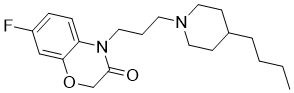
Physicochemical Properties
| Molecular Formula | C20H29FN2O2 |
| Molecular Weight | 348.454869031906 |
| Exact Mass | 348.221 |
| CAS # | 560083-42-3 |
| PubChem CID | 9928284 |
| Appearance | White to off-white solid powder |
| LogP | 3.846 |
| Hydrogen Bond Donor Count | 0 |
| Hydrogen Bond Acceptor Count | 4 |
| Rotatable Bond Count | 7 |
| Heavy Atom Count | 25 |
| Complexity | 426 |
| Defined Atom Stereocenter Count | 0 |
| InChi Key | BWAKMLKESHKOHK-UHFFFAOYSA-N |
| InChi Code | InChI=1S/C20H29FN2O2/c1-2-3-5-16-8-12-22(13-9-16)10-4-11-23-18-7-6-17(21)14-19(18)25-15-20(23)24/h6-7,14,16H,2-5,8-13,15H2,1H3 |
| Chemical Name | 4-[3-(4-butylpiperidin-1-yl)propyl]-7-fluoro-1,4-benzoxazin-3-one |
| HS Tariff Code | 2934.99.9001 |
| Storage |
Powder-20°C 3 years 4°C 2 years In solvent -80°C 6 months -20°C 1 month |
| Shipping Condition | Room temperature (This product is stable at ambient temperature for a few days during ordinary shipping and time spent in Customs) |
Biological Activity
| ln Vitro | The results showed that AC260584 is a strong muscarinic M1 receptor agonist (pEC50=7.6-7.7) and potent (90-98% of carbachol). Functional selectivity for the M1 receptor over the M2, M3, M4, and M5 muscarinic receptor subtypes is demonstrated by AC260584. Its spectrum in recombinant systems was shown to be similar to its selectivity in natural tissues expressing mAChR [1]. |
| ln Vivo | In rodents, the hippocampus, prefrontal cortex, and perirhinal cortex exhibit phosphorylation of extracellular signal-regulated kinase 1 and 2 (ERK1/2) upon activation by AC260584. Since M1 mutant animals did not exhibit this activation, ERK1/2 activation was reliant on muscarinic M1 receptor activation. In a unique object recognition test, AC260584 also enhanced mice's cognitive function; pirenzepine, a muscarinic receptor antagonist, prevented this benefit. Furthermore, it was discovered that AC260584 is orally accessible in rodents [1]. Dopamine release was markedly enhanced in the medial prefrontal cortex and hippocampus by AC260584 at doses of 3 and 10 mg/kg. However, the release of acetylcholine in these locations was only markedly augmented by a high dose of AC260584 (10 mg/kg (sc)) [2]. |
| References |
[1]. AC260584, an orally bioavailable M(1) muscarinic receptor allosteric agonist, improves cognitive performance in an animal model. Neuropharmacology. 2010 Feb;58(2):365-73. [2]. AC260584 (4-[3-(4-butylpiperidin-1-yl)-propyl]-7-fluoro-4H-benzo[1,4]oxazin-3-one), a selective muscarinic M1 receptor agonist, increases acetylcholine and dopamine release in rat medial prefrontal cortex and hippocampus. Eur J Pharmacol. 200. |
Solubility Data
| Solubility (In Vitro) | DMSO : ≥ 50 mg/mL (~143.49 mM) |
| Solubility (In Vivo) |
Solubility in Formulation 1: ≥ 2.5 mg/mL (7.17 mM) (saturation unknown) in 10% DMSO + 40% PEG300 + 5% Tween80 + 45% Saline (add these co-solvents sequentially from left to right, and one by one), clear solution. For example, if 1 mL of working solution is to be prepared, you can add 100 μL of 25.0 mg/mL clear DMSO stock solution to 400 μL PEG300 and mix evenly; then add 50 μL Tween-80 to the above solution and mix evenly; then add 450 μL normal saline to adjust the volume to 1 mL. Preparation of saline: Dissolve 0.9 g of sodium chloride in 100 mL ddH₂ O to obtain a clear solution. Solubility in Formulation 2: ≥ 2.5 mg/mL (7.17 mM) (saturation unknown) in 10% DMSO + 90% Corn Oil (add these co-solvents sequentially from left to right, and one by one), clear solution. For example, if 1 mL of working solution is to be prepared, you can add 100 μL of 25.0 mg/mL clear DMSO stock solution to 900 μL of corn oil and mix evenly. (Please use freshly prepared in vivo formulations for optimal results.) |
| Preparing Stock Solutions | 1 mg | 5 mg | 10 mg | |
| 1 mM | 2.8699 mL | 14.3493 mL | 28.6985 mL | |
| 5 mM | 0.5740 mL | 2.8699 mL | 5.7397 mL | |
| 10 mM | 0.2870 mL | 1.4349 mL | 2.8699 mL |