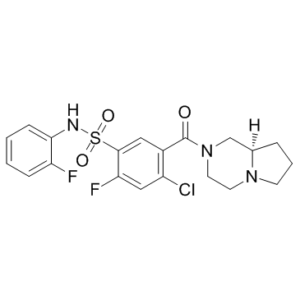
ABT-639 is a new potent, peripherally acting, selective T-type Ca2+ channel blocker that blocks recombinant human T-type (Cav3.2) Ca2+ channels in a voltage-dependent fashion (IC50=2 μM) and attenuates low voltage-activated (LVA) currents in rat DRG neurons (IC50=8 μM). ABT-639 is significantly less active at other Ca2+ channels (e.g. Cav1.2 and Cav2.2) (IC50>30 mM). Following oral administration ABT-639 produced dose-dependent antinociception in a rat model of knee joint pain (ED₅₀ = 2 mg/kg, p.o.). ABT-639 (10-100 mg/kg, p.o.) also increased tactile allodynia thresholds in multiple models of neuropathic pain (e.g. spinal nerve ligation, CCI, and vincristine-induced). [corrected]. ABT-639 did not attenuate hyperalgesia in inflammatory pain models induced by complete Freund's adjuvant or carrageenan. At higher doses (e.g. 100-300 mg/kg) ABT-639 did not significantly alter hemodynamic or psychomotor function. The antinociceptive profile of ABT-639 provides novel insights into the role of peripheral T-type (Ca(v)3.2) channels in chronic pain states.
Physicochemical Properties
| Molecular Formula | C20H20CLF2N3O3S | |
| Molecular Weight | 455.91 | |
| Exact Mass | 455.088 | |
| CAS # | 1235560-28-7 | |
| Related CAS # | ABT-639 hydrochloride;1235560-31-2 | |
| PubChem CID | 46851313 | |
| Appearance | White to off-white solid powder | |
| Density | 1.5±0.1 g/cm3 | |
| Boiling Point | 612.2±65.0 °C at 760 mmHg | |
| Flash Point | 324.0±34.3 °C | |
| Vapour Pressure | 0.0±1.8 mmHg at 25°C | |
| Index of Refraction | 1.653 | |
| LogP | 2.6 | |
| Hydrogen Bond Donor Count | 1 | |
| Hydrogen Bond Acceptor Count | 7 | |
| Rotatable Bond Count | 4 | |
| Heavy Atom Count | 30 | |
| Complexity | 737 | |
| Defined Atom Stereocenter Count | 1 | |
| SMILES | C1C[C@@H]2CN(CCN2C1)C(=O)C3=CC(=C(C=C3Cl)F)S(=O)(=O)NC4=CC=CC=C4F |
|
| InChi Key | AGPIHNZOZNKRGT-CYBMUJFWSA-N | |
| InChi Code | InChI=1S/C20H20ClF2N3O3S/c21-15-11-17(23)19(30(28,29)24-18-6-2-1-5-16(18)22)10-14(15)20(27)26-9-8-25-7-3-4-13(25)12-26/h1-2,5-6,10-11,13,24H,3-4,7-9,12H2/t13-/m1/s1 | |
| Chemical Name | 5-[(8aR)-3,4,6,7,8,8a-hexahydro-1H-pyrrolo[1,2-a]pyrazine-2-carbonyl]-4-chloro-2-fluoro-N-(2-fluorophenyl)benzenesulfonamide | |
| Synonyms |
|
|
| HS Tariff Code | 2934.99.9001 | |
| Storage |
Powder-20°C 3 years 4°C 2 years In solvent -80°C 6 months -20°C 1 month |
|
| Shipping Condition | Room temperature (This product is stable at ambient temperature for a few days during ordinary shipping and time spent in Customs) |
Biological Activity
| Targets |
T-type calcium channels (Caₐ₃.2): recombinant human Caₐ₃.2 (IC₅₀ = 2 μM, voltage-dependent block), rat dorsal root ganglion (DRG) neuron low voltage-activated (LVA) currents (IC₅₀ = 8 μM) [1] Other calcium channels (Caₐ₁.2, Caₐ₂.2): IC₅₀ > 30 μM (significantly less active) [1] |
| ln Vitro |
In vitro activity: ABT-639 is a new potent, peripherally acting, selective T-type Ca2+ channel blocker that blocks recombinant human T-type (Cav3.2) Ca2+ channels in a voltage-dependent fashion (IC50=2 μM) and attenuates low voltage-activated (LVA) currents in rat DRG neurons (IC50=8 μM). ABT-639 is significantly less active at other Ca2+ channels (e.g. Cav1.2 and Cav2.2) (IC50>30 mM). Following oral administration ABT-639 produced dose-dependent antinociception in a rat model of knee joint pain (ED₅₀ = 2 mg/kg, p.o.). ABT-639 (10-100 mg/kg, p.o.) also increased tactile allodynia thresholds in multiple models of neuropathic pain (e.g. spinal nerve ligation, CCI, and vincristine-induced). [corrected]. ABT-639 did not attenuate hyperalgesia in inflammatory pain models induced by complete Freunds adjuvant or carrageenan. At higher doses (e.g. 100-300 mg/kg) ABT-639 did not significantly alter hemodynamic or psychomotor function. The antinociceptive profile of ABT-639 provides novel insights into the role of peripheral T-type (Ca(v)3.2) channels in chronic pain states. Kinase Assay: Cell Assay: ABT-639 blocks recombinant human T-type (Cav3.2) Ca2+ channels in a voltage-dependent fashion (IC50=2 μM) and attenuates low voltage-activated (LVA) currents in rat DRG neurons (IC50=8 μM). ABT-639 is significantly less active at other Ca2+ channels (e.g. Cav1.2 and Cav2.2) (IC50>30 mM). ABT-639 has high oral bioavailability (%F=73), low protein binding (88.9%) and a low brain:plasma ratio (0.05:1) in rodents. Following oral administration 1. Channel blocking activity: ABT-639 acts as a voltage-dependent blocker of recombinant human T-type (Caₐ₃.2) calcium channels with an IC₅₀ value of 2 μM; it attenuates low voltage-activated (LVA) calcium currents in rat dorsal root ganglion (DRG) neurons with an IC₅₀ of 8 μM; the compound shows significantly lower activity against other calcium channel subtypes (Caₐ₁.2 and Caₐ₂.2), with IC₅₀ values greater than 30 μM, demonstrating high selectivity for T-type (Caₐ₃.2) channels [1] |
| ln Vivo |
ABT-639 attenuates low voltage-activated (LVA) currents in rat DRG neurons (IC50=8 μM) and blocks recombinant human T-type (Cav3.2) Ca2+ channels in a voltage-dependent manner (IC50=2 μM). ABT -639 exhibits significantly lower activity at other Ca2+ channels (IC50>30 mM), such as Cav1.2 and Cav2.2. In rodents, ABT-639 exhibits low protein binding (88.9%), a low brain:plasma ratio (0.05:1), and high oral bioavailability (%F=73). In a rat model of knee joint pain, oral administration of ABT-639 results in dose-dependent antinociception (ED50=2 mg/kg, po). In various models of neuropathic pain, such as spinal nerve ligation, CCI, vincristine-induced, and capsaicin secondary hypersensitivity, ABT-639 (10-100 mg/kg, po) also raises tactile allodynia thresholds. In inflammatory pain models induced by carrageenan or complete Freund's adjuvant, ABT-639 does not reduce hyperalgesia. Higher doses of ABT-639 (such as 100–300 mg/kg) have no discernible effects on hemodynamic or psychomotor function. Novel insights into the function of peripheral T-type (Cav3.2) channels in chronic pain states are offered by the antinociceptive profile of ABT-639[1]. 1. Antinociceptive effect in nociceptive pain model: Oral administration of ABT-639 produced dose-dependent antinociception in a rat model of knee joint pain, with an ED₅₀ value of 2 mg/kg (p.o.) [1] 2. Effect in neuropathic pain models: ABT-639 (10-100 mg/kg, p.o.) increased tactile allodynia thresholds in multiple rat models of neuropathic pain, including spinal nerve ligation, chronic constriction injury (CCI), and vincristine-induced neuropathic pain [1] 3. Effect in inflammatory pain models: ABT-639 did not attenuate hyperalgesia in rat models of inflammatory pain induced by complete Freund's adjuvant or carrageenan [1] 4. Hemodynamic and psychomotor effects: At higher doses (100-300 mg/kg, p.o.), ABT-639 did not significantly alter hemodynamic (e.g., blood pressure, heart rate) or psychomotor function in rats [1] |
| Enzyme Assay |
1. Recombinant human Caₐ₃.2 channel activity assay: Recombinant human Caₐ₃.2 T-type calcium channel preparations were exposed to varying concentrations of ABT-639 under different voltage conditions; the channel blocking activity was measured to determine the IC₅₀ value (2 μM) and verify the voltage-dependent blocking characteristic of ABT-639 [1] 2. Rat DRG neuron LVA current assay: Primary rat DRG neurons were isolated and cultured, then treated with different concentrations of ABT-639; patch-clamp techniques were used to record LVA calcium currents, and the inhibitory effect of ABT-639 on these currents was quantified to calculate the IC₅₀ value (8 μM) [1] 3. Other calcium channel activity assays: Preparations of Caₐ₁.2 and Caₐ₂.2 calcium channels were treated with ABT-639 (up to concentrations above 30 μM); channel activity was assessed to determine the IC₅₀ values (>30 μM) and confirm the low activity of ABT-639 against these subtypes [1] |
| Cell Assay |
1. Rat DRG neuron culture and LVA current measurement: Rat DRG neurons were isolated, purified, and cultured in appropriate medium; after reaching the required state, the neurons were incubated with different concentrations of ABT-639; patch-clamp electrophysiology was employed to measure low voltage-activated calcium currents, evaluate the inhibitory effect of ABT-639 on these currents, and determine the IC₅₀ value for rat DRG neuron LVA currents [1] |
| Animal Protocol |
10-100 mg/kg, p.o. Rat model of knee joint pain 1. Rat knee joint pain model (nociceptive pain): Male Sprague-Dawley rats were used to establish the knee joint pain model; ABT-639 was administered orally at different doses, and the antinociceptive effect was evaluated to determine the ED₅₀ value (2 mg/kg, p.o.) [1] 2. Neuropathic pain models (spinal nerve ligation, CCI, vincristine-induced): Male Sprague-Dawley rats were used to establish respective neuropathic pain models; ABT-639 was administered orally at doses of 10-100 mg/kg, and tactile allodynia thresholds were measured at specified time points to assess the therapeutic effect [1] 3. Inflammatory pain models (complete Freund's adjuvant/carrageenan-induced): Male Sprague-Dawley rats were injected with complete Freund's adjuvant or carrageenan to induce inflammatory pain; ABT-639 was administered orally, and hyperalgesia was evaluated to confirm the lack of effect of ABT-639 on inflammatory pain [1] 4. Hemodynamic/psychomotor function assessment: Male Sprague-Dawley rats were administered ABT-639 at high doses (100-300 mg/kg, p.o.); hemodynamic parameters (e.g., blood pressure, heart rate) and psychomotor function were monitored over a specified period to evaluate potential adverse effects [1] 5. Pharmacokinetic assessment in rodents: Rodents (specific strain not specified) were administered ABT-639 orally; plasma and brain samples were collected at different time points, and drug concentrations were measured to determine oral bioavailability, plasma protein binding, and brain:plasma ratio [1] |
| ADME/Pharmacokinetics |
1. Oral bioavailability: ABT-639 has high oral bioavailability in rodents, with a %F value of 73% [1] 2. Plasma protein binding: The plasma protein binding rate of ABT-639 in rodents is 88.9% (low protein binding) [1] 3. Tissue distribution: ABT-639 shows a low brain:plasma ratio (0.05:1) in rodents, indicating limited penetration across the blood-brain barrier and peripheral selectivity [1] |
| Toxicity/Toxicokinetics |
1. Hemodynamic/psychomotor toxicity: At doses up to 300 mg/kg (oral administration), ABT-639 did not cause significant alterations in hemodynamic parameters (e.g., blood pressure, heart rate) or psychomotor function in rats, indicating a lack of acute toxicity related to these endpoints [1] 2. Plasma protein binding: The plasma protein binding rate of ABT-639 is 88.9% (rodents), with no reported drug-drug interactions related to protein binding displacement [1] |
| References |
[1]. A peripherally acting, selective T-type calcium channel blocker, ABT-639, effectively reduces nociceptive and neuropathic pain in rats. Biochem Pharmacol. 2014 Jun 15;89(4):536-44. |
| Additional Infomation |
ABT-639 is under investigation in clinical trial NCT01345045 (A Multicenter Study Comparing the Analgesic Effects and Safety of ABT-639 Compared to Placebo in Subjects With Diabetic Neuropathic Pain). T-type Calcium Channel Blocker ABT-639 is an orally bioavailable, CaV3.2 T-type calcium channel blocker with potential anti-hyperalgesic activity. Upon oral administration, ABT-639 selectively binds to and blocks the CaV3.2 isoform of the low voltage-gated T-type calcium channels located in peripheral sensory neurons. This prevents the influx of calcium ions into the cell upon membrane depolarization. The inhibition of both neuronal hyperexcitability and firing of nociceptive, peripheral sensory neurons induces an anti-nociceptive effect. The expression of the CaV3.2 T-type channels plays a key role in nociceptive and neuropathic pain. 1. Mechanism of action: ABT-639 is a peripherally acting, selective T-type (Caₐ₃.2) calcium channel blocker; activation of T-type Ca²⁺ channels contributes to nociceptive signaling by facilitating action potential bursting and modulation of membrane potentials during neuronal hyperexcitability, and ABT-639 attenuates this signaling by blocking Caₐ₃.2 channels [1] 2. Therapeutic profile: ABT-639 is effective in reducing nociceptive pain (knee joint pain) and neuropathic pain in rats but has no effect on inflammatory pain, highlighting its selective efficacy for specific pain states; its peripheral selectivity (low brain penetration) and lack of hemodynamic/psychomotor toxicity at high doses support its potential as a safe therapeutic agent for chronic pain [1] 3. Background: The role of T-type Ca²⁺ channels (Caₐ₃.2) in chronic pain is supported by gene knockdown studies, which showed reduced LVA currents in DRG neurons and attenuated neuropathic pain in the CCI model; ABT-639 was developed as a novel peripherally acting blocker targeting this channel subtype [1] |
Solubility Data
| Solubility (In Vitro) |
|
|||
| Solubility (In Vivo) |
|
| Preparing Stock Solutions | 1 mg | 5 mg | 10 mg | |
| 1 mM | 2.1934 mL | 10.9671 mL | 21.9342 mL | |
| 5 mM | 0.4387 mL | 2.1934 mL | 4.3868 mL | |
| 10 mM | 0.2193 mL | 1.0967 mL | 2.1934 mL |