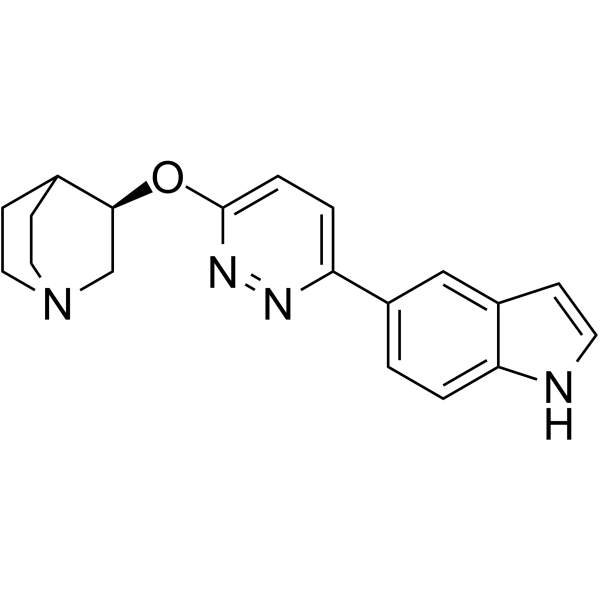
Physicochemical Properties
| Molecular Formula | C19H20N4O |
| Molecular Weight | 320.39 |
| Exact Mass | 320.163 |
| CAS # | 855291-54-2 |
| PubChem CID | 11151363 |
| Appearance | White to off-white solid powder |
| Density | 1.3±0.1 g/cm3 |
| Boiling Point | 598.0±50.0 °C at 760 mmHg |
| Flash Point | 315.4±30.1 °C |
| Vapour Pressure | 0.0±1.7 mmHg at 25°C |
| Index of Refraction | 1.699 |
| LogP | 2.18 |
| Hydrogen Bond Donor Count | 1 |
| Hydrogen Bond Acceptor Count | 4 |
| Rotatable Bond Count | 3 |
| Heavy Atom Count | 24 |
| Complexity | 439 |
| Defined Atom Stereocenter Count | 1 |
| SMILES | C1CN2CCC1[C@H](C2)OC3=NN=C(C=C3)C4=CC5=C(C=C4)NC=C5 |
| InChi Key | LUKNJAQKVPBDSC-SFHVURJKSA-N |
| InChi Code | InChI=1S/C19H20N4O/c1-2-16-15(5-8-20-16)11-14(1)17-3-4-19(22-21-17)24-18-12-23-9-6-13(18)7-10-23/h1-5,8,11,13,18,20H,6-7,9-10,12H2/t18-/m0/s1 |
| Chemical Name | 5-[6-[[(3R)-1-azabicyclo[2.2.2]octan-3-yl]oxy]pyridazin-3-yl]-1H-indole |
| HS Tariff Code | 2934.99.9001 |
| Storage |
Powder-20°C 3 years 4°C 2 years In solvent -80°C 6 months -20°C 1 month |
| Shipping Condition | Room temperature (This product is stable at ambient temperature for a few days during ordinary shipping and time spent in Customs) |
Biological Activity
| ln Vivo | In rodents with a brain/plasma ratio of 1, ABT-107 demonstrates strong CNS penetration and good bioavailability in mice (orally, 51.1%; intraperitoneally, 100%), rats (orally, 81.2%; intraperitoneally, 100%), and monkeys (orally, 40.6%; intramuscularly, 100%)[1]. ABT-107 (0.01-1 μmol/kg ip, 15 min prior to sacrifice) increases CREB and ERK1/2 in a dose-dependent manner[1]. In mouse cortex and hippocampus, ABT-107 (0.01, 0.1, and 1.0 mg/kg ip) raises S9-GSK3 and lowers p-tau[1]. In AD transgenic APP-tau mice, ABT-107 (5 mg/kg/day ip) infusion reduces tau hyperphosphorylation[1]. |
| Animal Protocol |
Animal/Disease Models: Rats (male Sprague-Dawley; 350-380 g b.wt.)[1]. Doses: 1, 3 μmol/kg. Route of Administration: IP daily for 3 days. Experimental Results: Induced a significant, dose-dependent increase in ACh release by day 3 of repeated administration. Higher doses may be required to evoke ACh release in naive rats not engaged in stimulated, ie, cognitive-related behavior. Animal/Disease Models: Female TAPP (and wild-type littermates) mice[1]. Doses: 1 mg/kg. Route of Administration: Continuous subcutaneous (sc) infusion for 2 weeks. Experimental Results: Produced a dose-dependent increase in Ser9 phosphorylation in the cingulate cortex 15 min after acute administration in mice. |
| References |
[1]. In vivo pharmacological characterization of a novel selective alpha7 neuronal nicotinic acetylcholine receptor agonist ABT-107: preclinical considerations in Alzheimer's disease. J Pharmacol Exp Ther. 2010 Sep 1;334(3):875-86. [2]. The α7 nicotinic receptor agonist ABT-107 protects against nigrostriatal damage in rats with unilateral 6-hydroxydopamine lesions. Exp Neurol. 2015 Jan;263:277-84. |
Solubility Data
| Solubility (In Vitro) | DMSO: 100 mg/mL (312.12 mM) |
| Solubility (In Vivo) |
Solubility in Formulation 1: ≥ 2.5 mg/mL (7.80 mM) (saturation unknown) in 10% DMSO + 40% PEG300 + 5% Tween80 + 45% Saline (add these co-solvents sequentially from left to right, and one by one), clear solution. For example, if 1 mL of working solution is to be prepared, you can add 100 μL of 25.0 mg/mL clear DMSO stock solution to 400 μL PEG300 and mix evenly; then add 50 μL Tween-80 to the above solution and mix evenly; then add 450 μL normal saline to adjust the volume to 1 mL. Preparation of saline: Dissolve 0.9 g of sodium chloride in 100 mL ddH₂ O to obtain a clear solution. Solubility in Formulation 2: ≥ 2.5 mg/mL (7.80 mM) (saturation unknown) in 10% DMSO + 90% (20% SBE-β-CD in Saline) (add these co-solvents sequentially from left to right, and one by one), clear solution. For example, if 1 mL of working solution is to be prepared, you can add 100 μL of 25.0 mg/mL clear DMSO stock solution to 900 μL of 20% SBE-β-CD physiological saline solution and mix evenly. Preparation of 20% SBE-β-CD in Saline (4°C,1 week): Dissolve 2 g SBE-β-CD in 10 mL saline to obtain a clear solution. Solubility in Formulation 3: ≥ 2.5 mg/mL (7.80 mM) (saturation unknown) in 10% DMSO + 90% Corn Oil (add these co-solvents sequentially from left to right, and one by one), clear solution. For example, if 1 mL of working solution is to be prepared, you can add 100 μL of 25.0 mg/mL clear DMSO stock solution to 900 μL of corn oil and mix evenly. (Please use freshly prepared in vivo formulations for optimal results.) |
| Preparing Stock Solutions | 1 mg | 5 mg | 10 mg | |
| 1 mM | 3.1212 mL | 15.6060 mL | 31.2120 mL | |
| 5 mM | 0.6242 mL | 3.1212 mL | 6.2424 mL | |
| 10 mM | 0.3121 mL | 1.5606 mL | 3.1212 mL |