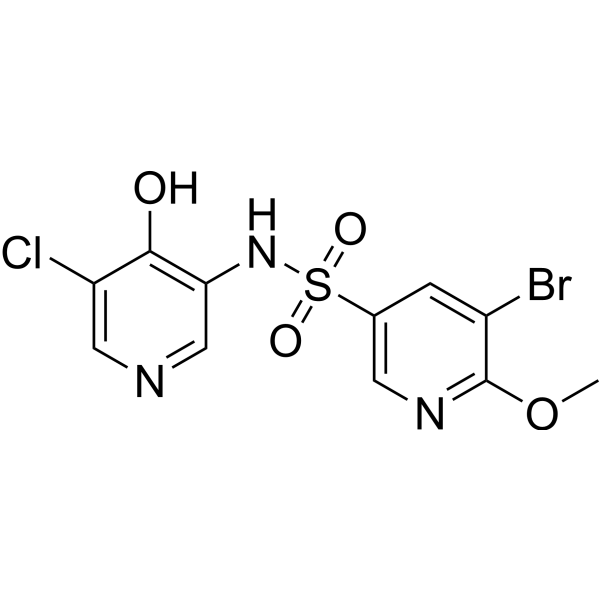
Physicochemical Properties
| Molecular Formula | C11H9BRCLN3O4S |
| Molecular Weight | 394.63 |
| Exact Mass | 392.918 |
| CAS # | 1638200-22-2 |
| PubChem CID | 86280668 |
| Appearance | Off-white to yellow solid powder |
| LogP | 1.6 |
| Hydrogen Bond Donor Count | 2 |
| Hydrogen Bond Acceptor Count | 7 |
| Rotatable Bond Count | 4 |
| Heavy Atom Count | 21 |
| Complexity | 587 |
| Defined Atom Stereocenter Count | 0 |
| SMILES | C1=NC(OC)=C(Br)C=C1S(NC1=C(O)C(Cl)=CN=C1)(=O)=O |
| InChi Key | IXVPHMAWVYMOQL-UHFFFAOYSA-N |
| InChi Code | InChI=1S/C11H9BrClN3O4S/c1-20-11-7(12)2-6(3-15-11)21(18,19)16-9-5-14-4-8(13)10(9)17/h2-5,16H,1H3,(H,14,17) |
| Chemical Name | 5-bromo-N-(5-chloro-4-oxo-1H-pyridin-3-yl)-6-methoxypyridine-3-sulfonamide |
| HS Tariff Code | 2934.99.9001 |
| Storage |
Powder-20°C 3 years 4°C 2 years In solvent -80°C 6 months -20°C 1 month |
| Shipping Condition | Room temperature (This product is stable at ambient temperature for a few days during ordinary shipping and time spent in Customs) |
Biological Activity
| ln Vivo | MDSCs treated with ABR-238901 (30 mg/kg/day; gavage; for 3 weeks) exhibit decreased angiogenesis as well as IL6 and IL10 levels[1]. When paired with bortezomib (0.6 mg/kg; subcutaneous injection; twice weekly), ABR-238901 (30 mg/kg/day; gavage) decreased the amount of tumor when compared to therapy with either drug alone[1]. In C57BL/6NRJ mice, ABR-238901 (30 mg/kg; intraperitoneal; for the first three days; then, continuing oral daily dosage; for 21 days) causes myocardial ischemia brought on by permanent coronary artery ligation, which progressively deteriorates cardiac function and speeds up left ventricular remodeling. In the initial three days following a myocardial infarction (MI), ABR-238901 treatment reduces inflammatory damage and fosters a healing milieu[2]. |
| Animal Protocol |
Animal/Disease Models: C57BL/KaLwRij mice with 5T33MMvv cells[1] Doses: 30 mg/kg Route of Administration: Gavage; daily; for 3 weeks Experimental Results: Caused less angiogenesis. Caused less IL6 and IL10 in myeloid-derived suppressor cells (MDSCs). |
| References |
[1]. Extracellular S100A9 Protein in Bone Marrow Supports Multiple Myeloma Survival by Stimulating Angiogenesis and Cytokine Secretion. Cancer Immunol Res. 2017 Oct;5(10):839-846. [2]. S100A9 Links Inflammation and Repair in Myocardial Infarction. Circ Res. 2020 Aug 14;127(5):664-676. [3]. Short-term blockade of the S100A8/A9 alarmin in the immediate post-myocardial infarction period inhibits acute myocardial inflammation and preserves myocardial repair. European Heart Journal, Volume 38, Issue suppl_1, August 2017, ehx504. |
Solubility Data
| Solubility (In Vitro) |
DMSO: 33.33 mg/mL (84.46 mM) H2O: < 0.1 mg/mL |
| Solubility (In Vivo) |
Solubility in Formulation 1: ≥ 2.5 mg/mL (6.34 mM) (saturation unknown) in 10% DMSO + 40% PEG300 +5% Tween-80 + 45% Saline (add these co-solvents sequentially from left to right, and one by one), clear solution. For example, if 1 mL of working solution is to be prepared, you can add 100 μL of 25.0 mg/mL clear DMSO stock solution to 400 μL PEG300 and mix evenly; then add 50 μL Tween-80 + to the above solution and mix evenly; then add 450 μL normal saline to adjust the volume to 1 mL. Preparation of saline: Dissolve 0.9 g of sodium chloride in 100 mL ddH₂ O to obtain a clear solution. (Please use freshly prepared in vivo formulations for optimal results.) |
| Preparing Stock Solutions | 1 mg | 5 mg | 10 mg | |
| 1 mM | 2.5340 mL | 12.6701 mL | 25.3402 mL | |
| 5 mM | 0.5068 mL | 2.5340 mL | 5.0680 mL | |
| 10 mM | 0.2534 mL | 1.2670 mL | 2.5340 mL |