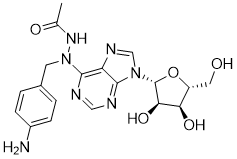
Physicochemical Properties
| Molecular Formula | C19H23N7O5 |
| Molecular Weight | 429.437 |
| Exact Mass | 399.166 |
| CAS # | 152918-26-8 |
| PubChem CID | 5310992 |
| Appearance | Typically exists as solid at room temperature |
| Density | 1.68g/cm3 |
| Index of Refraction | 1.789 |
| LogP | 0.88 |
| Hydrogen Bond Donor Count | 5 |
| Hydrogen Bond Acceptor Count | 9 |
| Rotatable Bond Count | 5 |
| Heavy Atom Count | 29 |
| Complexity | 576 |
| Defined Atom Stereocenter Count | 4 |
| SMILES | O[C@H]1[C@H](N2C=NC3=C(NCC4=CC=C(N)C=C4)N=CN=C23)O[C@H](C(NC)=O)[C@H]1O |
| InChi Key | LDYMCRRFCMRFKB-MOROJQBDSA-N |
| InChi Code | InChI=1S/C18H21N7O4/c1-20-17(28)14-12(26)13(27)18(29-14)25-8-24-11-15(22-7-23-16(11)25)21-6-9-2-4-10(19)5-3-9/h2-5,7-8,12-14,18,26-27H,6,19H2,1H3,(H,20,28)(H,21,22,23)/t12-,13+,14-,18+/m0/s1 |
| Chemical Name | N6-(4-Aminobenzyl)-N-methylcarboxamidoadenosine |
| Synonyms | AB MECA AB-MECAABMECA |
| HS Tariff Code | 2934.99.9001 |
| Storage |
Powder-20°C 3 years 4°C 2 years In solvent -80°C 6 months -20°C 1 month |
| Shipping Condition | Room temperature (This product is stable at ambient temperature for a few days during ordinary shipping and time spent in Customs) |
Biological Activity
| ln Vitro | The human lung cancer cell line A549 demonstrates the expected cytotoxicity when exposed to AB-MECA (1, 10, 100 μM; 24 hours) [2]. In transfected CHO cells and RBL-2H3 cells, the KD values of [125I]AB-MECA binding to A3 uptake were 1.48 and 3.61 nM, respectively [3]. |
| ln Vivo | Histamine levels can be raised intravenously by AB-MECA (3 ug/kg) [4]. Albino guinea pigs (body weight 180–220 g) respond better to medium induction when administered intravenously with AB-MECA (0.3 mg/kg). |
| Cell Assay |
Cytotoxicity assay[2] Cell Types: A549 Cell Tested Concentrations: 1, 10, 100 μM Incubation Duration: 24 hrs (hours) Experimental Results: demonstrated dose-dependent cytotoxicity. |
| Animal Protocol |
Animal/Disease Models: Male balb/c (Bagg ALBino) mouse, weight 18-25 g[4] Doses: 3 ug/kg given Medication: IV; systolic contraction [5]. Single dose Experimental Results: Caused a 5.9-fold increase in histamine levels in mouse plasma. |
| References |
[1]. L Yates, et al. Radioligand binding and functional responses of ligands for human recombinant adenosine A(3) receptors. Auton Autacoid Pharmacol. 2006 Apr;26(2):191-200. [2]. Solanki, N. D., et al. In Vitro Evaluation Of Anti-Cancer Potential Of A3 Adenosine Receptor Agonist On A549 Human Lung Cancer Cell Line. Int J Pharm Pharm Sci ; 2019 Jun; 11(6): 106-108. [3]. X D Ji, et al. A selective agonist affinity label for A3 adenosine receptors. Biochem Biophys Res Commun. 1994 Aug 30;203(1):570-6. [4]. Endre G Mikus, et al. Interaction of SSR161421, a novel specific adenosine A(3) receptor antagonist with adenosine A(3) receptor agonists both in vitro and in vivo. Eur J Pharmacol. 2013 Jan 15;699(1-3):62-6. [5]. Endre G Mikus, et al. Evaluation of SSR161421, a novel orally active adenosine A3 receptor antagonist on pharmacology models. Eur J Pharmacol. 2013 Jan 15;699(1-3):172-9. |
Solubility Data
| Solubility (In Vitro) | DMSO : ~55 mg/mL (~137.71 mM) |
| Solubility (In Vivo) |
Solubility in Formulation 1: ≥ 2.75 mg/mL (6.89 mM) (saturation unknown) in 10% DMSO + 40% PEG300 + 5% Tween80 + 45% Saline (add these co-solvents sequentially from left to right, and one by one), clear solution. For example, if 1 mL of working solution is to be prepared, you can add 100 μL of 27.5 mg/mL clear DMSO stock solution to 400 μL PEG300 and mix evenly; then add 50 μL Tween-80 to the above solution and mix evenly; then add 450 μL normal saline to adjust the volume to 1 mL. Preparation of saline: Dissolve 0.9 g of sodium chloride in 100 mL ddH₂ O to obtain a clear solution. Solubility in Formulation 2: ≥ 2.75 mg/mL (6.89 mM) (saturation unknown) in 10% DMSO + 90% (20% SBE-β-CD in Saline) (add these co-solvents sequentially from left to right, and one by one), clear solution. For example, if 1 mL of working solution is to be prepared, you can add 100 μL of 27.5 mg/mL clear DMSO stock solution to 900 μL of 20% SBE-β-CD physiological saline solution and mix evenly. Preparation of 20% SBE-β-CD in Saline (4°C,1 week): Dissolve 2 g SBE-β-CD in 10 mL saline to obtain a clear solution. Solubility in Formulation 3: ≥ 2.75 mg/mL (6.89 mM) (saturation unknown) in 10% DMSO + 90% Corn Oil (add these co-solvents sequentially from left to right, and one by one), clear solution. For example, if 1 mL of working solution is to be prepared, you can add 100 μL of 27.5 mg/mL clear DMSO stock solution to 900 μL of corn oil and mix evenly. (Please use freshly prepared in vivo formulations for optimal results.) |
| Preparing Stock Solutions | 1 mg | 5 mg | 10 mg | |
| 1 mM | 2.3286 mL | 11.6431 mL | 23.2861 mL | |
| 5 mM | 0.4657 mL | 2.3286 mL | 4.6572 mL | |
| 10 mM | 0.2329 mL | 1.1643 mL | 2.3286 mL |