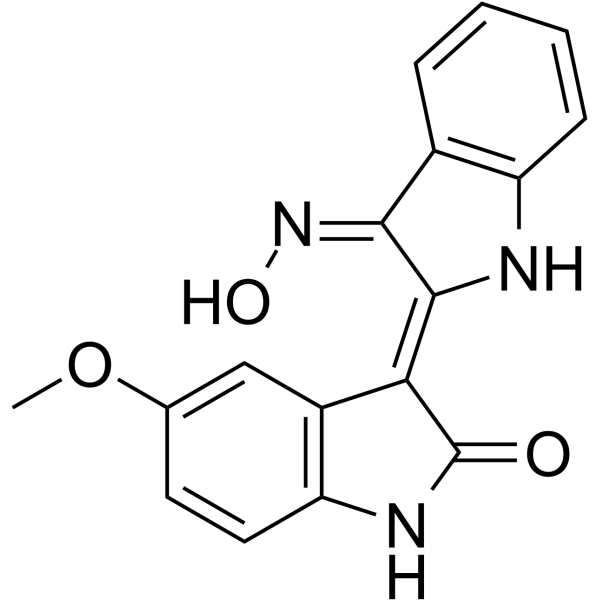
Physicochemical Properties
| Molecular Formula | C17H13N3O3 |
| Molecular Weight | 307.303423643112 |
| Exact Mass | 307.095 |
| CAS # | 854171-31-6 |
| PubChem CID | 136026170 |
| Appearance | Brown to reddish brown solid powder |
| LogP | 3.2 |
| Hydrogen Bond Donor Count | 3 |
| Hydrogen Bond Acceptor Count | 4 |
| Rotatable Bond Count | 2 |
| Heavy Atom Count | 23 |
| Complexity | 449 |
| Defined Atom Stereocenter Count | 0 |
| InChi Key | NNFVURTYXFYQFZ-UHFFFAOYSA-N |
| InChi Code | InChI=1S/C17H13N3O3/c1-23-9-6-7-13-11(8-9)14(17(21)19-13)16-15(20-22)10-4-2-3-5-12(10)18-16/h2-8,18-19,21H,1H3 |
| Chemical Name | 5-methoxy-3-(3-nitroso-1H-indol-2-yl)-1H-indol-2-ol |
| HS Tariff Code | 2934.99.9001 |
| Storage |
Powder-20°C 3 years 4°C 2 years In solvent -80°C 6 months -20°C 1 month |
| Shipping Condition | Room temperature (This product is stable at ambient temperature for a few days during ordinary shipping and time spent in Customs) |
Biological Activity
| Targets | IC50: 63.06 nM (CXXC5-DVL)[1] |
| ln Vitro | Through the Wnt/β-eatenin signaling pathway, A3334 (1–10 μM) effectively prevents 3T3-L1 preadipocytes from differentiating into adipocytes[1]. In HEK293-TOP cells, A3334 (1–10 μM; 24 h) increases TOPFlash reporter activity [1]. |
| ln Vivo | In mice on a high-fat diet (HFD), A3334 (25 mg/kg; po once daily for 16 weeks) exhibits anti-obesity benefits; in mice fed a regular diet, it has no effect[1]. A3334 (25 mg/kg; po once daily for 5 days) dramatically lowers blood levels of insulin tolerance (ITT) and glucose tolerance (GTT) in mice as well as fasting glucose[1]. In mice, hepatosteatosis and elevated levels of alanine transaminase (ALT) and aspartate transaminase (AST) are markedly reduced by A3334 (25 mg/kg; po once daily for 3 weeks)[1]. |
| Animal Protocol |
Animal/Disease Models: Male C57BL/6N mice (6weeks old) are fed on the high fat die (HFD) for 16 weeks[1] Doses: 25 mg/kg Route of Administration: Po daily for 16 weeks Experimental Results: Not observed the HFD-induced body weight gain and abdominal obesity. decreased the level of triglyceride and total cholesterol and increased the level of HDL-cholesterol. Suppressed the increase in adipocyte cell sizes and enhancement of inflammation. |
| References | [1]. Choi KY, et, al. Compositions and methods for suppressing and/or treating metabolic diseases and/or a clinical condition thereof. WO2020079569. |
Solubility Data
| Solubility (In Vitro) | DMSO: 250 mg/mL (813.54 mM) |
| Solubility (In Vivo) |
Solubility in Formulation 1: ≥ 2.08 mg/mL (6.77 mM) (saturation unknown) in 10% DMSO + 40% PEG300 +5% Tween-80 + 45% Saline (add these co-solvents sequentially from left to right, and one by one), clear solution. For example, if 1 mL of working solution is to be prepared, you can add 100 μL of 20.8 mg/mL clear DMSO stock solution to 400 μL PEG300 and mix evenly; then add 50 μL Tween-80 + to the above solution and mix evenly; then add 450 μL normal saline to adjust the volume to 1 mL. Preparation of saline: Dissolve 0.9 g of sodium chloride in 100 mL ddH₂ O to obtain a clear solution. (Please use freshly prepared in vivo formulations for optimal results.) |
| Preparing Stock Solutions | 1 mg | 5 mg | 10 mg | |
| 1 mM | 3.2541 mL | 16.2707 mL | 32.5415 mL | |
| 5 mM | 0.6508 mL | 3.2541 mL | 6.5083 mL | |
| 10 mM | 0.3254 mL | 1.6271 mL | 3.2541 mL |