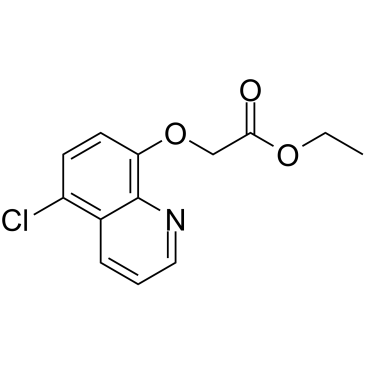
A2793 inhibited TWIK-related acid-sensitive K+ channel (TASK)-1 (100 µM, 53.4% ± 13, 5%, n = 5). The inhibitor analogs (A2764 and A2793) exerted state-dependent effects.
Physicochemical Properties
| Molecular Formula | C13H12CLNO3 |
| Molecular Weight | 265.692282676697 |
| Exact Mass | 265.051 |
| Elemental Analysis | C, 58.77; H, 4.55; Cl, 13.34; N, 5.27; O, 18.06 |
| CAS # | 88349-90-0 |
| PubChem CID | 21933492 |
| Appearance | White to off-white solid powder |
| Density | 1.291±0.06 g/cm3 |
| Boiling Point | 393.4±27.0 °C |
| LogP | 2.83 |
| Hydrogen Bond Donor Count | 0 |
| Hydrogen Bond Acceptor Count | 4 |
| Rotatable Bond Count | 5 |
| Heavy Atom Count | 18 |
| Complexity | 287 |
| Defined Atom Stereocenter Count | 0 |
| SMILES | O=C(COC1C2C(=CC=CN=2)C(Cl)=CC=1)OCC |
| InChi Key | JEMXUSHXYOXNFL-UHFFFAOYSA-N |
| InChi Code | InChI=1S/C13H12ClNO3/c1-2-17-12(16)8-18-11-6-5-10(14)9-4-3-7-15-13(9)11/h3-7H,2,8H2,1H3 |
| Chemical Name | ethyl 2-(5-chloroquinolin-8-yl)oxyacetate |
| Synonyms | A2793; A-2793; A2793; |
| HS Tariff Code | 2934.99.9001 |
| Storage |
Powder-20°C 3 years 4°C 2 years In solvent -80°C 6 months -20°C 1 month |
| Shipping Condition | Room temperature (This product is stable at ambient temperature for a few days during ordinary shipping and time spent in Customs) |
Biological Activity
| Targets |
A2793 targets TRESK (K₂P18.1) background potassium channel as an inhibitor, with an IC₅₀ value of 1.8 μM (whole-cell patch-clamp assay) [1] |
| ln Vitro |
When ionomycin is used to activate TRESK current, it decreases it by 85.5±2.9% (n=5), whereas A2793 (100 µM) inhibits unstimulated channels by 43.0±8.9% (n=5) [1]. While A2764 is more selective for TRESK, having only mild effects on TALK-1 and TREK-1, A2793 inhibits TASK-1 (100 µM, 53.4±13.5%, n=5) [1]. A2793 can be used as a tool in heterologous expression systems to discriminate between quiescent and activated channels and to block calcineurin-activated TRESK in native cells lacking TASK-1 expression [1]. A2793 (0.1–10 μM) dose-dependently inhibited TRESK channel currents in HEK293 cells stably expressing human TRESK, achieving 92% inhibition at 10 μM (whole-cell patch-clamp recording) [1] - The compound showed high selectivity for TRESK over other two-pore domain potassium channels (K₂P): IC₅₀ > 10 μM for TREK1 (K₂P2.1), TRAAK (K₂P4.1), and TASK1 (K₂P3.1) [1] - No significant inhibition of voltage-gated potassium channels (KV1.1, KV2.1) or calcium-activated potassium channels (BKCa) was observed at concentrations up to 10 μM [1] - A2793 exhibited no obvious cytotoxicity to HEK293 cells at concentrations up to 20 μM (MTT assay), with cell viability >90% compared to vehicle control [1] |
| Enzyme Assay |
TRESK channel inhibition assay (whole-cell patch-clamp): HEK293 cells were transfected with human TRESK cDNA and cultured for 24–48 hours. Cells were placed in a recording chamber, and whole-cell patch-clamp configuration was established with a holding potential of -60 mV. Serial dilutions of A2793 were applied via perfusion, and TRESK channel currents were recorded. Current amplitude changes were analyzed to calculate inhibition rate and IC₅₀ value [1] - K₂P channel selectivity assay: HEK293 cells expressing TREK1, TRAAK, or TASK1 were prepared similarly. A2793 (10 μM) was applied, and channel currents were recorded to evaluate cross-reactivity with other K₂P subtypes [1] |
| Cell Assay |
TRESK-expressing HEK293 cell culture and transfection: HEK293 cells were seeded in 35 mm dishes and transfected with human TRESK expression plasmid using transfection reagent. Cells were cultured in medium at 37°C with 5% CO₂ for 24–48 hours to allow TRESK expression [1] - Whole-cell patch-clamp recording for TRESK activity: Transfected cells were visualized under an inverted microscope. Patch pipettes were filled with intracellular solution, and seal resistance >1 GΩ was achieved. After breaking into whole-cell mode, cells were perfused with extracellular solution containing A2793 at different concentrations. Currents were amplified, digitized, and analyzed with recording software [1] - Cytotoxicity assay: HEK293 cells were seeded in 96-well plates (1×10⁴ cells/well) and treated with A2793 (0.1–20 μM) for 72 hours. MTT reagent was added, and absorbance at 570 nm was measured to calculate cell viability [1] |
| References |
[1]. Chemically Modified Derivatives of the Activator Compound Cloxyquin Exert Inhibitory Effect on TRESK (K 2P 18.1) Background Potassium Channel. Mol Pharmacol. 2019 Jun;95(6):652-660. |
| Additional Infomation |
A2793 is a chemically modified derivative of cloxyquin, designed as a selective TRESK (K₂P18.1) potassium channel inhibitor [1] - Its mechanism of action involves directly blocking the pore domain of TRESK channel, suppressing background potassium conductance without affecting channel gating kinetics [1] - The compound is a valuable tool compound for studying TRESK channel physiology and pathophysiology, with potential applications in research on pain, migraine, and neurological disorders [1] - Compared to the parent compound cloxyquin (a TRESK activator), A2793 exerts opposite regulatory effects on TRESK channel activity, providing a complementary tool for K₂P channel research [1] |
Solubility Data
| Solubility (In Vitro) | DMSO : ~100 mg/mL (~376.38 mM) |
| Solubility (In Vivo) |
Solubility in Formulation 1: ≥ 2.5 mg/mL (9.41 mM) (saturation unknown) in 10% DMSO + 40% PEG300 + 5% Tween80 + 45% Saline (add these co-solvents sequentially from left to right, and one by one), clear solution. For example, if 1 mL of working solution is to be prepared, you can add 100 μL of 25.0 mg/mL clear DMSO stock solution to 400 μL PEG300 and mix evenly; then add 50 μL Tween-80 to the above solution and mix evenly; then add 450 μL normal saline to adjust the volume to 1 mL. Preparation of saline: Dissolve 0.9 g of sodium chloride in 100 mL ddH₂ O to obtain a clear solution. Solubility in Formulation 2: ≥ 2.5 mg/mL (9.41 mM) (saturation unknown) in 10% DMSO + 90% Corn Oil (add these co-solvents sequentially from left to right, and one by one), clear solution. For example, if 1 mL of working solution is to be prepared, you can add 100 μL of 25.0 mg/mL clear DMSO stock solution to 900 μL of corn oil and mix evenly. (Please use freshly prepared in vivo formulations for optimal results.) |
| Preparing Stock Solutions | 1 mg | 5 mg | 10 mg | |
| 1 mM | 3.7638 mL | 18.8189 mL | 37.6378 mL | |
| 5 mM | 0.7528 mL | 3.7638 mL | 7.5276 mL | |
| 10 mM | 0.3764 mL | 1.8819 mL | 3.7638 mL |