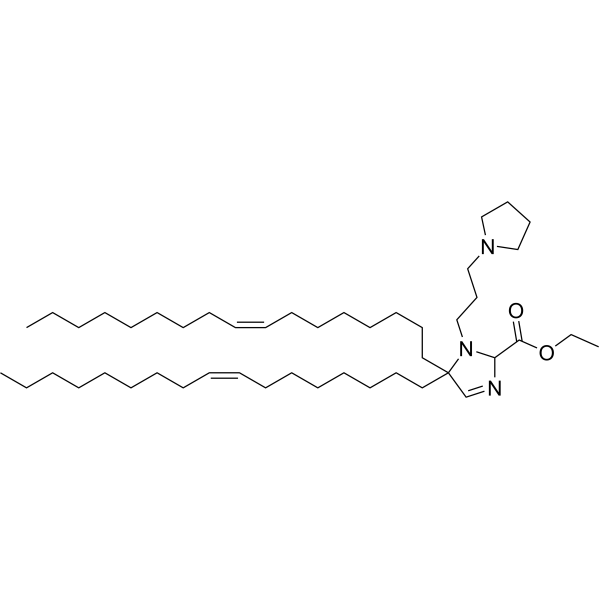
Physicochemical Properties
| Molecular Formula | C47H87N3O2 |
| Molecular Weight | 726.21 |
| Exact Mass | 725.679 |
| CAS # | 2412492-07-8 |
| PubChem CID | 146461367 |
| Appearance | Light yellow to yellow liquid(Density:0.95±0.1 g/cm3) |
| LogP | 16.6 |
| Hydrogen Bond Donor Count | 0 |
| Hydrogen Bond Acceptor Count | 5 |
| Rotatable Bond Count | 37 |
| Heavy Atom Count | 52 |
| Complexity | 868 |
| Defined Atom Stereocenter Count | 0 |
| SMILES | CCCCCCCC/C=C\CCCCCCCC1(N(C(N=C1)C(=O)OCC)CCCN2CCCC2)CCCCCCC/C=C\CCCCCCCC |
| InChi Key | WMYPEEPUVOTFJU-WRBBJXAJSA-N |
| InChi Code | InChI=1S/C47H87N3O2/c1-4-7-9-11-13-15-17-19-21-23-25-27-29-31-33-38-47(39-34-32-30-28-26-24-22-20-18-16-14-12-10-8-5-2)44-48-45(46(51)52-6-3)50(47)43-37-42-49-40-35-36-41-49/h19-22,44-45H,4-18,23-43H2,1-3H3/b21-19-,22-20- |
| Chemical Name | ethyl 5,5-bis[(Z)-heptadec-8-enyl]-1-(3-pyrrolidin-1-ylpropyl)-2H-imidazole-2-carboxylate |
| HS Tariff Code | 2934.99.9001 |
| Storage |
Powder-20°C 3 years 4°C 2 years In solvent -80°C 6 months -20°C 1 month Note: (1). This product requires protection from light (avoid light exposure) during transportation and storage.(2). Please store this product in a sealed and protected environment (e.g. under nitrogen), avoid exposure to moisture. |
| Shipping Condition | Room temperature (This product is stable at ambient temperature for a few days during ordinary shipping and time spent in Customs) |
Biological Activity
| ln Vivo | A2-Iso5-2DC18 transfects central antigen-presenting cells (APCs) in the A14 /Cre mRNA mouse model by loading it with either mLuc or Cre-recombinase mRNA LNPs (mCre) at doses of 0.1 mg/kg and 0.5 mg/kg, subcutaneously, once every week for two weeks[1]. In the B16F10 mouse melanoma model, A2-Iso5-2DC18 loaded with OVA mRNA (mOVA) vaccination (15 μg mOVA per animal; sc; twice dosage, once every 5 d) elicits a robust IFN-ɤ production concurrently with a significantly high antigen-specific cytotoxic T lymphocyte (CTL) response[1]. |
| Animal Protocol |
Animal/Disease Models: A14/Cre mRNA mouse model (female B6 mice)[1] Doses: Loaded with Cre-recombinase mRNA LNPs (mCre ); 0.1 mg/kg and 0.5 mg/kg Route of Administration: subcutaneous (sc) injection; 3 weeks Experimental Results: Induced protein expression in the local injection site and the draining lymph nodes and transfected central antigen presenting cells (APCs) including macrophages/monocytes (CD11b+) and dendritic cells (CD11c+) in mice. Animal/Disease Models: Ovalbumin (OVA)-expressing B16F10 mouse melanoma model[1] Doses: Loaded with OVA mRNA (mOVA) vaccine; 15 μg mOVA per mouse Route of Administration: subcutaneous (sc) injection; once per week for the first two weeks; 3 weeks continuous observation Experimental Results: Dramatically diminished tumor volume of B16-OVA melanoma and improved overall survival in mice. Increased the number of systemic and tumor-infiltrating antigen-specific T cells dramatically (20–30-fold). |
| References | [1]. Miao L, et al. Delivery of mRNA vaccines with heterocyclic lipids increases anti-tumor efficacy by STING-mediated immune cell activation. Nat Biotechnol. 2019 Oct;37(10):1174-1185. |
Solubility Data
| Solubility (In Vitro) | DMSO: 100 mg/mL (137.70 mM) |
| Solubility (In Vivo) |
Solubility in Formulation 1: ≥ 2.5 mg/mL (3.44 mM) (saturation unknown) in 10% DMSO + 40% PEG300 + 5% Tween80 + 45% Saline (add these co-solvents sequentially from left to right, and one by one), clear solution. For example, if 1 mL of working solution is to be prepared, you can add 100 μL of 25.0 mg/mL clear DMSO stock solution to 400 μL PEG300 and mix evenly; then add 50 μL Tween-80 to the above solution and mix evenly; then add 450 μL normal saline to adjust the volume to 1 mL. Preparation of saline: Dissolve 0.9 g of sodium chloride in 100 mL ddH₂ O to obtain a clear solution. Solubility in Formulation 2: 2.5 mg/mL (3.44 mM) in 10% DMSO + 90% (20% SBE-β-CD in Saline) (add these co-solvents sequentially from left to right, and one by one), suspension solution; with ultrasonication. For example, if 1 mL of working solution is to be prepared, you can add 100 μL of 25.0 mg/mL clear DMSO stock solution to 900 μL of 20% SBE-β-CD physiological saline solution and mix evenly. Preparation of 20% SBE-β-CD in Saline (4°C,1 week): Dissolve 2 g SBE-β-CD in 10 mL saline to obtain a clear solution. Solubility in Formulation 3: ≥ 2.5 mg/mL (3.44 mM) (saturation unknown) in 10% DMSO + 90% Corn Oil (add these co-solvents sequentially from left to right, and one by one), clear solution. For example, if 1 mL of working solution is to be prepared, you can add 100 μL of 25.0 mg/mL clear DMSO stock solution to 900 μL of corn oil and mix evenly. (Please use freshly prepared in vivo formulations for optimal results.) |
| Preparing Stock Solutions | 1 mg | 5 mg | 10 mg | |
| 1 mM | 1.3770 mL | 6.8851 mL | 13.7701 mL | |
| 5 mM | 0.2754 mL | 1.3770 mL | 2.7540 mL | |
| 10 mM | 0.1377 mL | 0.6885 mL | 1.3770 mL |