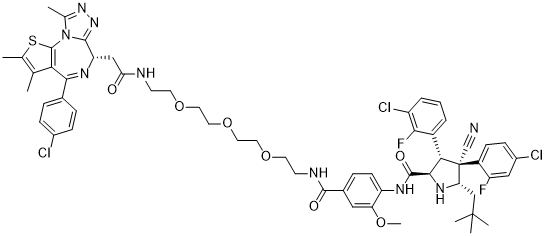
Physicochemical Properties
| Molecular Formula | C58H62CL3F2N9O7S |
| Molecular Weight | 1173.58979654312 |
| Exact Mass | 1171.352 |
| CAS # | 2064292-12-0 |
| PubChem CID | 124201003 |
| Appearance | White to off-white solid powder |
| LogP | 8.9 |
| Hydrogen Bond Donor Count | 4 |
| Hydrogen Bond Acceptor Count | 15 |
| Rotatable Bond Count | 23 |
| Heavy Atom Count | 80 |
| Complexity | 2150 |
| Defined Atom Stereocenter Count | 5 |
| SMILES | ClC1=CC=CC(=C1F)[C@H]1[C@H](C(NC2C=CC(C(NCCOCCOCCOCCNC(C[C@H]3C4=NN=C(C)N4C4=C(C(C)=C(C)S4)C(C4C=CC(=CC=4)Cl)=N3)=O)=O)=CC=2OC)=O)N[C@@H](CC(C)(C)C)[C@]1(C#N)C1C=CC(=CC=1F)Cl |
| InChi Key | IPNTVOAQOGRLQB-JJMBTQCASA-N |
| InChi Code | InChI=1S/C58H62Cl3F2N9O7S/c1-32-33(2)80-56-48(32)51(35-11-14-37(59)15-12-35)67-44(53-71-70-34(3)72(53)56)29-47(73)65-19-21-77-23-25-79-26-24-78-22-20-66-54(74)36-13-18-43(45(27-36)76-7)68-55(75)52-49(39-9-8-10-41(61)50(39)63)58(31-64,46(69-52)30-57(4,5)6)40-17-16-38(60)28-42(40)62/h8-18,27-28,44,46,49,52,69H,19-26,29-30H2,1-7H3,(H,65,73)(H,66,74)(H,68,75)/t44-,46-,49-,52+,58-/m0/s1 |
| Chemical Name | (2R,3S,4R,5S)-3-(3-chloro-2-fluorophenyl)-4-(4-chloro-2-fluorophenyl)-N-[4-[2-[2-[2-[2-[[2-[(9S)-7-(4-chlorophenyl)-4,5,13-trimethyl-3-thia-1,8,11,12-tetrazatricyclo[8.3.0.02,6]trideca-2(6),4,7,10,12-pentaen-9-yl]acetyl]amino]ethoxy]ethoxy]ethoxy]ethylcarbamoyl]-2-methoxyphenyl]-4-cyano-5-(2,2-dimethylpropyl)pyrrolidine-2-carboxamide |
| HS Tariff Code | 2934.99.9001 |
| Storage |
Powder-20°C 3 years 4°C 2 years In solvent -80°C 6 months -20°C 1 month Note: Please store this product in a sealed and protected environment (e.g. under nitrogen), avoid exposure to moisture. |
| Shipping Condition | Room temperature (This product is stable at ambient temperature for a few days during ordinary shipping and time spent in Customs) |
Biological Activity
| Targets |
Bromodomain-containing protein 4 (BRD4). A1874 is a heterobifunctional PROTAC designed to recruit BRD4 to the E3 ubiquitin ligase MDM2, leading to BRD4 ubiquitination and subsequent proteasomal degradation. It also binds to and inhibits MDM2, resulting in stabilization of the tumor suppressor p53.[1] |
| ln Vitro |
Treatment of HCT116 cells with A1874 (0-10 μM, 24 hours) increased p53 levels in HCT116 cells and quantitatively demonstrated p53 stability. Treatment of BRD4 levels induced ligation knockdown, with near maximal knockdown at 100 nmol/L and maximal degradation of BRD4 in control (0.1% DMSO treated) cells [1]. In HCT116 colorectal cancer cells (wild-type p53), treatment with increasing concentrations of A1874 for 24 hours induced a dose-dependent knockdown of BRD4 protein levels, with a maximum degradation (Dmax) of 98% compared to DMSO-treated control cells and a DC50 (half-maximal degradation concentration) of 32 nM. This degradation led to a downstream suppression of c-Myc protein expression by 85%.[1] Concurrently, A1874 treatment stabilized p53 protein levels in HCT116 cells in a dose-dependent manner, up to 5.9-fold over steady-state levels. This p53 stabilization was sufficient to upregulate the expression of its effector protein p21CIP1/WAF1.[1] In cell viability assays (MTS assay), A1874 demonstrated potent anti-proliferative activity. In HCT116 cells treated for 48 hours, A1874 caused a 97% loss of viability. In A375 melanoma cells (wild-type p53), it caused a 98% loss of viability. This effect was significantly greater than the effects of its individual component ligands (JQ1 and idasanutlin) alone or in combination, indicating a synergistic antiproliferative effect, as confirmed by Bliss Independence analysis (Combination Index < 1 at concentrations ≥100 nM in HCT116 cells and ≥250 nM in A375 cells).[1] The anti-proliferative activity of A1874 was highly dependent on the p53 status of the cell lines. In cell lines with wild-type p53 (HCT116, A375, MOLM-13, SJSA-1), A1874 was highly effective. In contrast, in cell lines with mutant or null p53 (NCI-H2030, HT29, p53-/- HCT116), A1874 showed markedly reduced effectiveness in reducing cell viability.[1] Compared to a VHL-recruiting BRD4-degrading PROTAC (A743) with similar BRD4 degradation potency (DC50 = 23.1 nM) and efficacy (Dmax = 89%), A1874 was more effective at reducing viability in wild-type p53 cell lines but less effective in p53 mutant/null lines, highlighting the contribution of its p53-stabilizing activity.[1] An inactive diastereomeric analog of A1874, A1875, which has greatly reduced MDM2 binding affinity, showed substantially diminished ability to degrade BRD4, stabilize p53, and reduce cell viability, confirming that the activity of A1874 is dependent on efficient engagement of MDM2.[1] |
| Cell Assay |
Western Blot Analysis[1] Cell Types: HCT116 cells. Tested Concentrations: 0-10 μM. Incubation Duration: 24 hrs (hours). Experimental Results: Induced dose-dependent knockdown of BRD4 levels, approaching maximal knockdown of 100 nM. Increased p53 levels and demonstrated dose-dependent p53 stability. Immunoblotting (Western Blot): Cultured cells (e.g., HCT116) were incubated with A1874, its component ligands (JQ1, idasanutlin), or control (DMSO) for 24 hours. Cells were then rinsed with ice-cold PBS and lysed in a buffer containing Tris HCl, Nonidet P-40, deoxycholic acid, and protease inhibitors (pepstatin A, leupeptin, bestatin, aprotinin). Lysis proceeded on ice for 15 minutes. Lysates were centrifuged, and the supernatants were subjected to SDS-PAGE. Proteins were electrophoretically transferred to nitrocellulose membranes. Membranes were probed with primary antibodies against proteins of interest (e.g., BRD4, c-Myc, p53, p21CIP1/WAF1, GAPDH) and then with appropriate horseradish peroxidase (HRP)-linked secondary antibodies. Protein bands were visualized using a chemiluminescence imaging system, and band intensities were quantified using image analysis software.[1] Cell Viability Assay (MTS Assay): Cells were seeded into 96-well plates. After adherence, cells were incubated with indicated concentrations of A1874, component ligands, or DMSO control for 48 hours. MTS reagent and phenazine methosulfate (PMS) were then added to each well to final concentrations of 330 µg/mL and 25 µM, respectively. The plates were incubated further to allow viable cells to convert MTS into a colored formazan product. The absorbance of the formazan product was measured at 490 nm using a plate reader. Cell viability was calculated relative to control-treated cells. Data analysis and graphing were performed using statistical software. To assess synergy between the activities of A1874's components, the Combination Index (CI) was calculated using the Bliss Independence model based on the viability effects of A1874, JQ1, and idasanutlin at each concentration.[1] |
| References |
[1]. MDM2-Recruiting PROTAC Offers Superior, Synergistic Antiproliferative Activity via Simultaneous Degradation of BRD4 and Stabilization of p53. Cancer Res. 2019 Jan 1;79(1):251-262. |
| Additional Infomation |
A1874 is a proteolysis-targeting chimera (PROTAC) molecule. It is synthesized by tethering the BET bromodomain inhibitor JQ1 (which targets BRD4) to the MDM2 antagonist idasanutlin via a 13-atom polyethylene glycol (PEG)-based linker.[1] Its mechanism of action is dual: 1) It recruits the E3 ubiquitin ligase MDM2 to BRD4, inducing BRD4 ubiquitination and proteasomal degradation, leading to downregulation of oncogenic signals such as c-Myc. 2) Simultaneously, its idasanutlin moiety inhibits MDM2, disrupting MDM2-mediated degradation of the tumor suppressor p53, resulting in p53 stabilization and activation of p53-dependent pathways (e.g., p21 upregulation).[1] This combination of target protein degradation and tumor suppressor stabilization within a single molecule leads to a synergistic anti-proliferative effect in cancer cells with wild-type p53, which is more potent than the effects of individual inhibitors or a PROTAC recruiting a different E3 ligase (e.g., VHL) without p53-stabilizing activity.[1] The study highlights the potential of expanding the repertoire of E3 ligases used in PROTAC design, particularly those like MDM2 whose ligands can confer additional therapeutic benefits beyond target degradation.[1] |
Solubility Data
| Solubility (In Vitro) | DMSO : ~150 mg/mL (~127.81 mM) |
| Solubility (In Vivo) |
Solubility in Formulation 1: ≥ 2.5 mg/mL (2.13 mM) (saturation unknown) in 10% DMSO + 40% PEG300 + 5% Tween80 + 45% Saline (add these co-solvents sequentially from left to right, and one by one), clear solution. For example, if 1 mL of working solution is to be prepared, you can add 100 μL of 25.0 mg/mL clear DMSO stock solution to 400 μL PEG300 and mix evenly; then add 50 μL Tween-80 to the above solution and mix evenly; then add 450 μL normal saline to adjust the volume to 1 mL. Preparation of saline: Dissolve 0.9 g of sodium chloride in 100 mL ddH₂ O to obtain a clear solution. Solubility in Formulation 2: ≥ 2.5 mg/mL (2.13 mM) (saturation unknown) in 10% DMSO + 90% Corn Oil (add these co-solvents sequentially from left to right, and one by one), clear solution. For example, if 1 mL of working solution is to be prepared, you can add 100 μL of 25.0 mg/mL clear DMSO stock solution to 900 μL of corn oil and mix evenly. (Please use freshly prepared in vivo formulations for optimal results.) |
| Preparing Stock Solutions | 1 mg | 5 mg | 10 mg | |
| 1 mM | 0.8521 mL | 4.2604 mL | 8.5209 mL | |
| 5 mM | 0.1704 mL | 0.8521 mL | 1.7042 mL | |
| 10 mM | 0.0852 mL | 0.4260 mL | 0.8521 mL |