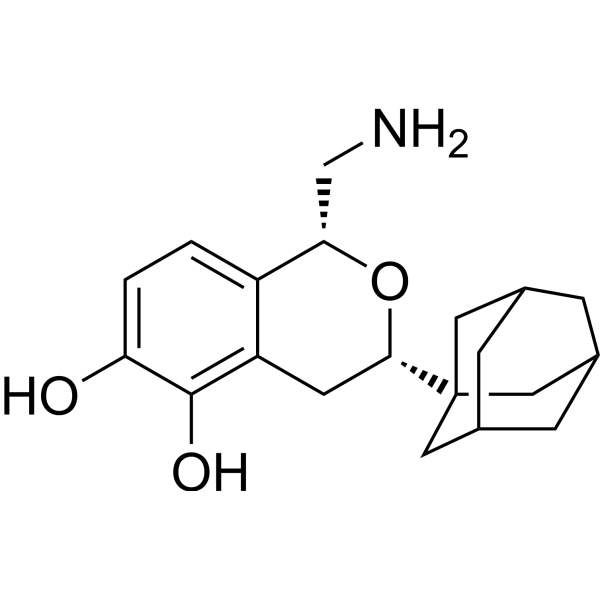
Physicochemical Properties
| Molecular Formula | C20H27NO3 |
| Molecular Weight | 329.433285951614 |
| Exact Mass | 329.199 |
| CAS # | 778546-51-3 |
| Related CAS # | A-77636 hydrochloride;145307-34-2 |
| PubChem CID | 6603703 |
| Appearance | Typically exists as solid at room temperature |
| LogP | 3.955 |
| Hydrogen Bond Donor Count | 3 |
| Hydrogen Bond Acceptor Count | 4 |
| Rotatable Bond Count | 2 |
| Heavy Atom Count | 24 |
| Complexity | 454 |
| Defined Atom Stereocenter Count | 2 |
| SMILES | O1[C@@H](CN)C2C=CC(=C(C=2C[C@H]1C12CC3CC(CC(C3)C1)C2)O)O |
| InChi Key | QLJOSZATCBCBDR-DFKUFRTHSA-N |
| InChi Code | InChI=1S/C20H27NO3/c21-10-17-14-1-2-16(22)19(23)15(14)6-18(24-17)20-7-11-3-12(8-20)5-13(4-11)9-20/h1-2,11-13,17-18,22-23H,3-10,21H2/t11?,12?,13?,17-,18-,20?/m0/s1 |
| Chemical Name | (1R,3S)-3-(1-adamantyl)-1-(aminomethyl)-3,4-dihydro-1H-isochromene-5,6-diol |
| HS Tariff Code | 2934.99.9001 |
| Storage |
Powder-20°C 3 years 4°C 2 years In solvent -80°C 6 months -20°C 1 month |
| Shipping Condition | Room temperature (This product is stable at ambient temperature for a few days during ordinary shipping and time spent in Customs) |
Biological Activity
| Targets | Dopamine D1 receptor 1.1 nM (EC50) Dopamine D1 receptor 39.8 nM (Ki) |
| ln Vivo | Rats lesioned with 6-OHDA (ED50=0.32 μmol/kg sc) exhibit rotating behavior when exposed to A-77636 (0-3.2 μmol/kg, sc)[1]. Locomotor activity generated by addictive agents is dose-dependently attenuated by A-77636 (1–10 mg/kg)[2]. Rats (ED50=12.3 μmol/kg sc) and mice (ED50=12.1 μmol/kg sc) both develop forelimb clonus when exposed to A-77636[1]. A-77636 (0.5, 1.0, or 2.0 μmol/kg, orally) improved locomotor activity and lessened the severity of parkinsonian-like symptoms in marmosets treated with MPTP to create a parkinsonian-like condition. The compound was given subcutaneously or orally, and all forms of administration are active[1]. |
| Animal Protocol |
Animal/Disease Models: Rats with unilateral 6-OHDA (6-hydroxydopamine) lesions of the nigrostriatal pathway (six/group)[1] Doses: 0.32, 1.0, 3.2 μmol/kg Route of Administration: subcutaneously (sc) Experimental Results: Elicited prolonged (> 20 h) contralateral turning, which was blocked by SCH 23390, a D1 receptor antagonist, but not by haloperidol at doses selective for the dopamine D2 receptor. Animal/Disease Models: Male Swiss Webster mice (18-25 g, five or six per cage)[2] Doses: 1, 3, 10 mg/kg Route of Administration: Experimental Results: Attenuated addiction-induced locomotor activity in a dose-dependent manner. When administered alone, 1 and 3 mg/kg A-77636 produced little change in locomotor activity, whereas 10 mg/ kg produced a significant and substantial decrease in locomotor activity. |
| References |
[1]. A-77636: a potent and selective dopamine D1 receptor agonist with antiparkinsonian activity in marmosets. Eur J Pharmacol. 1992 Dec 15;229(2-3):203-9. [2]. Comparison of interactions of D1-like agonists, SKF 81297, SKF 82958 and A-77636, with cocaine: locomotor activity and drug discrimination studies in rodents. Psychopharmacology (Berl). 2002 Jan;159(2):145-53. |
| Additional Infomation | (1R,3S)-3-(adamantan-1-yl)-1-(aminomethyl)-3,4-dihydroisochromene-5,6-diol is an isochromene that is 3,4-dihydroisochromene-5,6-diol bearing additional aminomethyl and 1-adamantyl substituents at positions 1 and 3 respectively (the 1R,3S-diastereomer). Potent and selective dopamine D1-like receptor agonist (pEC50 values are 8.97 and < 5 for D1-like and D2-like receptors respectively). Displays anti-Parkinsonian activity following oral administration in vivo. It has a role as an antiparkinson drug and a dopamine agonist. It is a member of adamantanes, a member of isochromenes, a member of catechols and a primary amino compound. It is a conjugate base of a (1R,3S)-3-(adamantan-1-yl)-1-(ammoniomethyl)-3,4-dihydroisochromene-5,6-diol(1+). |
Solubility Data
| Solubility (In Vitro) | May dissolve in DMSO (in most cases), if not, try other solvents such as H2O, Ethanol, or DMF with a minute amount of products to avoid loss of samples |
| Solubility (In Vivo) |
Note: Listed below are some common formulations that may be used to formulate products with low water solubility (e.g. < 1 mg/mL), you may test these formulations using a minute amount of products to avoid loss of samples. Injection Formulations (e.g. IP/IV/IM/SC) Injection Formulation 1: DMSO : Tween 80: Saline = 10 : 5 : 85 (i.e. 100 μL DMSO stock solution → 50 μL Tween 80 → 850 μL Saline) *Preparation of saline: Dissolve 0.9 g of sodium chloride in 100 mL ddH ₂ O to obtain a clear solution. Injection Formulation 2: DMSO : PEG300 :Tween 80 : Saline = 10 : 40 : 5 : 45 (i.e. 100 μL DMSO → 400 μLPEG300 → 50 μL Tween 80 → 450 μL Saline) Injection Formulation 3: DMSO : Corn oil = 10 : 90 (i.e. 100 μL DMSO → 900 μL Corn oil) Example: Take the Injection Formulation 3 (DMSO : Corn oil = 10 : 90) as an example, if 1 mL of 2.5 mg/mL working solution is to be prepared, you can take 100 μL 25 mg/mL DMSO stock solution and add to 900 μL corn oil, mix well to obtain a clear or suspension solution (2.5 mg/mL, ready for use in animals). Injection Formulation 4: DMSO : 20% SBE-β-CD in saline = 10 : 90 [i.e. 100 μL DMSO → 900 μL (20% SBE-β-CD in saline)] *Preparation of 20% SBE-β-CD in Saline (4°C,1 week): Dissolve 2 g SBE-β-CD in 10 mL saline to obtain a clear solution. Injection Formulation 5: 2-Hydroxypropyl-β-cyclodextrin : Saline = 50 : 50 (i.e. 500 μL 2-Hydroxypropyl-β-cyclodextrin → 500 μL Saline) Injection Formulation 6: DMSO : PEG300 : castor oil : Saline = 5 : 10 : 20 : 65 (i.e. 50 μL DMSO → 100 μLPEG300 → 200 μL castor oil → 650 μL Saline) Injection Formulation 7: Ethanol : Cremophor : Saline = 10: 10 : 80 (i.e. 100 μL Ethanol → 100 μL Cremophor → 800 μL Saline) Injection Formulation 8: Dissolve in Cremophor/Ethanol (50 : 50), then diluted by Saline Injection Formulation 9: EtOH : Corn oil = 10 : 90 (i.e. 100 μL EtOH → 900 μL Corn oil) Injection Formulation 10: EtOH : PEG300:Tween 80 : Saline = 10 : 40 : 5 : 45 (i.e. 100 μL EtOH → 400 μLPEG300 → 50 μL Tween 80 → 450 μL Saline) Oral Formulations Oral Formulation 1: Suspend in 0.5% CMC Na (carboxymethylcellulose sodium) Oral Formulation 2: Suspend in 0.5% Carboxymethyl cellulose Example: Take the Oral Formulation 1 (Suspend in 0.5% CMC Na) as an example, if 100 mL of 2.5 mg/mL working solution is to be prepared, you can first prepare 0.5% CMC Na solution by measuring 0.5 g CMC Na and dissolve it in 100 mL ddH2O to obtain a clear solution; then add 250 mg of the product to 100 mL 0.5% CMC Na solution, to make the suspension solution (2.5 mg/mL, ready for use in animals). Oral Formulation 3: Dissolved in PEG400 Oral Formulation 4: Suspend in 0.2% Carboxymethyl cellulose Oral Formulation 5: Dissolve in 0.25% Tween 80 and 0.5% Carboxymethyl cellulose Oral Formulation 6: Mixing with food powders Note: Please be aware that the above formulations are for reference only. InvivoChem strongly recommends customers to read literature methods/protocols carefully before determining which formulation you should use for in vivo studies, as different compounds have different solubility properties and have to be formulated differently. (Please use freshly prepared in vivo formulations for optimal results.) |
| Preparing Stock Solutions | 1 mg | 5 mg | 10 mg | |
| 1 mM | 3.0355 mL | 15.1777 mL | 30.3555 mL | |
| 5 mM | 0.6071 mL | 3.0355 mL | 6.0711 mL | |
| 10 mM | 0.3036 mL | 1.5178 mL | 3.0355 mL |