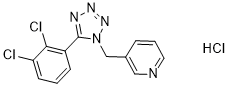
A-438079 HCl (A438079; A 438079), the hydrochloride salt of -438079, is a novel, potent, and selective P2X7 receptor antagonist with anti-Parkinson's disease effects. It inhibits P2X7 receptor with a pIC50 of 6.9. A438079 protects against acetaminophen-induced liver injury by inhibiting p450 isoenzymes, not by inflammasome activation. A-438079 reduced electrographic and clinical seizure severity during status epilepticus and reduced seizure-induced neuronal death in the neocortex. Blockade of P2X(7) receptors may represent a novel protective strategy for striatal DA terminals in Parkinson's disease.
Physicochemical Properties
| Molecular Formula | C13H10CL3N5 | |
| Molecular Weight | 342.61 | |
| Exact Mass | 341 | |
| CAS # | 899431-18-6 | |
| Related CAS # | 899507-36-9 | |
| PubChem CID | 11688742 | |
| Appearance | White to off-white solid powder | |
| LogP | 3.892 | |
| Hydrogen Bond Donor Count | 1 | |
| Hydrogen Bond Acceptor Count | 4 | |
| Rotatable Bond Count | 3 | |
| Heavy Atom Count | 21 | |
| Complexity | 319 | |
| Defined Atom Stereocenter Count | 0 | |
| InChi Key | MBTJFFMIPPMRGR-UHFFFAOYSA-N | |
| InChi Code | InChI=1S/C13H9Cl2N5.ClH/c14-11-5-1-4-10(12(11)15)13-17-18-19-20(13)8-9-3-2-6-16-7-9;/h1-7H,8H2;1H | |
| Chemical Name | 3-[[5-(2,3-dichlorophenyl)tetrazol-1-yl]methyl]pyridine;hydrochloride | |
| Synonyms |
|
|
| HS Tariff Code | 2934.99.9001 | |
| Storage |
Powder-20°C 3 years 4°C 2 years In solvent -80°C 6 months -20°C 1 month Note: Please store this product in a sealed and protected environment, avoid exposure to moisture. |
|
| Shipping Condition | Room temperature (This product is stable at ambient temperature for a few days during ordinary shipping and time spent in Customs) |
Biological Activity
| Targets |
P2X7 receptor [3] |
| ln Vitro | A 438079, with an IC50 of 321 nM, suppresses BzATP-(10 μM) induced increases in intracellular calcium concentrations in 1321N1 cells that express rat P2X7 receptors consistently. Up to 100 μM of A 438079 is likewise selective for the P2X7 receptor[1]. |
| ln Vivo |
In neuropathic rats, 438079 (80 μmol/kg, iv) decreases both benign and harmful evoked activity of various spinal neuron classes. 438079 (i.p., 100 and 300 μmol/kg) as a signi?increases withdrawal thresholds in the SNL and CCI models significantly[1]. A 438079 (5 and 15 mg/kg) injected intraperitoneally 60 minutes after seizures begin lessens the intensity of the convulsions and hippocampal neuronal loss. When A 438079 is administered at the same dose of 25 mg/kg of phenobarbital, the neuroprotective effects are greater[2]. ?A 438079 somewhat, but meaningfully?effectively stops the striatal DA reserves from being depleted by 6-OHDA[3]. In the HC model, pretreatment with A 438079 lowers nociceptive behavior scores[4]. Neuroprotective effect in Parkinson's disease (PD) rat model: A-438079 HCl treatment protected dopaminergic neurons in the substantia nigra pars compacta (SNpc) of rats with 6-hydroxydopamine (6-OHDA)-induced PD. At doses of 3 mg/kg and 10 mg/kg (i.p.), the compound significantly reduced the loss of tyrosine hydroxylase (TH)-positive neurons in the SNpc compared to vehicle-treated PD rats, with protection rates of 42% and 58% respectively [3] - Preservation of striatal dopamine levels: Administration of A-438079 HCl (3 mg/kg and 10 mg/kg, i.p.) prevented the decrease in dopamine concentration in the striatum of 6-OHDA-lesioned rats. The striatal dopamine levels in treated rats were 63% and 75% of normal control levels, respectively, compared to 31% in vehicle-treated PD rats [3] - No significant effect at low dose: The 1 mg/kg (i.p.) dose of A-438079 HCl did not show statistically significant neuroprotection or dopamine preservation in the PD rat model [3] |
| Animal Protocol |
Dissolved in Saline; 30 mg/kg; i.p. Sprague-Dawley male rats PD rat model establishment: Male Wistar rats (250-300 g) were anesthetized and stereotaxically injected with 6-hydroxydopamine (6-OHDA) into the right substantia nigra pars compacta (SNpc) to induce dopaminergic neuron degeneration [3] - Drug administration: A-438079 HCl was dissolved in physiological saline. The compound was administered intraperitoneally (i.p.) at doses of 1 mg/kg, 3 mg/kg, and 10 mg/kg. The first dose was given 1 hour before 6-OHDA injection, followed by daily injections for 7 consecutive days after surgery [3] - Control groups: Two control groups were set: normal rats (no 6-OHDA lesion, no drug treatment) and vehicle-treated PD rats (6-OHDA lesion + physiological saline injection with the same volume and schedule as the drug group) [3] - Tissue collection and analysis: Seven days after the last drug administration, rats were sacrificed, and the brain was dissected to isolate the SNpc and striatum. TH-positive neurons in the SNpc were detected by immunohistochemistry, and striatal dopamine levels were measured using high-performance liquid chromatography (HPLC) [3] |
| References |
[1]. P2X7-related modulation of pathological nociception in rats. Neuroscience. 2007 Jun 8;146(4):1817-28. [2]. CNS Neurosci Ther. 2014 Jun;20(6):556-64. [3]. On the role of P2X(7) receptors in dopamine nerve cell degeneration in a rat model of Parkinson's disease: studies with the P2X(7) receptor antagonist A-438079. J Neural Transm (Vienna). 2010 Jun;117(6):681-7. [4]. The role of P2X7 purinergic receptors in inflammatory and nociceptive changes accompanying cyclophosphamide-induced haemorrhagic cystitis in mice. Br J Pharmacol. 2012 Jan;165(1):183-96. |
| Additional Infomation |
See also: A438079 (annotation moved to). A-438079 HCl is a selective P2X7 receptor antagonist used to investigate the role of P2X7 receptors in dopaminergic neuron degeneration in Parkinson's disease [3] - Its neuroprotective effect in the 6-OHDA-induced PD model is hypothesized to be mediated by inhibiting P2X7 receptor-dependent neuroinflammation and oxidative stress, which are key factors in dopaminergic neuron loss [3] |
Solubility Data
| Solubility (In Vitro) |
|
|||
| Solubility (In Vivo) |
Solubility in Formulation 1: ≥ 2.5 mg/mL (7.30 mM) (saturation unknown) in 10% DMSO + 40% PEG300 + 5% Tween80 + 45% Saline (add these co-solvents sequentially from left to right, and one by one), clear solution. For example, if 1 mL of working solution is to be prepared, you can add 100 μL of 25.0 mg/mL clear DMSO stock solution to 400 μL PEG300 and mix evenly; then add 50 μL Tween-80 to the above solution and mix evenly; then add 450 μL normal saline to adjust the volume to 1 mL. Preparation of saline: Dissolve 0.9 g of sodium chloride in 100 mL ddH₂ O to obtain a clear solution. Solubility in Formulation 2: ≥ 2.5 mg/mL (7.30 mM) (saturation unknown) in 10% DMSO + 90% (20% SBE-β-CD in Saline) (add these co-solvents sequentially from left to right, and one by one), clear solution. For example, if 1 mL of working solution is to be prepared, you can add 100 μL of 25.0 mg/mL clear DMSO stock solution to 900 μL of 20% SBE-β-CD physiological saline solution and mix evenly. Preparation of 20% SBE-β-CD in Saline (4°C,1 week): Dissolve 2 g SBE-β-CD in 10 mL saline to obtain a clear solution. Solubility in Formulation 3: ≥ 2.5 mg/mL (7.30 mM) (saturation unknown) in 10% DMSO + 90% Corn Oil (add these co-solvents sequentially from left to right, and one by one), clear solution. For example, if 1 mL of working solution is to be prepared, you can add 100 μL of 25.0 mg/mL clear DMSO stock solution to 900 μL of corn oil and mix evenly. Solubility in Formulation 4: Saline: 30mg/mL (Please use freshly prepared in vivo formulations for optimal results.) |
| Preparing Stock Solutions | 1 mg | 5 mg | 10 mg | |
| 1 mM | 2.9188 mL | 14.5939 mL | 29.1877 mL | |
| 5 mM | 0.5838 mL | 2.9188 mL | 5.8375 mL | |
| 10 mM | 0.2919 mL | 1.4594 mL | 2.9188 mL |