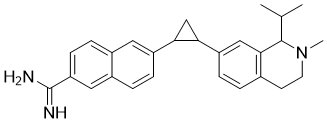
A-317567 (A317567) is a novel non-amiloride inhibitor of the acid-sensing ion channel (ASIC) (IC50 = 1.025 μM) with antidepressant and antinociception effects. It acts on three distinct types of native ASIC currents evoked in acutely dissociated adult rat dorsal root ganglion (DRG) neurons. A-317567 produced concentration-dependent inhibition of all pH 4.5-evoked ASIC currents with an IC50 ranging between 2 and 30muM, depending upon the type of ASIC current activated. Unlike amiloride, A-317567 equipotently blocked the sustained phase of ASIC3-like current, a biphasic current akin to cloned ASIC3, which is predominant in DRG. When evaluated in the rat Complete Freud's Adjuvant (CFA)-induced inflammatory thermal hyperalgesia model, A-317567 was fully efficacious at a dose 10-fold lower than amiloride.
Physicochemical Properties
| Molecular Formula | 397.57 | |
| Molecular Weight | C27H31N3 | |
| Exact Mass | 397.252 | |
| CAS # | 371217-32-2 | |
| Related CAS # |
|
|
| PubChem CID | 10200844 | |
| Appearance | White to off-white solid powder | |
| LogP | 6.317 | |
| Hydrogen Bond Donor Count | 2 | |
| Hydrogen Bond Acceptor Count | 2 | |
| Rotatable Bond Count | 4 | |
| Heavy Atom Count | 30 | |
| Complexity | 630 | |
| Defined Atom Stereocenter Count | 0 | |
| InChi Key | FEPIUXBUJVISNN-UHFFFAOYSA-N | |
| InChi Code | InChI=1S/C27H31N3/c1-16(2)26-25-14-21(7-4-17(25)10-11-30(26)3)24-15-23(24)20-8-5-19-13-22(27(28)29)9-6-18(19)12-20/h4-9,12-14,16,23-24,26H,10-11,15H2,1-3H3,(H3,28,29) | |
| Chemical Name | 6-[2-(2-methyl-1-propan-2-yl-3,4-dihydro-1H-isoquinolin-7-yl)cyclopropyl]naphthalene-2-carboximidamide | |
| Synonyms |
|
|
| HS Tariff Code | 2934.99.9001 | |
| Storage |
Powder-20°C 3 years 4°C 2 years In solvent -80°C 6 months -20°C 1 month Note: This product requires protection from light (avoid light exposure) during transportation and storage. |
|
| Shipping Condition | Room temperature (This product is stable at ambient temperature for a few days during ordinary shipping and time spent in Customs) |
Biological Activity
| ln Vitro | A-317567 generated concentration-dependent suppression of all pH 4.5-evoked ASIC currents in acutely isolated adult rat dorsal root ganglion (DRG) neurons, with an IC50 spanning from 2 to 30 μM. The sustained phase of the ASIC3-like current, a biphasic current resembling the cloned ASIC3 that predominates in the DRG, is efficiently blocked by A-317567 [2]. |
| ln Vivo | In the CFA model, A-317567 (1-100 μmol/kg; ip; once) exhibits complete analgesic action (ED50 = 17 μmol/kg). A-317567 had no discernible impact on contralateral paw withdrawal latency in these circumstances [2]. |
| Animal Protocol |
Animal/Disease Models: Adult male SD (Sprague-Dawley) rats (230-350 g) injected with Complete Freund's Adjuvant- (CFA-) induced thermal hyperalgesia[2]. Doses: 1-100 μmol/kg Route of Administration: ip; once Experimental Results: demonstrated dose- dependent analgesic effects. |
| References |
[1]. Synthesis, structure-activity relationship, and pharmacological profile of analogs of the ASIC-3 inhibitor A-317567. ACS Chem Neurosci. 2010 Jan 20;1(1):19-24. [2]. Electrophysiological and in vivo characterization of A-317567, a novel blocker of acid sensing ion channels. Pain. 2005 Sep;117(1-2):88-96. |
Solubility Data
| Solubility (In Vitro) |
|
|||
| Solubility (In Vivo) |
Solubility in Formulation 1: ≥ 2.08 mg/mL (5.23 mM) (saturation unknown) in 10% DMSO + 40% PEG300 + 5% Tween80 + 45% Saline (add these co-solvents sequentially from left to right, and one by one), clear solution. For example, if 1 mL of working solution is to be prepared, you can add 100 μL of 20.8 mg/mL clear DMSO stock solution to 400 μL PEG300 and mix evenly; then add 50 μL Tween-80 to the above solution and mix evenly; then add 450 μL normal saline to adjust the volume to 1 mL. Preparation of saline: Dissolve 0.9 g of sodium chloride in 100 mL ddH₂ O to obtain a clear solution. Solubility in Formulation 2: ≥ 2.08 mg/mL (5.23 mM) (saturation unknown) in 10% DMSO + 90% Corn Oil (add these co-solvents sequentially from left to right, and one by one), clear solution. For example, if 1 mL of working solution is to be prepared, you can add 100 μL of 20.8 mg/mL clear DMSO stock solution to 900 μL of corn oil and mix evenly. (Please use freshly prepared in vivo formulations for optimal results.) |