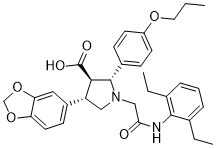
A-192621 is an antagonist of endothelin-B. Endothelins (ETs), 21-amino-acid peptides involved in the pathogenesis of various diseases, bind to ET(A) and ET(B) receptors to initiate their effects. A-192621 can markedly enhance MAP, TPR, and mesenteric, and the renal constrictor effects of ET-1. A-192621 was more effective than IRL-2500 in blocking IRL-1620-induced vasoconstriction, but both augmented constrictor responses to ET-1.
Physicochemical Properties
| Molecular Formula | C33H38N2O6 | |
| Molecular Weight | 558.67 | |
| Exact Mass | 558.273 | |
| CAS # | 195529-54-5 | |
| Related CAS # |
|
|
| PubChem CID | 5310991 | |
| Appearance | White to off-white solid powder | |
| LogP | 6.396 | |
| Hydrogen Bond Donor Count | 2 | |
| Hydrogen Bond Acceptor Count | 7 | |
| Rotatable Bond Count | 11 | |
| Heavy Atom Count | 41 | |
| Complexity | 851 | |
| Defined Atom Stereocenter Count | 3 | |
| SMILES | CCCOC1=CC=C(C=C1)[C@H]2[C@@H]([C@H](CN2CC(=O)NC3=C(C=CC=C3CC)CC)C4=CC5=C(C=C4)OCO5)C(=O)O |
|
| InChi Key | LQEHCKYYIXQEBM-FUKIBTTHSA-N | |
| InChi Code | InChI=1S/C33H38N2O6/c1-4-16-39-25-13-10-23(11-14-25)32-30(33(37)38)26(24-12-15-27-28(17-24)41-20-40-27)18-35(32)19-29(36)34-31-21(5-2)8-7-9-22(31)6-3/h7-15,17,26,30,32H,4-6,16,18-20H2,1-3H3,(H,34,36)(H,37,38)/t26-,30-,32+/m1/s1 | |
| Chemical Name | (2R,3R,4S)-4-(1,3-benzodioxol-5-yl)-1-[2-(2,6-diethylanilino)-2-oxoethyl]-2-(4-propoxyphenyl)pyrrolidine-3-carboxylic acid | |
| Synonyms |
|
|
| HS Tariff Code | 2934.99.9001 | |
| Storage |
Powder-20°C 3 years 4°C 2 years In solvent -80°C 6 months -20°C 1 month |
|
| Shipping Condition | Room temperature (This product is stable at ambient temperature for a few days during ordinary shipping and time spent in Customs) |
Biological Activity
| ln Vitro | In a dose-dependent manner, A-192621 (1-100 μM) treatment for 48 hours dramatically decreased the cell viability of PASMCs [2]. In PASMCs, treatment with A-192621 (1-100 μM; 48 hours) dramatically elevated caspase-3/7 activity and cleaved caspase-3 expression. A-192621 improves the sensitivity of cells to apoptosis caused by doxorubicin treatment and promotes apoptosis in a dose-dependent manner [2]. |
| ln Vivo | Male Sprague-Dawley rats were treated with A-192621 (30-100 mg/kg; PO; daily; for 3 days) to suppress the ETB-mediated S6c-induced dilation and pressor responses. However, the ETA-mediated ET-1-induced pressor response was not inhibited by this treatment, with an ED50 value of 30 mg/kg. In awake normotensive rats, A-192621 alone raises plasma ET-1 levels and arterial blood pressure [3]. |
| Cell Assay |
Cell Viability Assay[2] Cell Types: Pulmonary arterial smooth muscle cells (PASMCs) with Doxorubicin Tested Concentrations: 1 μM, 10 μM, 50 μM, 100 μM Incubation Duration: 72 hrs (hours) Experimental Results: The viability of PASMCs was Dramatically diminished in a dose- dependent manner. Western Blot Analysis[2] Cell Types: Pulmonary arterial smooth muscle cells (PASMCs) with Doxorubicin Tested Concentrations: 1 μM, 10 μM, 100 μM Incubation Duration: 72 hrs (hours) Experimental Results: The caspase-3/7 activity in PASMCs was Dramatically increased in a dose-dependent manner. |
| Animal Protocol |
Animal/Disease Models: Male SD (Sprague-Dawley) rats (250-350 g)[3] Doses: 30 mg/kg 100 mg/kg Route of Administration: Oral administration; daily; for 3 days Experimental Results: Inhibited both dilatory and pressor responses induced by S6c mediated by ETB with an ED50value of 30 mg/kg. |
| References |
[1]. Pharmacology of endothelin receptor antagonists ABT-627, ABT-546, A-182086 and A-192621: in vitro studies. Clin Sci (Lond). 2002 Aug;103 Suppl 48:107S-111S. [2]. Antagonists to endothelin receptor type B promote apoptosis in human pulmonary arterial smooth muscle cells. Life Sci. 2016 Aug 15;159:116-120. [3]. Pharmacology of endothelin receptor antagonists ABT-627, ABT-546, A-182086 and A-192621: ex vivo and in vivo studies. Clin Sci (Lond). 2002 Aug;103 Suppl 48:112S-117S. |
Solubility Data
| Solubility (In Vitro) |
|
|||
| Solubility (In Vivo) |
Solubility in Formulation 1: ≥ 2.5 mg/mL (4.47 mM) (saturation unknown) in 10% DMSO + 40% PEG300 +5% Tween-80 + 45% Saline (add these co-solvents sequentially from left to right, and one by one), clear solution. For example, if 1 mL of working solution is to be prepared, you can add 100 μL of 25.0 mg/mL clear DMSO stock solution to 400 μL PEG300 and mix evenly; then add 50 μL Tween-80 + to the above solution and mix evenly; then add 450 μL normal saline to adjust the volume to 1 mL. Preparation of saline: Dissolve 0.9 g of sodium chloride in 100 mL ddH₂ O to obtain a clear solution. (Please use freshly prepared in vivo formulations for optimal results.) |
| Preparing Stock Solutions | 1 mg | 5 mg | 10 mg | |
| 1 mM | 1.7900 mL | 8.9498 mL | 17.8997 mL | |
| 5 mM | 0.3580 mL | 1.7900 mL | 3.5799 mL | |
| 10 mM | 0.1790 mL | 0.8950 mL | 1.7900 mL |