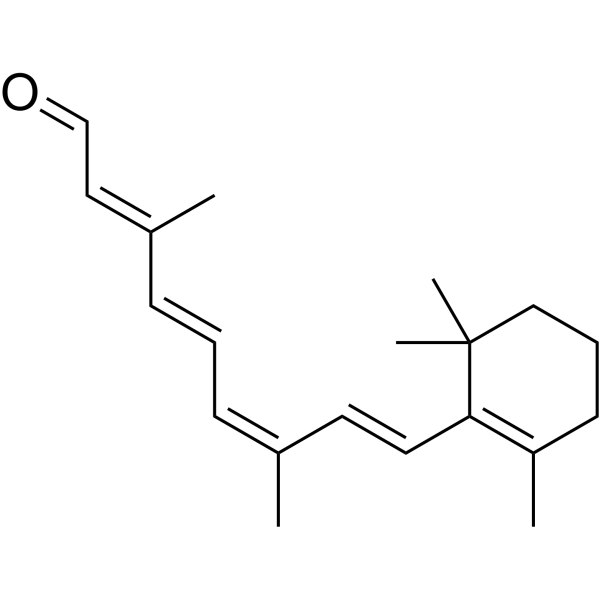
Physicochemical Properties
| Molecular Formula | C₂₀H₂₈O |
| Molecular Weight | 284.44 |
| Exact Mass | 284.214 |
| CAS # | 514-85-2 |
| PubChem CID | 6436082 |
| Appearance | Light yellow to brown solid powder |
| Density | 0.9±0.1 g/cm3 |
| Boiling Point | 421.4±14.0 °C at 760 mmHg |
| Melting Point | 56-58ºC(lit.) |
| Flash Point | 205.4±12.4 °C |
| Vapour Pressure | 0.0±1.0 mmHg at 25°C |
| Index of Refraction | 1.541 |
| LogP | 6.54 |
| Hydrogen Bond Donor Count | 0 |
| Hydrogen Bond Acceptor Count | 1 |
| Rotatable Bond Count | 5 |
| Heavy Atom Count | 21 |
| Complexity | 522 |
| Defined Atom Stereocenter Count | 0 |
| SMILES | CC1=C(C(CCC1)(C)C)/C=C/C(=C\C=C\C(=C\C=O)\C)/C |
| InChi Key | NCYCYZXNIZJOKI-MKOSUFFBSA-N |
| InChi Code | InChI=1S/C20H28O/c1-16(8-6-9-17(2)13-15-21)11-12-19-18(3)10-7-14-20(19,4)5/h6,8-9,11-13,15H,7,10,14H2,1-5H3/b9-6+,12-11+,16-8-,17-13+ |
| Chemical Name | (2E,4E,6Z,8E)-3,7-dimethyl-9-(2,6,6-trimethylcyclohexen-1-yl)nona-2,4,6,8-tetraenal |
| Synonyms | 9cisRetinal; 9 cis Retinal |
| HS Tariff Code | 2934.99.9001 |
| Storage |
Powder-20°C 3 years 4°C 2 years In solvent -80°C 6 months -20°C 1 month Note: (1). This product requires protection from light (avoid light exposure) during transportation and storage.(2). Please store this product in a sealed and protected environment (e.g. under nitrogen), avoid exposure to moisture. |
| Shipping Condition | Room temperature (This product is stable at ambient temperature for a few days during ordinary shipping and time spent in Customs) |
Biological Activity
| ln Vitro | In organoid cells, the addition of 9-cis-Retinal, as opposed to the commonly employed all-trans retinoic acid, accelerates rod photoreceptor maturation, with stronger rhodopsin expression and more mature mitochondrial morphology seen by day. Rhodopsin that functions can be formed by binding opsin with 9-cis-Retinal[3]. |
| ln Vivo | In interphotoreceptor retinoid-binding protein (IRBP)-/-mice, treatment with 9-cis-retinal resulted in a considerable recovery of the cone response, indicating that retinoid insufficiency is the cause of cone dysfunction[4]. |
| ADME/Pharmacokinetics |
Metabolism / Metabolites 9-cis-retinal has known human metabolites that include 4-hydroxy-9-cis-retinals. |
| References |
[1]. Binding affinities of CRBPI and CRBPII for 9-cis-retinoids.Biochim Biophys Acta. 2011 May;1810(5):514-8. [2]. Identification and characterization of a stereospecific human enzyme that catalyzes 9-cis-retinol oxidation. A possible role in 9-cis-retinoic acid formation. J Biol Chem. 1997 May 2;272(18):11744-9. [3]. Transcriptome-based molecular staging of human stem cell-derived retinal organoids uncovers accelerated photoreceptor differentiation by 9-cis retinal. Mol Vis. 2019 Nov 11;25:663-678. [4]. Normal cone function requires the interphotoreceptor retinoid binding protein. J Neurosci. 2009 Apr 8;29(14):4616-21. |
| Additional Infomation | 9-cis-retinal is a retinal in which the double bond at position 9 has cis configuration, whilst the remaining acyclic double bonds have trans configuration. |
Solubility Data
| Solubility (In Vitro) | DMSO : ~16 mg/mL (~56.25 mM) |
| Solubility (In Vivo) |
Note: Listed below are some common formulations that may be used to formulate products with low water solubility (e.g. < 1 mg/mL), you may test these formulations using a minute amount of products to avoid loss of samples. Injection Formulations (e.g. IP/IV/IM/SC) Injection Formulation 1: DMSO : Tween 80: Saline = 10 : 5 : 85 (i.e. 100 μL DMSO stock solution → 50 μL Tween 80 → 850 μL Saline) *Preparation of saline: Dissolve 0.9 g of sodium chloride in 100 mL ddH ₂ O to obtain a clear solution. Injection Formulation 2: DMSO : PEG300 :Tween 80 : Saline = 10 : 40 : 5 : 45 (i.e. 100 μL DMSO → 400 μLPEG300 → 50 μL Tween 80 → 450 μL Saline) Injection Formulation 3: DMSO : Corn oil = 10 : 90 (i.e. 100 μL DMSO → 900 μL Corn oil) Example: Take the Injection Formulation 3 (DMSO : Corn oil = 10 : 90) as an example, if 1 mL of 2.5 mg/mL working solution is to be prepared, you can take 100 μL 25 mg/mL DMSO stock solution and add to 900 μL corn oil, mix well to obtain a clear or suspension solution (2.5 mg/mL, ready for use in animals). Injection Formulation 4: DMSO : 20% SBE-β-CD in saline = 10 : 90 [i.e. 100 μL DMSO → 900 μL (20% SBE-β-CD in saline)] *Preparation of 20% SBE-β-CD in Saline (4°C,1 week): Dissolve 2 g SBE-β-CD in 10 mL saline to obtain a clear solution. Injection Formulation 5: 2-Hydroxypropyl-β-cyclodextrin : Saline = 50 : 50 (i.e. 500 μL 2-Hydroxypropyl-β-cyclodextrin → 500 μL Saline) Injection Formulation 6: DMSO : PEG300 : castor oil : Saline = 5 : 10 : 20 : 65 (i.e. 50 μL DMSO → 100 μLPEG300 → 200 μL castor oil → 650 μL Saline) Injection Formulation 7: Ethanol : Cremophor : Saline = 10: 10 : 80 (i.e. 100 μL Ethanol → 100 μL Cremophor → 800 μL Saline) Injection Formulation 8: Dissolve in Cremophor/Ethanol (50 : 50), then diluted by Saline Injection Formulation 9: EtOH : Corn oil = 10 : 90 (i.e. 100 μL EtOH → 900 μL Corn oil) Injection Formulation 10: EtOH : PEG300:Tween 80 : Saline = 10 : 40 : 5 : 45 (i.e. 100 μL EtOH → 400 μLPEG300 → 50 μL Tween 80 → 450 μL Saline) Oral Formulations Oral Formulation 1: Suspend in 0.5% CMC Na (carboxymethylcellulose sodium) Oral Formulation 2: Suspend in 0.5% Carboxymethyl cellulose Example: Take the Oral Formulation 1 (Suspend in 0.5% CMC Na) as an example, if 100 mL of 2.5 mg/mL working solution is to be prepared, you can first prepare 0.5% CMC Na solution by measuring 0.5 g CMC Na and dissolve it in 100 mL ddH2O to obtain a clear solution; then add 250 mg of the product to 100 mL 0.5% CMC Na solution, to make the suspension solution (2.5 mg/mL, ready for use in animals). Oral Formulation 3: Dissolved in PEG400 Oral Formulation 4: Suspend in 0.2% Carboxymethyl cellulose Oral Formulation 5: Dissolve in 0.25% Tween 80 and 0.5% Carboxymethyl cellulose Oral Formulation 6: Mixing with food powders Note: Please be aware that the above formulations are for reference only. InvivoChem strongly recommends customers to read literature methods/protocols carefully before determining which formulation you should use for in vivo studies, as different compounds have different solubility properties and have to be formulated differently. (Please use freshly prepared in vivo formulations for optimal results.) |
| Preparing Stock Solutions | 1 mg | 5 mg | 10 mg | |
| 1 mM | 3.5157 mL | 17.5784 mL | 35.1568 mL | |
| 5 mM | 0.7031 mL | 3.5157 mL | 7.0314 mL | |
| 10 mM | 0.3516 mL | 1.7578 mL | 3.5157 mL |