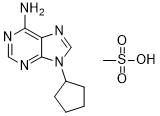
Physicochemical Properties
| Molecular Formula | C11H17N5O3S |
| Molecular Weight | 299.34 |
| Exact Mass | 299.105 |
| CAS # | 189639-09-6 |
| PubChem CID | 6604076 |
| Appearance | White to off-white solid powder |
| Boiling Point | 440.5ºC at 760 mmHg |
| Melting Point | 180-183ºC(lit.) |
| Flash Point | 220.2ºC |
| Vapour Pressure | 5.85E-08mmHg at 25°C |
| LogP | 2.689 |
| Hydrogen Bond Donor Count | 2 |
| Hydrogen Bond Acceptor Count | 7 |
| Rotatable Bond Count | 1 |
| Heavy Atom Count | 20 |
| Complexity | 320 |
| Defined Atom Stereocenter Count | 0 |
| InChi Key | AJMDRSJHCYQPQI-UHFFFAOYSA-N |
| InChi Code | InChI=1S/C10H13N5.CH4O3S/c11-9-8-10(13-5-12-9)15(6-14-8)7-3-1-2-4-7;1-5(2,3)4/h5-7H,1-4H2,(H2,11,12,13);1H3,(H,2,3,4) |
| Chemical Name | 9-cyclopentylpurin-6-amine;methanesulfonic acid |
| Synonyms | 9-CP-Ade Mesylate 9CPAde Mesylate 9 CP Ade Mesylate |
| HS Tariff Code | 2934.99.9001 |
| Storage |
Powder-20°C 3 years 4°C 2 years In solvent -80°C 6 months -20°C 1 month Note: Please store this product in a sealed and protected environment, avoid exposure to moisture. |
| Shipping Condition | Room temperature (This product is stable at ambient temperature for a few days during ordinary shipping and time spent in Customs) |
Biological Activity
| Targets |
9-Cyclopentyladenine (CPA) is an adenylyl cyclase inhibitor. [1] |
| ln Vitro |
9-Cyclopentyladenine monomethanesulfonate (200 μM, 30 min) totally prevents neurogenesis in PC12 cells and suppresses the activation of cAMP response element-binding pigment (CREB) [1]. In the ileum of female CD1 Swiss mice, the effects of 9-cyclopentyladenine monomethane sulfonate (100 μM, 30 min) on mechanorelaxin activity and suppression of mechanorelaxin-induced hypersensitivity[2]. In hairless mice, 9-cyclopentyladenine monomethanesulfonate (100 μM, 6 hours) stimulates cAMP production, which aids in the repair of the duct-forming cell permeability barrier [3]. 9-Cyclopentyladenine (CPA) at a concentration of 200 μM significantly decreased the activation of transcription factor CREB induced by Militarinone A (MILI A) in PC12 cells, as assessed by Western blot analysis using a phospho-specific antibody against CREB (Ser133). [1] 9-Cyclopentyladenine (CPA) at 200 μM completely blocked MILI A-induced neuritogenesis in NGF-primed PC12 cells, as observed by phase contrast microscopy. [1] MILI A did not show a direct activating effect on adenylyl cyclase activity in assays with isolated PC12 membranes, in contrast to forskolin, a known activator of adenylyl cyclase. [1] |
| Enzyme Assay |
Adenylyl cyclase activity was assessed in isolated PC12 cell membranes to determine whether MILI A directly activated the enzyme. Membranes were prepared from PC12 cells, and the activity of adenylyl cyclase was measured in the presence of MILI A or forskolin as a positive control. The assay did not indicate any activating effect of MILI A on adenylyl cyclase, suggesting that MILI A’s effect on cAMP levels might be indirect, possibly via membrane interaction. [1] |
| Cell Assay |
PC12 cells were primed with NGF (50 ng/ml) for 4 days under serum-starved conditions (1% horse serum, 0.5% fetal bovine serum) to enhance TrkA receptor density and sensitivity. Primed cells were then seeded in collagen-coated 24-well plates. After 2 hours of cultivation, cells were pretreated with 9-Cyclopentyladenine (CPA) at 200 μM for 30 minutes, followed by treatment with MILI A (40 μM) for 16–24 hours. Neurite outgrowth was assessed by phase contrast microscopy. CPA completely inhibited MILI A-induced neurite formation, while control cells treated with MILI A alone showed significant neurite outgrowth. [1] Western blot analysis was performed to evaluate the phosphorylation state of CREB. PC12 cells were serum-starved overnight, pretreated with CPA (200 μM) for 30 minutes, and then exposed to MILI A (10 or 40 μM) for 30 minutes or 24 hours. Cells were lysed, and equal amounts of protein were separated by SDS-PAGE, transferred to PVDF membranes, and probed with phospho-specific antibodies against CREB (Ser133). CPA moderately decreased MILI A-induced CREB phosphorylation. [1] |
| Animal Protocol |
Experiments were performed on 8- to 12-week-old female CD1 Swiss strain mice. Animals were housed under a 12-hour light/dark cycle at a constant temperature of 21 ± 1°C with standard laboratory feed. After one week of acclimatization, the phase of the estrous cycle was assessed by vaginal smear cytology, and only mice in proestrus or estrus (estrogen-dominated phases) were used. Mice were killed by cervical dislocation. The abdomen was opened, and the distal ileum (within 30 mm from the ileocaecal valve) was removed and cleaned with physiological solution. For mechanical experiments, ileal segments (10 mm in length) were mounted in organ baths containing Krebs-Henseleit solution (gassed with 95% O2 / 5% CO2, maintained at 37 ± 0.5°C) under an initial tension of 1.5 g. Isometric tension was recorded. For electrophysiological experiments, ileal strips were prepared by dissecting away mucosa and submucosa, and the smooth muscle layer was pinned in a recording chamber for microelectrode impalement. 9-Cyclopentyladenine Mesylate was dissolved and used at a final bath concentration of 100 µmol/L. [2] |
| References |
[1]. Militarinone A induces differentiation in PC12 cells via MAP and Akt kinase signal transduction pathways. FEBS Lett. 2004 Nov 19;577(3):455-9. [2]. Relaxin influences ileal muscular activity through a dual signaling pathway in mice. World J Gastroenterol. 2018 Feb 28;24(8):882-893. [3]. Association of cyclic adenosine monophosphate with permeability barrier homeostasis of murine skin. J Invest Dermatol. 2004 Jan;122(1):140-6. |
| Additional Infomation |
9-Cyclopentyladenine (CPA) is used as a pharmacological tool to inhibit adenylyl cyclase activity in cell-based studies. [1] In the context of MILI A-induced neuritogenesis in PC12 cells, CPA’s inhibitory effect suggests that cAMP elevation and adenylyl cyclase activity may be involved in the neuritogenic signaling pathway, possibly via adenosine receptor-coupled modulation or indirect membrane effects. [1] The complete blockade of neurite outgrowth by CPA, despite only a moderate reduction in CREB phosphorylation, indicates that cAMP-dependent pathways are critical for MILI A-induced differentiation, independent of ERK and PI3K pathways. [1] |
Solubility Data
| Solubility (In Vitro) | DMSO : ~41.67 mg/mL (~139.20 mM) |
| Solubility (In Vivo) |
Note: Listed below are some common formulations that may be used to formulate products with low water solubility (e.g. < 1 mg/mL), you may test these formulations using a minute amount of products to avoid loss of samples. Injection Formulations (e.g. IP/IV/IM/SC) Injection Formulation 1: DMSO : Tween 80: Saline = 10 : 5 : 85 (i.e. 100 μL DMSO stock solution → 50 μL Tween 80 → 850 μL Saline) *Preparation of saline: Dissolve 0.9 g of sodium chloride in 100 mL ddH ₂ O to obtain a clear solution. Injection Formulation 2: DMSO : PEG300 :Tween 80 : Saline = 10 : 40 : 5 : 45 (i.e. 100 μL DMSO → 400 μLPEG300 → 50 μL Tween 80 → 450 μL Saline) Injection Formulation 3: DMSO : Corn oil = 10 : 90 (i.e. 100 μL DMSO → 900 μL Corn oil) Example: Take the Injection Formulation 3 (DMSO : Corn oil = 10 : 90) as an example, if 1 mL of 2.5 mg/mL working solution is to be prepared, you can take 100 μL 25 mg/mL DMSO stock solution and add to 900 μL corn oil, mix well to obtain a clear or suspension solution (2.5 mg/mL, ready for use in animals). Injection Formulation 4: DMSO : 20% SBE-β-CD in saline = 10 : 90 [i.e. 100 μL DMSO → 900 μL (20% SBE-β-CD in saline)] *Preparation of 20% SBE-β-CD in Saline (4°C,1 week): Dissolve 2 g SBE-β-CD in 10 mL saline to obtain a clear solution. Injection Formulation 5: 2-Hydroxypropyl-β-cyclodextrin : Saline = 50 : 50 (i.e. 500 μL 2-Hydroxypropyl-β-cyclodextrin → 500 μL Saline) Injection Formulation 6: DMSO : PEG300 : castor oil : Saline = 5 : 10 : 20 : 65 (i.e. 50 μL DMSO → 100 μLPEG300 → 200 μL castor oil → 650 μL Saline) Injection Formulation 7: Ethanol : Cremophor : Saline = 10: 10 : 80 (i.e. 100 μL Ethanol → 100 μL Cremophor → 800 μL Saline) Injection Formulation 8: Dissolve in Cremophor/Ethanol (50 : 50), then diluted by Saline Injection Formulation 9: EtOH : Corn oil = 10 : 90 (i.e. 100 μL EtOH → 900 μL Corn oil) Injection Formulation 10: EtOH : PEG300:Tween 80 : Saline = 10 : 40 : 5 : 45 (i.e. 100 μL EtOH → 400 μLPEG300 → 50 μL Tween 80 → 450 μL Saline) Oral Formulations Oral Formulation 1: Suspend in 0.5% CMC Na (carboxymethylcellulose sodium) Oral Formulation 2: Suspend in 0.5% Carboxymethyl cellulose Example: Take the Oral Formulation 1 (Suspend in 0.5% CMC Na) as an example, if 100 mL of 2.5 mg/mL working solution is to be prepared, you can first prepare 0.5% CMC Na solution by measuring 0.5 g CMC Na and dissolve it in 100 mL ddH2O to obtain a clear solution; then add 250 mg of the product to 100 mL 0.5% CMC Na solution, to make the suspension solution (2.5 mg/mL, ready for use in animals). Oral Formulation 3: Dissolved in PEG400 Oral Formulation 4: Suspend in 0.2% Carboxymethyl cellulose Oral Formulation 5: Dissolve in 0.25% Tween 80 and 0.5% Carboxymethyl cellulose Oral Formulation 6: Mixing with food powders Note: Please be aware that the above formulations are for reference only. InvivoChem strongly recommends customers to read literature methods/protocols carefully before determining which formulation you should use for in vivo studies, as different compounds have different solubility properties and have to be formulated differently. (Please use freshly prepared in vivo formulations for optimal results.) |
| Preparing Stock Solutions | 1 mg | 5 mg | 10 mg | |
| 1 mM | 3.3407 mL | 16.7034 mL | 33.4068 mL | |
| 5 mM | 0.6681 mL | 3.3407 mL | 6.6814 mL | |
| 10 mM | 0.3341 mL | 1.6703 mL | 3.3407 mL |