Physicochemical Properties
| Exact Mass | 283.091 |
| Elemental Analysis | C, 42.41; H, 4.63; N, 24.73; O, 28.24 |
| CAS # | 88847-89-6 |
| Related CAS # | 8-Hydroxy-2'-deoxyguanosine-15N5;569649-11-2 |
| PubChem CID | 135440064 |
| Appearance | White to off-white solid powder |
| Density | 2.3±0.1 g/cm3 |
| Melting Point | 217-220ºC |
| Index of Refraction | 1.955 |
| LogP | -1.32 |
| Hydrogen Bond Donor Count | 5 |
| Hydrogen Bond Acceptor Count | 6 |
| Rotatable Bond Count | 2 |
| Heavy Atom Count | 20 |
| Complexity | 544 |
| Defined Atom Stereocenter Count | 3 |
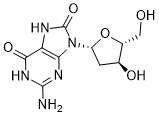
| SMILES | C1[C@@H]([C@H](O[C@H]1N2C3=C(C(=O)NC(=N3)N)NC2=O)CO)O |
| InChi Key | HCAJQHYUCKICQH-VPENINKCSA-N |
| InChi Code | InChI=1S/C10H13N5O5/c11-9-13-7-6(8(18)14-9)12-10(19)15(7)5-1-3(17)4(2-16)20-5/h3-5,16-17H,1-2H2,(H,12,19)(H3,11,13,14,18)/t3-,4+,5+/m0/s1 |
| Chemical Name | 2-amino-9-[(2R,4S,5R)-4-hydroxy-5-(hydroxymethyl)oxolan-2-yl]-1,7-dihydropurine-6,8-dione |
| Synonyms | 8 Oxo dG; 8-OHdG; 88847-89-6; 8-Hydroxy-2'-deoxyguanosine; 8-Oxo-2'-deoxyguanosine; 8-Oxo-dG; 8-Hydroxydeoxyguanosine; 8-Oxo-7,8-dihydro-2'-deoxyguanosine; 2'-deoxy-8-oxoguanosine; 8-Oxo-7-hydrodeoxyguanosine; 8 OHdG; 8-Oxo-dG |
| HS Tariff Code | 2934.99.9001 |
| Storage |
Powder-20°C 3 years 4°C 2 years In solvent -80°C 6 months -20°C 1 month |
| Shipping Condition | Room temperature (This product is stable at ambient temperature for a few days during ordinary shipping and time spent in Customs) |
Biological Activity
| Targets | Endogenous Metabolite |
| ln Vitro | 8-Hydroxy-2'-deoxyguanosine (8-OHdG) is a useful biomarker for determining the risk of developing several types of cancer and degenerative illnesses. The biomarker 8-hydroxy-2'-deoxyguanosine (8-OHdG), also known as 8-oxodG, is involved in the start and progression of carcinogenesis and has emerged as a critical marker for assessing the consequences of endogenous oxidative damage to DNA. After exposure to carcinogens such tobacco smoke, asbestos fibers, heavy metals, and polycyclic aromatic hydrocarbons, this biomarker has been used to evaluate DNA damage in humans [1]. |
| Enzyme Assay | There is extensive experimental evidence that oxidative damage permanently occurs to lipids of cellular membranes, proteins, and DNA. In nuclear and mitochondrial DNA, 8-hydroxy-2' -deoxyguanosine (8-OHdG) or 8-oxo-7,8-dihydro-2' -deoxyguanosine (8-oxodG) is one of the predominant forms of free radical-induced oxidative lesions, and has therefore been widely used as a biomarker for oxidative stress and carcinogenesis. Studies showed that urinary 8-OHdG is a good biomarker for risk assessment of various cancers and degenerative diseases. The most widely used method of quantitative analysis is high-performance liquid chromatography (HPLC) with electrochemical detection (EC), gas chromatography-mass spectrometry (GC-MS), and HPLC tandem mass spectrometry. In order to resolve the methodological problems encountered in measuring quantitatively 8-OHdG, the European Standards Committee for Oxidative DNA Damage was set up in 1997 to resolve the artifactual oxidation problems during the procedures of isolation and purification of oxidative DNA products. The biomarker 8-OHdG or 8-oxodG has been a pivotal marker for measuring the effect of endogenous oxidative damage to DNA and as a factor of initiation and promotion of carcinogenesis. The biomarker has been used to estimate the DNA damage in humans after exposure to cancer-causing agents, such as tobacco smoke, asbestos fibers, heavy metals, and polycyclic aromatic hydrocarbons. In recent years, 8-OHdG has been used widely in many studies not only as a biomarker for the measurement of endogenous oxidative DNA damage but also as a risk factor for many diseases including cancer [1]. |
| Toxicity/Toxicokinetics |
Toxicity Summary
Uremic toxins such as 8-Hydroxy-2Х-deoxyguanosine are actively transported into the kidneys via organic ion transporters (especially OAT3). Increased levels of uremic toxins can stimulate the production of reactive oxygen species. This seems to be mediated by the direct binding or inhibition by uremic toxins of the enzyme NADPH oxidase (especially NOX4 which is abundant in the kidneys and heart) (A7868). Reactive oxygen species can induce several different DNA methyltransferases (DNMTs) which are involved in the silencing of a protein known as KLOTHO. KLOTHO has been identified as having important roles in anti-aging, mineral metabolism, and vitamin D metabolism. A number of studies have indicated that KLOTHO mRNA and protein levels are reduced during acute or chronic kidney diseases in response to high local levels of reactive oxygen species (A7869). |
| References |
[1]. 8-hydroxy-2' -deoxyguanosine (8-OHdG): A critical biomarker of oxidative stress and carcinogenesis. J Environ Sci Health C Environ Carcinog Ecotoxicol Rev. 2009 Apr;27(2):120-39. |
| Additional Infomation |
8-hydroxy-2'-deoxyguanosine is guanosine substituted at the purine 8-position by a hydroxy group. It is used as a biomarker of oxidative DNA damage. It has a role as a biomarker. 8-Hydroxy-2'-deoxyguanosine has been reported in Vibrio harveyi with data available. 8-Hydroxy-2'-deoxyguanosine is a major spontaneous oxidized derivative of 2'-deoxyguanosine and a biomarker of oxidative DNA damage. 8-hydroxy-2'-deoxyguanosine (8-oxo-dG) is formed through the reaction of guanine with reactive oxygen species. Although normally repaired and removed by the base excision repair mechanism, 8-oxo-dG can potentially mispair with deoxyadenine leading to G-to-T transversion mutations, which cause frequent recombinations and single nucleotide polymorphisms (SNPs) in the human genome. The concentration of 8-oxo-dG within a cell is a measurement of oxidative stress and may thus be used to assess the extent of physiological and environmental damage to DNA. Common oxidized form of deoxyguanosine in which C-8 position of guanine base has a carbonyl group. 8-Hydroxy-deoxyguanosine is a uremic toxin. Uremic toxins can be subdivided into three major groups based upon their chemical and physical characteristics: 1) small, water-soluble, non-protein-bound compounds, such as urea; 2) small, lipid-soluble and/or protein-bound compounds, such as the phenols and 3) larger so-called middle-molecules, such as beta2-microglobulin. Chronic exposure of uremic toxins can lead to a number of conditions including renal damage, chronic kidney disease and cardiovascular disease. 8-Hydroxy-deoxyguanosine (8-OHdG) is a sensitive marker of the DNA damage due to hydroxyl radical attack at the C8 of guanine. This damage, if left unrepaired, has been proposed to contribute to mutagenicity and cancer promotion. Common oxidized form of deoxyguanosine in which C-8 position of guanine base has a carbonyl group. |
Solubility Data
| Solubility (In Vitro) | DMSO : ~155 mg/mL (~547.24 mM) |
| Solubility (In Vivo) |
Solubility in Formulation 1: ≥ 2.58 mg/mL (9.11 mM) (saturation unknown) in 10% DMSO + 40% PEG300 + 5% Tween80 + 45% Saline (add these co-solvents sequentially from left to right, and one by one), clear solution. For example, if 1 mL of working solution is to be prepared, you can add 100 μL of 25.8 mg/mL clear DMSO stock solution to 400 μL PEG300 and mix evenly; then add 50 μL Tween-80 to the above solution and mix evenly; then add 450 μL normal saline to adjust the volume to 1 mL. Preparation of saline: Dissolve 0.9 g of sodium chloride in 100 mL ddH₂ O to obtain a clear solution. Solubility in Formulation 2: ≥ 2.58 mg/mL (9.11 mM) (saturation unknown) in 10% DMSO + 90% (20% SBE-β-CD in Saline) (add these co-solvents sequentially from left to right, and one by one), clear solution. For example, if 1 mL of working solution is to be prepared, you can add 100 μL of 25.8 mg/mL clear DMSO stock solution to 900 μL of 20% SBE-β-CD physiological saline solution and mix evenly. Preparation of 20% SBE-β-CD in Saline (4°C,1 week): Dissolve 2 g SBE-β-CD in 10 mL saline to obtain a clear solution. Solubility in Formulation 3: ≥ 2.58 mg/mL (9.11 mM) (saturation unknown) in 10% DMSO + 90% Corn Oil (add these co-solvents sequentially from left to right, and one by one), clear solution. For example, if 1 mL of working solution is to be prepared, you can add 100 μL of 25.8 mg/mL clear DMSO stock solution to 900 μL of corn oil and mix evenly. (Please use freshly prepared in vivo formulations for optimal results.) |