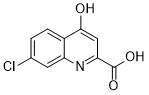
Physicochemical Properties
| Molecular Formula | C10H6CLNO3 |
| Molecular Weight | 223.61 |
| Exact Mass | 223.004 |
| CAS # | 18000-24-3 |
| Related CAS # | 7-Chlorokynurenic acid sodium salt;1263094-00-3 |
| PubChem CID | 1884 |
| Appearance | White to off-white solid powder |
| Density | 1.549 g/cm3 |
| Boiling Point | 395ºC at 760 mmHg |
| Flash Point | 192.7ºC |
| Vapour Pressure | 6E-07mmHg at 25°C |
| Index of Refraction | 1.648 |
| LogP | 2.292 |
| Hydrogen Bond Donor Count | 2 |
| Hydrogen Bond Acceptor Count | 4 |
| Rotatable Bond Count | 1 |
| Heavy Atom Count | 15 |
| Complexity | 340 |
| Defined Atom Stereocenter Count | 0 |
| InChi Key | UAWVRVFHMOSAPU-UHFFFAOYSA-N |
| InChi Code | InChI=1S/C10H6ClNO3/c11-5-1-2-6-7(3-5)12-8(10(14)15)4-9(6)13/h1-4H,(H,12,13)(H,14,15) |
| Chemical Name | 7-Chloro-4-hydroxyquinoline-2-carboxylic acid |
| Synonyms | 7CKA 7 CKA7-CKA 7-CTKA 7 CTKA7CTKA NSC 149792 NSC-149792NSC149792 7-Chlorokynurenic Acid 7 Chlorokynurenic Acid7-chloro KYNA 7 chloro KYNA |
| HS Tariff Code | 2934.99.9001 |
| Storage |
Powder-20°C 3 years 4°C 2 years In solvent -80°C 6 months -20°C 1 month |
| Shipping Condition | Room temperature (This product is stable at ambient temperature for a few days during ordinary shipping and time spent in Customs) |
Biological Activity
| ln Vivo | Pretreated with 7-chlorokynurenic acid (10 nM), male Sprague-Dawley rats exhibit a marked delay in the development of the motor (17.7 ± 2.9 stimulations per day) and electroencephalographic (17.7 ± 2.9 stimulations per day) components of the epileptic response [3]. |
| References |
[1]. 7-Chlorokynurenic acid is a selective antagonist at the glycine modulatory site of the N-methyl-D-aspartate receptor complex. Proc Natl Acad Sci U S A. 1988 Sep;85(17):6547-50. [2]. Characterization of the Effects of L-4-Chlorokynurenine on Nociception in Rodents. J Pain. 2017 Oct;18(10):1184-1196. [3]. 7-Chlorokynurenic acid, a strychnine-insensitive glycine receptor antagonist, inhibits limbic seizurekindling. Neurosci Lett. 1990 Oct 2;118(1):29-32. |
| Additional Infomation |
7-chlorokynurenic acid is a quinolinemonocarboxylic acid that is quinaldic acid which is substituted by a hydroxy group at position 4 and by a chlorine at position 7. It is a potent NMDA glutamate receptor antagonist which antagonizes the strychnine-insensitive glycine site of the NMDA receptor. It also prevents neurodegeneration produced by quinolinic acid. It has a role as a neuroprotective agent and a NMDA receptor antagonist. It is an organochlorine compound and a quinolinemonocarboxylic acid. 7-Chlorokynurenic acid has been reported in Streptomyces with data available. |
Solubility Data
| Solubility (In Vitro) |
DMSO : ~16.67 mg/mL (~74.55 mM) H2O : ~1 mg/mL (~4.47 mM) |
| Solubility (In Vivo) |
Solubility in Formulation 1: ≥ 1.67 mg/mL (7.47 mM) (saturation unknown) in 10% DMSO + 40% PEG300 +5% Tween-80 + 45% Saline (add these co-solvents sequentially from left to right, and one by one), clear solution. For example, if 1 mL of working solution is to be prepared, you can add 100 μL of 16.7 mg/mL clear DMSO stock solution to 400 μL PEG300 and mix evenly; then add 50 μL Tween-80 + to the above solution and mix evenly; then add 450 μL normal saline to adjust the volume to 1 mL. Preparation of saline: Dissolve 0.9 g of sodium chloride in 100 mL ddH₂ O to obtain a clear solution. (Please use freshly prepared in vivo formulations for optimal results.) |
| Preparing Stock Solutions | 1 mg | 5 mg | 10 mg | |
| 1 mM | 4.4721 mL | 22.3604 mL | 44.7207 mL | |
| 5 mM | 0.8944 mL | 4.4721 mL | 8.9441 mL | |
| 10 mM | 0.4472 mL | 2.2360 mL | 4.4721 mL |