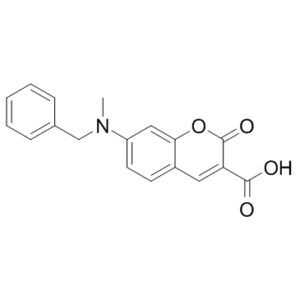
7ACC2 (7-ACC2), an aminocarboxycoumarin derivative, is a novel and potent MCT (Monocarboxylate transporters) inhibitor with anticancer activity. It inhibits MCT with IC50 of 11 nM for inhibition of [14C]-lactate influx; Compare with warfarin, a conventional anticoagulant coumarin, 7ACC2 did not influence the prothrombin time which, together with a good in vitro ADME profile, supports the potential of this new family of compounds to act as anticancer drugs through inhibition of lactate flux. Under hypoxia, cancer cells consume glucose and release lactate at a high rate. Lactate was recently documented to be recaptured by oxygenated cancer cells to fuel the TCA cycle and thereby to support tumor growth. Monocarboxylate transporters (MCT) are the main lactate carriers and therefore represent potential therapeutic targets to limit cancer progression.
Physicochemical Properties
| Molecular Formula | C18H15NO4 | |
| Molecular Weight | 309.32 | |
| Exact Mass | 309.1 | |
| Elemental Analysis | C, 69.89; H, 4.89; N, 4.53; O, 20.69 | |
| CAS # | 1472624-85-3 | |
| Related CAS # |
|
|
| PubChem CID | 72696735 | |
| Appearance | Light yellow to yellow solid powder | |
| Density | 1.4±0.1 g/cm3 | |
| Boiling Point | 548.9±50.0 °C at 760 mmHg | |
| Flash Point | 285.8±30.1 °C | |
| Vapour Pressure | 0.0±1.6 mmHg at 25°C | |
| Index of Refraction | 1.672 | |
| LogP | 4.17 | |
| Hydrogen Bond Donor Count | 1 | |
| Hydrogen Bond Acceptor Count | 5 | |
| Rotatable Bond Count | 4 | |
| Heavy Atom Count | 23 | |
| Complexity | 495 | |
| Defined Atom Stereocenter Count | 0 | |
| SMILES | O1C(C(C(=O)O[H])=C([H])C2C([H])=C([H])C(=C([H])C1=2)N(C([H])([H])[H])C([H])([H])C1C([H])=C([H])C([H])=C([H])C=1[H])=O |
|
| InChi Key | XTKDQPFUOFAMRL-UHFFFAOYSA-N | |
| InChi Code | InChI=1S/C18H15NO4/c1-19(11-12-5-3-2-4-6-12)14-8-7-13-9-15(17(20)21)18(22)23-16(13)10-14/h2-10H,11H2,1H3,(H,20,21) | |
| Chemical Name | 7-[benzyl(methyl)amino]-2-oxochromene-3-carboxylic acid | |
| Synonyms |
|
|
| HS Tariff Code | 2934.99.9001 | |
| Storage |
Powder-20°C 3 years 4°C 2 years In solvent -80°C 6 months -20°C 1 month Note: This product requires protection from light (avoid light exposure) during transportation and storage. |
|
| Shipping Condition | Room temperature (This product is stable at ambient temperature for a few days during ordinary shipping and time spent in Customs) |
Biological Activity
| Targets |
Mitochondrial pyruvate carrier [2] Monocarboxylate transporters [1] |
| ln Vitro |
Compound 19 (7ACC2), which suppresses SiHa cell proliferation in lactate-containing media, has an EC50 of 0.22 μM. It works for 72 hours. The high affinity MCT1 transporter is the main factor influencing lactate uptake in SiHa cells[1]. Compound 19, or 7ACC2, exhibits remarkable chemical stability in simulated gastric (SGF) and intestinal (SIF) fluids, a good apparent permeability coefficient (Papp) through the Caco-2 monolayer, and a high level of metabolic stability on human hepatocytes, mouse liver microsomes, and human liver microsomes [1]. 7ACC2 is a strong inhibitor of mitochondrial pyruvate transport that increases intracellular pyruvate buildup, hence blocking the uptake of extracellular lactate[2]. 1. Effects on cancer cell metabolism and growth: 7ACC2 (10 µM) treatment of SiHa cells showed differential effects on cell growth and oxygen consumption rate (OCR) depending on glucose/lactate availability in the medium; it did not inhibit MCT1 activity (assessed by ¹⁴C-lactate uptake and intracellular H⁺ concentration measurements in MCT1-expressing Xenopus oocytes), nor did it affect MCT4 activity in MCT4-expressing Xenopus oocytes; in SiHa cells, it increased glycolytic flux (elevated extracellular acidification rate, ECAR), reduced mitochondrial respiration (decreased OCR), promoted intracellular pyruvate accumulation, blocked extracellular lactate uptake, increased glucose consumption, altered the lactate/glucose ratio, and modified the abundance of glycolysis-derived pyruvate/lactate, TCA cycle intermediates, and serine synthesis pathway metabolites; in isolated SiHa cell mitochondria, it inhibited pyruvate-dependent OCR and [2−¹⁴C]pyruvate uptake in a dose- and time-dependent manner, and affected BCECF fluorescence (reflecting mitochondrial pH changes) in a dose-dependent way; in FaDu tumor spheroids, 20 µM 7ACC2 induced cytotoxic effects (in contrast to cytostatic effects of MCT1 inhibitor AR-C155858), stimulated glycolysis, caused uncompensated inhibition of mitochondrial respiration, increased cellular debris accumulation, altered 2-deoxyglucose-IRDye (2DG-IR) distributioccumulation (especially in the spheroid core), and modified GLUT-1 staining distribution at different spheroid depths; knockdown of MPC1 in FaDu cells mimicked the effect of 7ACC2 on 2DG-IR accumulation in the spheroid core [2] |
| ln Vivo |
Treatment with 7ACC2 (3 mg/kg; intraperitoneal administration; daily; for 5 days or 10 days) dramatically reduces the growth of tumors in mice. 7ACC2 decreases hypoxia in vivo, which radiosensitizes tumor cells[2]. When mice are given 7ACC2 (compound 19; 3 mg/kg) intraperitoneally, they quickly reach a Cmax of 1246 ng/ml (4 μM) (Tmax=10 min), which is accompanied by a 4.5-hour plasma half-life[1]. 1. Metabolic effects in tumor xenografts: In SiHa tumor xenografts in nude mice, administration of 3 mg/kg 7ACC2 (2 h treatment) altered in vivo ¹³C-MRS spectra after hyperpolarized ¹³C-pyruvate injection, reduced the relative ¹³C-lactate NMR signal and the ¹³C lactate/pyruvate ratio [2] 2. Antitumor and radiosensitizing effects: 3 mg/kg 7ACC2 treatment for 9 days reduced SiHa xenograft tumor volume in nude mice; daily administration of 3 mg/kg 7ACC2 (for 10 or 5 days) sensitized SiHa xenografts to radiotherapy (single 16 Gy irradiation or 5 fractions of 4 Gy), reducing tumor growth; it also reduced tumor hypoxia (assessed by CA9/pimonidazole staining in FaDu spheroids and tumor pO₂ measurements by EPR oximetry in SiHa xenografts) [2] |
| Enzyme Assay |
1. Mitochondrial pyruvate transport assay: Isolated mitochondria from SiHa cells were treated with different doses of 7ACC2 for varying durations, then [2−¹⁴C]pyruvate uptake was measured to evaluate the inhibitory effect of 7ACC2 on mitochondrial pyruvate transport; BCECF fluorescence was used to detect pH changes in isolated SiHa mitochondria treated with increasing doses of 7ACC2 to reflect the impact on pyruvate transport; OCR measurements were performed on isolated SiHa mitochondria exposed to pyruvate/malate (with/without methylpyruvate) after 10 µM 7ACC2 treatment to assess mitochondrial respiration inhibition [2] 2. MCT activity assay: MCT1-expressing Xenopus oocytes were treated with increasing doses of 7ACC2, and ¹⁴C-lactate uptake and intracellular H⁺ concentration were measured to evaluate MCT1 inhibition; the same assays were conducted on MCT4-expressing Xenopus oocytes to assess MCT4 activity [2] |
| Cell Assay |
1. SiHa cell metabolic assay: SiHa cells were treated with 10 µM 7ACC2 for 24 h in media with different glucose/lactate combinations; cell growth (72 h) and OCR were measured to evaluate metabolic effects; ¹³C-glucose labeling was used to analyze intracellular metabolite abundance (glycolysis-derived pyruvate/lactate, TCA cycle intermediates, serine synthesis pathway metabolites), glucose consumption, and lactate/glucose ratio; ECAR was measured to assess glycolytic activity; lactate consumption/secretion was quantified after 24 h incubation in lactate/glucose-containing media [2] 2. FaDu spheroid assay: FaDu spheroids were treated with 20 µM 7ACC2 for up to 9 days; spheroid growth, cellular density, and cellular debris accumulation were monitored over time; 2DG-IR (3 h exposure) distributioccumulation (periphery to core, core region) was assessed by immunofluorescence; GLUT-1 staining at different spheroid depths was quantified by immunofluorescence; MPC1 knockdown in FaDu cells was achieved via shRNA, and 2DG-IR accumulation in the spheroid core was evaluated [2] |
| Animal Protocol |
Animal/Disease Models: 7-week- old female NMRI nude mice with radiotherapy administered[2] Doses: 3 mg/kg Route of Administration: intraperitoneal (ip)administration; daily; for 5 days or 10days Experimental Results: A significant increase in tumor growth delay was observed. 1. Tumor xenograft metabolic assessment: Nude mice bearing SiHa tumor xenografts were administered 3 mg/kg 7ACC2; 2 h after administration, hyperpolarized ¹³C-pyruvate was injected, and in vivo ¹³C-MRS spectra were acquired to measure ¹³C-lactate/pyruvate ratios [2] 2. Antitumor efficacy assay: Nude mice with SiHa xenografts were treated with 3 mg/kg 7ACC2 daily for 9 days, and tumor volume was monitored; for radiosensitization experiments, mice received daily 3 mg/kg 7ACC2 for 10 days (single 16 Gy irradiation) or 5 days (5 fractions of 4 Gy), with 7ACC2 formulated in DMSO (10-day treatment) or 5% DMA/50% HPβCD/45% sodium phosphate buffer (5-day treatment); tumor pO₂ was measured by EPR oximetry at different time points after 3 mg/kg 7ACC2 administration [2] |
| References |
[1]. Synthesis and pharmacological evaluation of carboxycoumarins as a new antitumor treatment targeting lactate transport in cancer cells. Bioorg Med Chem. 2013 Nov 15;21(22):7107-17. [2]. Interruption of lactate uptake by inhibiting mitochondrial pyruvate transport unravels direct antitumor and radiosensitizing effects. Nat Commun. 2018 Mar 23;9(1):1208. |
| Additional Infomation |
1. Mechanism of action: 7ACC2 inhibits mitochondrial pyruvate transport (MPC), leading to intracellular pyruvate accumulation, which consecutively blocks extracellular lactate uptake by cancer cells; it stimulates glycolysis and causes uncompensated inhibition of mitochondrial respiration in tumor cells; its inhibition of MPC reduces tumor hypoxia, thereby radiosensitizing tumor xenografts [2] 2. Therapeutic potential: 7ACC2 represents a novel anticancer agent targeting lactate metabolism, with direct antitumor effects and radiosensitizing properties; it acts via a different mechanism from MCT1 inhibitors (AR-C155858), inducing cytotoxicity rather than cytostasis in tumor spheroids [2] 3. Structural background: 7ACC2 belongs to carboxycoumarin derivatives, a class of compounds developed as potential antitumor agents targeting lactate transport in cancer cells; palladium-catalyzed Buchwald-Hartwig coupling reaction is an efficient method to synthesize aminocarboxycoumarin derivatives (the class of 7ACC2) [1] |
Solubility Data
| Solubility (In Vitro) |
|
|||
| Solubility (In Vivo) |
Solubility in Formulation 1: 2.5 mg/mL (8.08 mM) in 10% DMSO + 40% PEG300 +5% Tween-80 + 45% Saline (add these co-solvents sequentially from left to right, and one by one), suspension solution; with sonication. For example, if 1 mL of working solution is to be prepared, you can add 100 μL of 25.0 mg/mL clear DMSO stock solution to 400 μL PEG300 and mix evenly; then add 50 μL Tween-80 + to the above solution and mix evenly; then add 450 μL normal saline to adjust the volume to 1 mL. Preparation of saline: Dissolve 0.9 g of sodium chloride in 100 mL ddH₂ O to obtain a clear solution. (Please use freshly prepared in vivo formulations for optimal results.) |
| Preparing Stock Solutions | 1 mg | 5 mg | 10 mg | |
| 1 mM | 3.2329 mL | 16.1645 mL | 32.3290 mL | |
| 5 mM | 0.6466 mL | 3.2329 mL | 6.4658 mL | |
| 10 mM | 0.3233 mL | 1.6164 mL | 3.2329 mL |