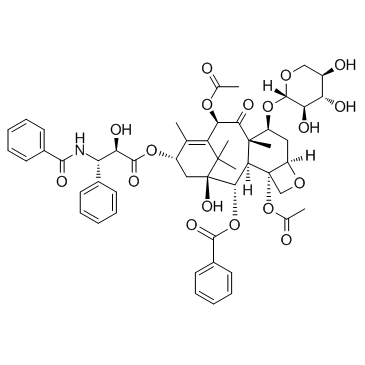
7-xylosyltaxol (7-Xylosylpaclitaxel; Taxol-7-xyloside) is a naturally occurring taxol (Paclitaxel) analogue isolated from T. chinensis with anticancer activities. It is a microtubule stabilizing agent/tubulin inhibitor/microtubule disruptor.
Physicochemical Properties
| Molecular Formula | C₅₂H₅₉NO₁₈ |
| Molecular Weight | 986.02 |
| Exact Mass | 985.373 |
| Elemental Analysis | C, 63.34; H, 6.03; N, 1.42; O, 29.21 |
| CAS # | 90332-66-4 |
| PubChem CID | 11094265 |
| Appearance | Typically exists as solid at room temperature |
| Density | 1.5±0.1 g/cm3 |
| Boiling Point | 1062.3±65.0 °C at 760 mmHg |
| Flash Point | 596.3±34.3 °C |
| Vapour Pressure | 0.0±0.3 mmHg at 25°C |
| Index of Refraction | 1.646 |
| LogP | 7.81 |
| Hydrogen Bond Donor Count | 6 |
| Hydrogen Bond Acceptor Count | 18 |
| Rotatable Bond Count | 16 |
| Heavy Atom Count | 71 |
| Complexity | 2060 |
| Defined Atom Stereocenter Count | 15 |
| SMILES | O([C@@]12CO[C@@H]1C[C@H](O[C@@H]1OC[C@@H](O)[C@H](O)[C@H]1O)[C@]1(C([C@@H](C3=C(C)[C@@H](OC(=O)[C@H](O)[C@H](C4C=CC=CC=4)NC(C4C=CC=CC=4)=O)C[C@]([C@H]([C@H]21)OC(C1C=CC=CC=1)=O)(O)C3(C)C)OC(=O)C)=O)C)C(=O)C |
| InChi Key | ZVEGOBHUZTXSFK-TZIKQHFSSA-N |
| InChi Code | InChI=1S/C52H59NO18/c1-26-33(68-47(63)39(58)37(29-16-10-7-11-17-29)53-45(61)30-18-12-8-13-19-30)23-52(64)44(70-46(62)31-20-14-9-15-21-31)42-50(6,43(60)41(67-27(2)54)36(26)49(52,4)5)34(22-35-51(42,25-66-35)71-28(3)55)69-48-40(59)38(57)32(56)24-65-48/h7-21,32-35,37-42,44,48,56-59,64H,22-25H2,1-6H3,(H,53,61)/t32-,33+,34+,35-,37+,38+,39-,40-,41-,42+,44+,48+,50-,51+,52-/m1/s1 |
| Chemical Name | (2aR,4S,4aS,6R,9S,11S,12S,12aR,12bS)-9-(((2R,3S)-3-benzamido-2-hydroxy-3-phenylpropanoyl)oxy)-12-(benzoyloxy)-11-hydroxy-4a,8,13,13-tetramethyl-5-oxo-4-(((2S,3R,4S,5R)-3,4,5-trihydroxytetrahydro-2H-pyran-2-yl)oxy)-3,4,4a,5,6,9,10,11,12,12a-decahydro-1H-7,11-methanocyclodeca[3,4]benzo[1,2-b]oxete-6,12b(2aH)-diyl diacetate |
| Synonyms | 7-Xylosylpaclitaxel; 7-Xylosylpaclitaxel; Taxol-7-xyloside; Taxol-7-xyloside; 90332-66-4; 7-?Xylosyltaxol; [(1S,2S,3R,4S,7R,9S,10S,12R,15S)-4,12-diacetyloxy-15-[(2R,3S)-3-benzamido-2-hydroxy-3-phenylpropanoyl]oxy-1-hydroxy-10,14,17,17-tetramethyl-11-oxo-9-[(2S,3R,4S,5R)-3,4,5-trihydroxyoxan-2-yl]oxy-6-oxatetracyclo[11.3.1.03,10.04,7]heptadec-13-en-2-yl] benzoate; 7-(beta-Xylosyl)taxol; 7-Xylosylpaclitaxel; 4W5FWK9L2W; |
| HS Tariff Code | 2934.99.9001 |
| Storage |
Powder-20°C 3 years 4°C 2 years In solvent -80°C 6 months -20°C 1 month |
| Shipping Condition | Room temperature (This product is stable at ambient temperature for a few days during ordinary shipping and time spent in Customs) |
Biological Activity
| Targets | Tubulin |
| ln Vitro | Taxus chinensis var. mairei is an endemic and endangered plant species in China. The resources of T. chinensis var. mairei have been excessively exploited due to its anti-cancer potential, accordingly, the extant T. chinensis var. mairei population is decreasing. In this paper, ultrasonic extraction and HPLC were adopted to determine the contents of active components paclitaxel, 7-xylosyltaxol and cephalomannine in cultivated and wild T. chinensis var. mairei plants, with the content distribution of these components in different parts of the plants having grown for different years and at different slope aspects investigated. There existed obvious differences in the contents of these active components between cultivated and wild T. chinensis var. mairei plants. The paclitaxel content in the wild plants was about 0.78 times more than that in the cultivated plants, whereas the 7-xylosyltaxol and cephalomannine contents were slishtly higher in the cultivated plants. The differences in the three active components contents between different parts and tree canopies of the plants were notable, being higher in barks and upper tree canopies. Four-year old plants had comparatively higher contents of paclitaxel, 7-xylosyltaxol and cephalomannine (0.08, 0.91 and 0.32 mg x g(-1), respectively), and the plants growing at sunny slope had higher contents of the three active components, with significant differences in the paclitaxel and 7-xylosyltaxol contents and unapparent difference in the cephalomannine content of the plants at shady slope. It was suggested that the accumulation of the three active components in T. chinensis var. mairei plants were closely related to the sunshine conditions. To appropriately increase the sunshine during the artificial cultivation of T. chinensis var. mairei would be beneficial to the accumulation of the three active components in T. chinensis var. mairei plants[1]. |
| Enzyme Assay | Photoaffinity labeling methods have allowed a definition of the sites of interaction between Taxol and its cellular target, the microtubule, specifically beta-tubulin. Our previous studies have indicated that [(3)H]3'-(p-azidobenzamido)Taxol photolabels the N-terminal 31 amino acids of beta-tubulin (Rao, S., Krauss, N. E., Heerding, J. M., Swindell, C. S., Ringel, I., Orr, G. A., and Horwitz, S. B. (1994) J. Biol. Chem. 269, 3132-3134) and [(3)H]2-(m-azidobenzoyl)Taxol photolabels a peptide containing amino acid residues 217-233 of beta-tubulin (Rao, S., Orr, G. A., Chaudhary, A. G., Kingston, D. G. I., and Horwitz, S. B. (1995) J. Biol. Chem. 270, 20235-20238). The site of photoincorporation of a third photoaffinity analogue of Taxol, [(3)H]7-(benzoyldihydrocinnamoyl) Taxol, has been determined. This analogue stabilizes microtubules polymerized in the presence of GTP, but in contrast to Taxol, does not by itself enhance the polymerization of tubulin to its polymer form. CNBr digestion of [(3)H]7-(benzoyldihydrocinnamoyl)Taxol-labeled tubulin, with further arginine-specific cleavage by clostripain resulted in the isolation of a peptide containing amino acid residues 277-293. Amino acid sequence analysis indicated that the photoaffinity analogue cross-links to Arg(282) in beta-tubulin. Advances made by electron crystallography in understanding the structure of the tubulin dimer have allowed us to visualize the three sites of photoincorporation by molecular modeling. There is good agreement between the binding site of Taxol in beta-tubulin as determined by photoaffinity labeling and electron crystallography[4]. |
| References |
[1]. Content and distribution of active components in cultivated and wild Taxus chinensis var. mairei plants. Ying Yong Sheng Tai Xue Bao. 2012 Oct;23(10):2641-7. [2]. Development of an indirect competitive enzyme-linked immunosorbent assay (icELISA) using highly specific monoclonal antibody against paclitaxel. J Nat Med. 2012 Sep 25. [3]. Taxol induces caspase-10-dependent apoptosis. J Biol Chem. 2004 Dec 3;279(49):51057-67. Epub 2004 Sep 27. [4]. Characterization of the Taxol binding site on the microtubule. Identification of Arg(282) in beta-tubulin as the site of photoincorporation of a 7-benzophenone analogue of Taxol. J Biol Chem. 1999 Dec 31;274(53):37990-4. [5]. Paclitaxel. |
| Additional Infomation | 7-Xylosyltaxol has been reported in Taxus cuspidata with data available. |
Solubility Data
| Solubility (In Vitro) | May dissolve in DMSO (in most cases), if not, try other solvents such as H2O, Ethanol, or DMF with a minute amount of products to avoid loss of samples |
| Solubility (In Vivo) |
Note: Listed below are some common formulations that may be used to formulate products with low water solubility (e.g. < 1 mg/mL), you may test these formulations using a minute amount of products to avoid loss of samples. Injection Formulations (e.g. IP/IV/IM/SC) Injection Formulation 1: DMSO : Tween 80: Saline = 10 : 5 : 85 (i.e. 100 μL DMSO stock solution → 50 μL Tween 80 → 850 μL Saline) *Preparation of saline: Dissolve 0.9 g of sodium chloride in 100 mL ddH ₂ O to obtain a clear solution. Injection Formulation 2: DMSO : PEG300 :Tween 80 : Saline = 10 : 40 : 5 : 45 (i.e. 100 μL DMSO → 400 μLPEG300 → 50 μL Tween 80 → 450 μL Saline) Injection Formulation 3: DMSO : Corn oil = 10 : 90 (i.e. 100 μL DMSO → 900 μL Corn oil) Example: Take the Injection Formulation 3 (DMSO : Corn oil = 10 : 90) as an example, if 1 mL of 2.5 mg/mL working solution is to be prepared, you can take 100 μL 25 mg/mL DMSO stock solution and add to 900 μL corn oil, mix well to obtain a clear or suspension solution (2.5 mg/mL, ready for use in animals). Injection Formulation 4: DMSO : 20% SBE-β-CD in saline = 10 : 90 [i.e. 100 μL DMSO → 900 μL (20% SBE-β-CD in saline)] *Preparation of 20% SBE-β-CD in Saline (4°C,1 week): Dissolve 2 g SBE-β-CD in 10 mL saline to obtain a clear solution. Injection Formulation 5: 2-Hydroxypropyl-β-cyclodextrin : Saline = 50 : 50 (i.e. 500 μL 2-Hydroxypropyl-β-cyclodextrin → 500 μL Saline) Injection Formulation 6: DMSO : PEG300 : castor oil : Saline = 5 : 10 : 20 : 65 (i.e. 50 μL DMSO → 100 μLPEG300 → 200 μL castor oil → 650 μL Saline) Injection Formulation 7: Ethanol : Cremophor : Saline = 10: 10 : 80 (i.e. 100 μL Ethanol → 100 μL Cremophor → 800 μL Saline) Injection Formulation 8: Dissolve in Cremophor/Ethanol (50 : 50), then diluted by Saline Injection Formulation 9: EtOH : Corn oil = 10 : 90 (i.e. 100 μL EtOH → 900 μL Corn oil) Injection Formulation 10: EtOH : PEG300:Tween 80 : Saline = 10 : 40 : 5 : 45 (i.e. 100 μL EtOH → 400 μLPEG300 → 50 μL Tween 80 → 450 μL Saline) Oral Formulations Oral Formulation 1: Suspend in 0.5% CMC Na (carboxymethylcellulose sodium) Oral Formulation 2: Suspend in 0.5% Carboxymethyl cellulose Example: Take the Oral Formulation 1 (Suspend in 0.5% CMC Na) as an example, if 100 mL of 2.5 mg/mL working solution is to be prepared, you can first prepare 0.5% CMC Na solution by measuring 0.5 g CMC Na and dissolve it in 100 mL ddH2O to obtain a clear solution; then add 250 mg of the product to 100 mL 0.5% CMC Na solution, to make the suspension solution (2.5 mg/mL, ready for use in animals). Oral Formulation 3: Dissolved in PEG400 Oral Formulation 4: Suspend in 0.2% Carboxymethyl cellulose Oral Formulation 5: Dissolve in 0.25% Tween 80 and 0.5% Carboxymethyl cellulose Oral Formulation 6: Mixing with food powders Note: Please be aware that the above formulations are for reference only. InvivoChem strongly recommends customers to read literature methods/protocols carefully before determining which formulation you should use for in vivo studies, as different compounds have different solubility properties and have to be formulated differently. (Please use freshly prepared in vivo formulations for optimal results.) |
| Preparing Stock Solutions | 1 mg | 5 mg | 10 mg | |
| 1 mM | 1.0142 mL | 5.0709 mL | 10.1418 mL | |
| 5 mM | 0.2028 mL | 1.0142 mL | 2.0284 mL | |
| 10 mM | 0.1014 mL | 0.5071 mL | 1.0142 mL |