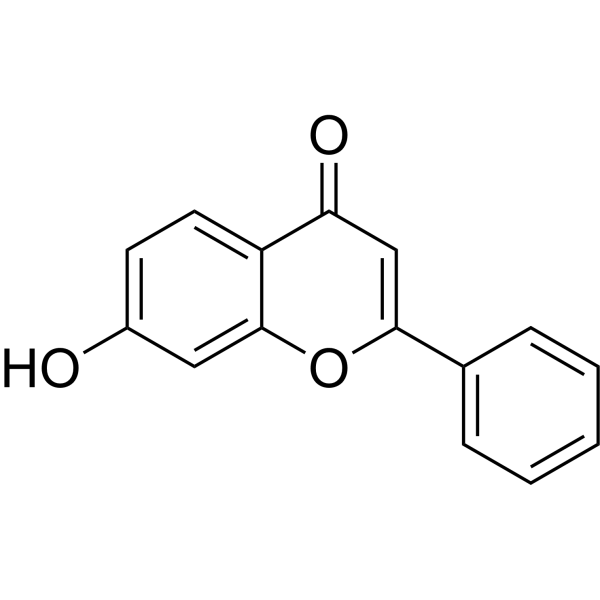
Physicochemical Properties
| Molecular Formula | C15H10O3 |
| Molecular Weight | 238.2381 |
| Exact Mass | 238.062 |
| CAS # | 6665-86-7 |
| PubChem CID | 5281894 |
| Appearance | White to off-white solid powder |
| Density | 1.3±0.1 g/cm3 |
| Boiling Point | 450.1±45.0 °C at 760 mmHg |
| Melting Point | 245-247 °C(lit.) |
| Flash Point | 176.3±22.2 °C |
| Vapour Pressure | 0.0±1.1 mmHg at 25°C |
| Index of Refraction | 1.666 |
| LogP | 3.32 |
| Hydrogen Bond Donor Count | 1 |
| Hydrogen Bond Acceptor Count | 3 |
| Rotatable Bond Count | 1 |
| Heavy Atom Count | 18 |
| Complexity | 355 |
| Defined Atom Stereocenter Count | 0 |
| InChi Key | MQGPSCMMNJKMHQ-UHFFFAOYSA-N |
| InChi Code | InChI=1S/C15H10O3/c16-11-6-7-12-13(17)9-14(18-15(12)8-11)10-4-2-1-3-5-10/h1-9,16H |
| Chemical Name | 7-hydroxy-2-phenylchromen-4-one |
| Synonyms | 7-Hydroxyflavone; 6665-86-7; 7-Hydroxy-2-phenyl-4H-chromen-4-one; 7-hydroxy-2-phenylchromen-4-one; 4H-1-Benzopyran-4-one, 7-hydroxy-2-phenyl-; Flavone, 7-hydroxy-; 7-Hydroxy-2-phenyl-4-benzopyrone; 7-Hydroxy-2-phenyl-chromen-4-one; |
| HS Tariff Code | 2934.99.9001 |
| Storage |
Powder-20°C 3 years 4°C 2 years In solvent -80°C 6 months -20°C 1 month |
| Shipping Condition | Room temperature (This product is stable at ambient temperature for a few days during ordinary shipping and time spent in Customs) |
Biological Activity
| Targets | Natural flavone; anti-inflammatory, anti-tumor, anti-oxidant, neuroprotective, anti-fungal activities |
| ln Vitro |
Hence, through in silico studies, it may be concluded that querciten, myricetin and 7-hydroxyflavonol can be used as novel drugs (radioprotectors) for protecting normal cells from radiation.[1] Plant flavonoids are well known as antioxidants against oxidative stress induced by exposure to external pollutants. Nicotine (NIC) is one of those agents which increases renal oxidative stress, an important factor in the pathogenesis of renal epithelial injury in smokers. Although several studies had been conducted on flavonoids and oxidative stress, the mechanism of the protective pathways are not fully understood. Here, we present studies on antioxidant properties of two mono-hydroxyflavone isomers, 3-hydroxyflanove (3HF)- and 7-hydroxyflavone (7HF), against nicotine-associated oxidative stress and injury in cultured renal proximal tubule cells and correlate their antioxidant properties with their chemical structure. Our data clearly demonstrates, for the first time, that while both 3HF and 7HF protect renal cells from NIC-associated cytotoxicity, the mechanism of their action is different: 3HF elicits protective activity via the PKA/CREB/MnSOD pathway while 7HF does so via the ERK/Nrf2/HO-1 pathway. Molecular docking and dynamics simulations with two major signaling pathway proteins showed significant differences in the binding energies of 3HF (-5.67 and -7.39 kcal.mol-1) compared to 7HF (-5.41 and -8.55 kcal.mol-1) in the matrices of CREB and Keap1-Nrf2 proteins respectively, which corroborate with the observed differences in their protective properties in the renal cells. The implications of this novel explorative study is likely to promote the understanding of the mechanisms of the antioxidative functions of different flavones[2]. |
| Cell Assay |
Measurement of intracellular ROS production[2] Microplate assay using oxidant-sensitive 2′,7′-dichlorofluorescein-diacetate measured the intracellular generation of ROS. Cells grown in T25 flasks were pretreated with either 20 μM 3HF or 20 μM 7HF for overnight as required and isolated with trypsinization. After washing and counting, cells were loaded with 100 μM DCFDA in HBSS for 30 min at 37°C. After incubation, the excess dye was removed by washing with fresh HBSS and placed in wells of a 96-well plate (0.5 × 10⁶ cells/well). 200 μM NIC was added to the appropriate wells and the increase in fluorescence was monitored in a fluorescence plate reader at 485 nmexc/530 nmem. ROS production was calculated as changes in fluorescence/30 min/0.5 × 106 cells and expressed as the percentage of untreated values as described in our earlier studies. |
| ADME/Pharmacokinetics |
Metabolism / Metabolites 7-Hydroxyflavone has known human metabolites that include (2S,3S,4S,5R)-3,4,5-trihydroxy-6-(4-oxo-2-phenylchromen-7-yl)oxyoxane-2-carboxylic acid. |
| References |
[1]. Aqueous extract from Madhuca indica bark protects cells from oxidative stress caused by electron beam radiation: in vitro, in vivo and in silico approach. Heliyon. 2019 May 30;5(5):e01749. [2]. Differential roles of 3-Hydroxyflavone and 7-Hydroxyflavone against nicotine-induced oxidative stress in rat renal proximal tubule cells. PLoS One. 2017 Jun 22;12(6):e0179777. |
| Additional Infomation |
7-hydroxyflavone is a hydroxyflavonoid in which the flavone nucleus is substituted at position 7 by a hydroxy group. 7-Hydroxyflavone has been reported in Astragalus microcephalus, Medicago sativa, and other organisms with data available. |
Solubility Data
| Solubility (In Vitro) | DMSO : ~125 mg/mL (~524.68 mM) |
| Solubility (In Vivo) |
Solubility in Formulation 1: ≥ 2.08 mg/mL (8.73 mM) (saturation unknown) in 10% DMSO + 40% PEG300 + 5% Tween80 + 45% Saline (add these co-solvents sequentially from left to right, and one by one), clear solution. For example, if 1 mL of working solution is to be prepared, you can add 100 μL of 20.8 mg/mL clear DMSO stock solution to 400 μL PEG300 and mix evenly; then add 50 μL Tween-80 to the above solution and mix evenly; then add 450 μL normal saline to adjust the volume to 1 mL. Preparation of saline: Dissolve 0.9 g of sodium chloride in 100 mL ddH₂ O to obtain a clear solution. Solubility in Formulation 2: 2.08 mg/mL (8.73 mM) in 10% DMSO + 90% (20% SBE-β-CD in Saline) (add these co-solvents sequentially from left to right, and one by one), suspension solution; with ultrasonication. For example, if 1 mL of working solution is to be prepared, you can add 100 μL of 20.8 mg/mL clear DMSO stock solution to 900 μL of 20% SBE-β-CD physiological saline solution and mix evenly. Preparation of 20% SBE-β-CD in Saline (4°C,1 week): Dissolve 2 g SBE-β-CD in 10 mL saline to obtain a clear solution. Solubility in Formulation 3: ≥ 2.08 mg/mL (8.73 mM) (saturation unknown) in 10% DMSO + 90% Corn Oil (add these co-solvents sequentially from left to right, and one by one), clear solution. For example, if 1 mL of working solution is to be prepared, you can add 100 μL of 20.8 mg/mL clear DMSO stock solution to 900 μL of corn oil and mix evenly. (Please use freshly prepared in vivo formulations for optimal results.) |
| Preparing Stock Solutions | 1 mg | 5 mg | 10 mg | |
| 1 mM | 4.1974 mL | 20.9872 mL | 41.9745 mL | |
| 5 mM | 0.8395 mL | 4.1974 mL | 8.3949 mL | |
| 10 mM | 0.4197 mL | 2.0987 mL | 4.1974 mL |