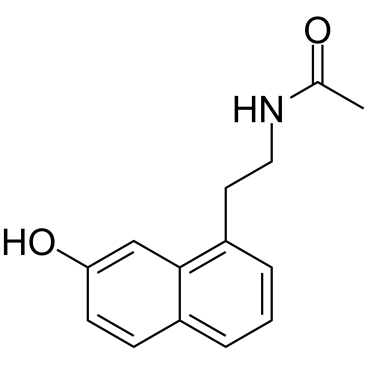
7-Desmethyl-agomelatine is a major metabolite of Agomelatine. Agomelatine (S20098; BAN, rINN; Valdoxan, Melitor, Thymanax) is a potent and specific agonist of MT1 and MT2 receptors with Kis of 0.1, 0.06, 0.12, and 0.27 nM for CHO-hMT1, HEK-hMT1, CHO-hMT2, and HEK-hMT2, respectively. It is a unique antidepressant and is developed for treatment of major depressive disorder (MDD). It shows low affinities to cloned human 5-HT2A and 5-HT1A. In the in vivo studies, agomelatine causes increase of dopamine and noradrenaline levels via blocking the inhibitory input of 5-HT2C.
Physicochemical Properties
| Molecular Formula | C14H15NO2 |
| Molecular Weight | 229.2744 |
| Exact Mass | 229.11 |
| CAS # | 152302-45-9 |
| Related CAS # | 7-Desmethyl-agomelatine-d3;2749427-92-5 |
| PubChem CID | 11775984 |
| Appearance | Typically exists as White to off-white solid at room temperature |
| Density | 1.2±0.1 g/cm3 |
| Boiling Point | 511.3±33.0 °C at 760 mmHg |
| Flash Point | 263.0±25.4 °C |
| Vapour Pressure | 0.0±1.4 mmHg at 25°C |
| Index of Refraction | 1.624 |
| LogP | 1.62 |
| Hydrogen Bond Donor Count | 2 |
| Hydrogen Bond Acceptor Count | 2 |
| Rotatable Bond Count | 3 |
| Heavy Atom Count | 17 |
| Complexity | 267 |
| Defined Atom Stereocenter Count | 0 |
| SMILES | CC(NCCC1=CC=CC2=C1C=C(O)C=C2)=O |
| InChi Key | UNTZQBYXDYYXIY-UHFFFAOYSA-N |
| InChi Code | InChI=1S/C14H15NO2/c1-10(16)15-8-7-12-4-2-3-11-5-6-13(17)9-14(11)12/h2-6,9,17H,7-8H2,1H3,(H,15,16) |
| Chemical Name | N-[2-(7-hydroxynaphthalen-1-yl)ethyl]acetamide |
| Synonyms | N-(2-(7-Hydroxynaphthalen-1-yl)ethyl)acetamide; 152302-45-9; 7-Desmethyl-agomelatine; N-[2-(7-hydroxynaphthalen-1-yl)ethyl]acetamide; 7-Desmethylagomelatine; CHEMBL109784; N-[2-(7-hydroxy-1-naphthalenyl)ethyl]acetamide; O-Demethylagomelatine; |
| HS Tariff Code | 2934.99.9001 |
| Storage |
Powder-20°C 3 years 4°C 2 years In solvent -80°C 6 months -20°C 1 month |
| Shipping Condition | Room temperature (This product is stable at ambient temperature for a few days during ordinary shipping and time spent in Customs) |
Biological Activity
| Targets | Agomelatine metabolite |
| ln Vitro | A novel sensitive and selective LC-MS/MS method for the determination of agomelatine, 7-desmethyl-agomelatine and 3-hydroxy-agomelatine in human plasma was developed and validated. After simple protein precipitation, the analytes were separated on a Phenomenex ODS3 column (4.6×150 mm, 5μm, Phenomenex, USA) with mobile phase consisted of methanol and 5mM ammonium formate solution (containing 0.2% formic acid) at a ratio of 70:30 (v/v) with a flow rate of 0.8mL/min. The MS acquisition was performed in multiple reactions monitoring (MRM) mode with a positive electrospray ionization source. The mass transitions monitored were m/z 244.1→185.1, m/z 230.1→171.1, m/z 260.1→201.1 and m/z 180.1→110.1 for agomelatine, 7-desmethyl-agomelatine, 3-hydroxy-agomelatine and internal standard (phenacetin), respectively. The method was validated for specificity, linearity and lower limit of quantification, precision and accuracy, extraction recovery, matrix effect and stability. The calibration curves for agomelatine, 7-desmethyl-agomelatine and 3-hydroxy-agomelatine in human plasma were linear over concentration ranges of 0.0457-100ng/mL, 0.1372-300ng/mL and 0.4572-1000ng/mL, respectively. Intra- and inter-day precisions and accuracies data met the acceptance criteria of FDA guideline for bioanalytical method validation. The developed method has been successfully applied to a bioequivalence study in healthy Chinese volunteers.[2] |
| References |
[1]. The novel melatonin agonist agomelatine (S20098) is an antagonist at 5-hydroxytryptamine2C receptors, blockade of which enhances the activity of frontocortical dopaminergic and adrenergic pathways. J Pharmacol Exp Ther. 2003 Sep;306(3):9. [2]. Development and validation a LC-MS/MS method for the simultaneous determination of agomelatine and its metabolites, 7-desmethyl-agomelatine and 3-hydroxy-agomelatine in human plasma: Application to a bioequivalence study. J Chromatogr B Analy. |
| Additional Infomation | Agomelatine (S20098) displayed pKi values of 6.4 and 6.2 at native (porcine) and cloned, human (h)5-hydroxytryptamine (5-HT)2C receptors, respectively. It also interacted with h5-HT2B receptors (6.6), whereas it showed low affinity at native (rat)/cloned, human 5-HT2A (<5.0/5.3) and 5-HT1A (<5.0/5.2) receptors, and negligible (<5.0) affinity for other 5-HT receptors. In antibody capture/scintillation proximity assays, agomelatine concentration dependently and competitively abolished h5-HT2C receptor-mediated activation of Gq/11 and Gi3 (pA2 values of 6.0 and 6.1). As measured by [3H]phosphatidylinositol depletion, agomelatine abolished activation of phospholipase C by h5-HT2C (pKB value of 6.1) and h5-HT2B (pKB value of 6.6) receptors. In vivo, it dose dependently blocked induction of penile erections by the 5-HT2C agonists (S)-2-(6-chloro-5-fluoroindol-1-yl)-1-methylethylamine (Ro60,0175) and 1-methyl-2-(5,8,8-trimethyl-8H-3-aza-cyclopenta[a]inden-3-yl) ethylamine (Ro60,0332). Furthermore, agomelatine dose dependently enhanced dialysis levels of dopamine in frontal cortex of freely moving rats, whereas they were unaffected in nucleus accumbens and striatum. Although the electrical activity of ventrotegmental dopaminergic neurons was unaffected agomelatine, it abolished their inhibition by Ro60,0175. Extracellular levels of noradrenaline in frontal cortex were also dose dependently enhanced by agomelatine in parallel with an acceleration in the firing rate of adrenergic cell bodies in the locus coeruleus. These increases in noradrenaline and dopamine levels were unaffected by the selective melatonin antagonist N-[2-(5-ethyl-benzo[b]thien-3-yl)ethyl] acetamide (S22153) and likely flect blockade of 5-HT2C receptors inhibitory to frontocortical dopaminergic and adrenergic pathways. Correspondingly, distinction to agomelatine, melatonin showed negligible activity 5-HT2C receptors and failed to modify the activity of adrenergic and dopaminergic pathways. In conclusion, in contrast to melatonin, agomelatine behaves as an antagonist at 5-HT2B and 5-HT2C receptors: blockade of the latter reinforces frontocortical adrenergic and dopaminergic transmission.[1] |
Solubility Data
| Solubility (In Vitro) | DMSO : ~160 mg/mL (~697.87 mM) |
| Solubility (In Vivo) |
Solubility in Formulation 1: ≥ 2.08 mg/mL (9.07 mM) (saturation unknown) in 10% DMSO + 40% PEG300 + 5% Tween80 + 45% Saline (add these co-solvents sequentially from left to right, and one by one), clear solution. For example, if 1 mL of working solution is to be prepared, you can add 100 μL of 20.8 mg/mL clear DMSO stock solution to 400 μL PEG300 and mix evenly; then add 50 μL Tween-80 to the above solution and mix evenly; then add 450 μL normal saline to adjust the volume to 1 mL. Preparation of saline: Dissolve 0.9 g of sodium chloride in 100 mL ddH₂ O to obtain a clear solution. Solubility in Formulation 2: ≥ 2.08 mg/mL (9.07 mM) (saturation unknown) in 10% DMSO + 90% (20% SBE-β-CD in Saline) (add these co-solvents sequentially from left to right, and one by one), clear solution. For example, if 1 mL of working solution is to be prepared, you can add 100 μL of 20.8 mg/mL clear DMSO stock solution to 900 μL of 20% SBE-β-CD physiological saline solution and mix evenly. Preparation of 20% SBE-β-CD in Saline (4°C,1 week): Dissolve 2 g SBE-β-CD in 10 mL saline to obtain a clear solution. Solubility in Formulation 3: ≥ 2.08 mg/mL (9.07 mM) (saturation unknown) in 10% DMSO + 90% Corn Oil (add these co-solvents sequentially from left to right, and one by one), clear solution. For example, if 1 mL of working solution is to be prepared, you can add 100 μL of 20.8 mg/mL clear DMSO stock solution to 900 μL of corn oil and mix evenly. (Please use freshly prepared in vivo formulations for optimal results.) |
| Preparing Stock Solutions | 1 mg | 5 mg | 10 mg | |
| 1 mM | 4.3617 mL | 21.8083 mL | 43.6167 mL | |
| 5 mM | 0.8723 mL | 4.3617 mL | 8.7233 mL | |
| 10 mM | 0.4362 mL | 2.1808 mL | 4.3617 mL |